
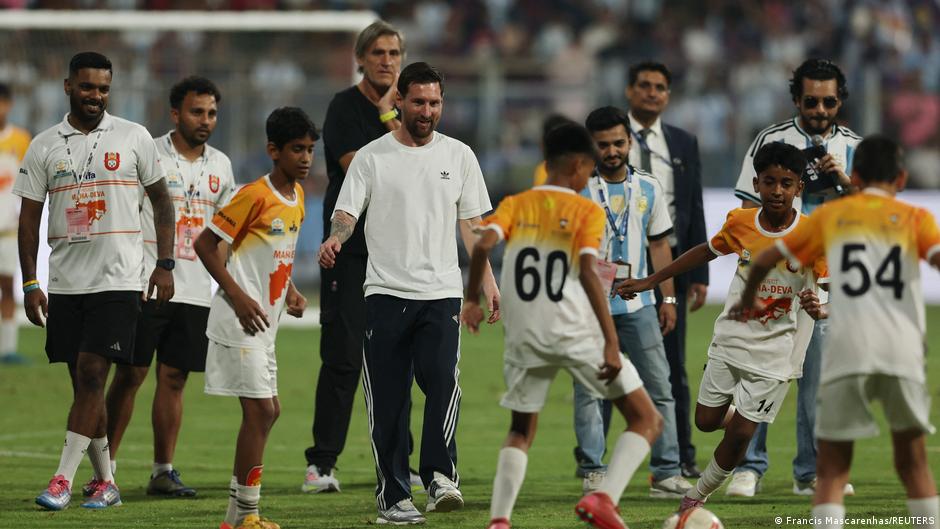
Lionel Messi’s visit to India, dubbed “The GOAT Tour”, is the latest promotional solo jaunt by a sports star in 2025. It didn’t go entirely according to plan, with fans storming the field in Kolkata, but the numbers in attendance were proof that interest in sports stars remains sky-high.
At the beginning of the year, NBA stars LeBron James and Steph Curry were in China on solo tours, James’s trip was done with main sponsor Nike and was named “The Forever King Tour”.
Brands are not new to sports. Fred Perry clothing was created by the British tennis player in the 1950s. Air Jordan entered the picture in 1984 with basketball star Michael Jordan.
But in the modern era, athlete brands are far more common, with many looking to create a brand early in their careers. Beyond the desire to give back and inspire the next generation, the recent spate of solo tours is also an insight into the importance of branding in sports.
“It’s not completely new, but I think where the novelty comes is that over the last decade, maybe a little more than that, the meaning of the athlete brand has really expanded,” Natalia Bradikhina told DW. Bradikhina is an assistant professor of sports management at the University of Delaware, USA, and specializes in personal branding in professional sports.
virtual world tour
“An athlete is more than just a competitor or someone who works hard on the field, but I feel like it wasn’t until the rise of social media and technologies that the boundaries of the athlete were really pushed,” Bradikhina said. He said athlete tours, shows and promotions are becoming common.
Perhaps it is not surprising that Messi and his team are at the forefront. He created the Messi Experience, an interactive multimedia exhibition that allows fans to follow the football great’s career despite not being present in Argentina. The show is currently on a world tour and has been to Los Angeles, Dubai and Sao Paulo.
Although these ideas may only make sense to truly noble people, Bradikhina believes that they are a sign of things to come due to something called the “Kings Two Bodies” principle.
“In the past, it was developed primarily to focus on politicians, but I think in recent years, it’s generally applied to celebrities and especially athletes, where we think of this living person, this human being, and then it’s the brand that expands and becomes even bigger than them,” Bradykhina said.
The brands that move forward feel like they’re making the kind of marketing talk that may confuse people rather than engage them. But there are enough examples in sports that prove that this theory has now become a reality.
Bradikhina said, “Roger Federer, with the development of all his enterprises, is a great example, but with Leo Messi right now, in the mature stage of his career, I think it’s a very good time for something like this.”
He said investing in this concept early helps many athletes get out of the sport.
The future of sports branding
The most interesting aspect of increased sports branding is what it says about fan engagement. On the surface, it seems obvious that people will connect more easily to other people than to organizations. But people also need to belong to a group, so why does it seem like the focus on the individual is greater than ever?
Bradikhina believes that the increased consumption of social media and younger audiences’ inclination more toward highlights rather than watching a television or entire game in person are part of the reason the culture is moving more toward the in-person. After all, this would be one of the reasons why Cristiano Ronaldo has over 660 million followers on Instagram, while his former club and 15-time Champions League winners Real Madrid have fewer followers across all social media channels.
“Maybe we are moving toward a more individualistic culture,” Bradikhina said. “Maybe it’s this idea that everyone is an influencer in some way. It doesn’t matter how many followers you have, you’re influencing someone; you’re broadcasting your life to someone. So maybe that’s kind of the mentality we start to get, especially among the younger generation.”
A trend for all levels
This change is reflected not only in consumption habits but also in the ever-growing influencer market. College athletes in the United States are considering how to brand themselves from the beginning.
“I think if the goal is to impact the community, athletes at different levels can get involved,” Bradikhina said. “Some athletes will only have a few thousand followers on social media, so it’s nothing compared to the mega celebrities they’re looking at, but they’re still able to build a brand, they’re still able to monetize it even through small sponsorships.”
This is perhaps best reflected in the impact of NIL (name, image and likeness) deals in college sports and how social media following is impacting team recruiting. Business is inevitable, and the emotional stress is difficult for those managing their own accounts. But the goal is built on a familiar psychological foundation.
“Even at that level, branding isn’t easy. What they’re saying sometimes helps them overcome the mess of social media. It’s the belief that they’re influencing people. They’re telling their story of overcoming it, they’re teaching young athletes what the reality can be if they get to college.”
Ultimately, the visits of Messi, James and Curry are reminders that the game is changing. Get ready for virtual reality and AI assistants as the customized fan experience reaches a whole new level. The athlete’s brand has never been stronger. As Bradikhina argued, “Right now the athlete isn’t just an endorser, they’re definitely a partner to those brands and someone who brings a lot to the table.”
Edited by: Matt Pearson