
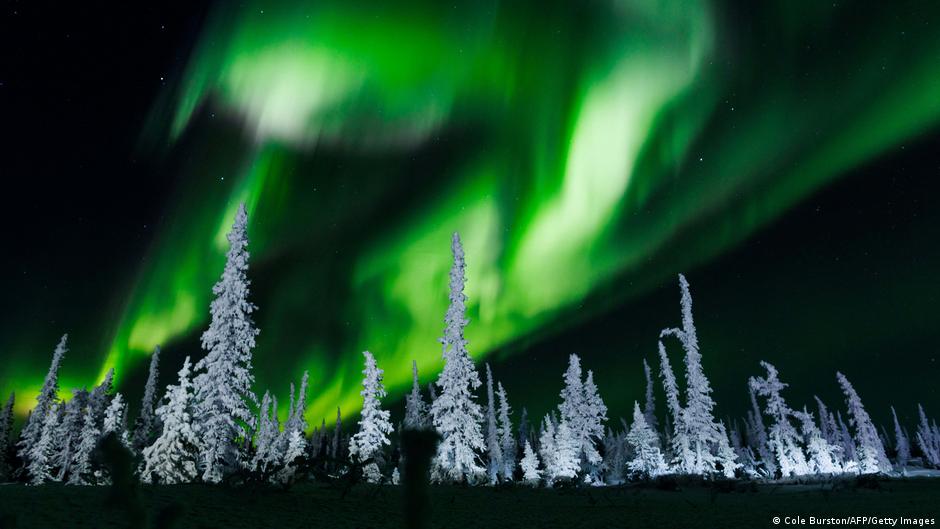
In recent years there has been a surge of interest in the almost psychedelic sight of vibrant green and purple lights dancing in the sky. The desire to catch a glimpse of what are officially known as the Aurora Borealis and Aurora Australis has given rise to designated tours, watch parties and numerous tracking apps.
And while the allure of the momentary display is obvious, here are a few things about the Northern and Southern Lights you might not know.
What causes the different colors?
Huge explosions on the Sun’s surface, known as solar storms, regularly emit huge streams of electrically charged particles. Some of this plasma ends up traveling toward Earth, and is drawn toward the planet’s magnetic poles.
“These particles then collide with atoms and molecules in Earth’s atmosphere and essentially heat them,” explained astronomer Tom Kearse. Royal Museums Greenwich website. “It’s just like heating gas and lighting it.”
Different colors of light depend on the elements present in the atmosphere. Oxygen, which makes up about 21% of the atmosphere, gives off a green color when heated, while nitrogen gives off a purple, blue or pink tint to the light.
Interaction with oxygen at very high altitudes can also give the light a deep red color, but this is relatively rare.
Where is the light visible?
The light show is usually only visible near the Arctic Circle – or, in the case of Aurora Australis, around Antarctica. But we’ve just ended an 11-year cycle of powerful sunspots and flares, known as solar maximum, during which the lights have painted the sky far beyond the poles.
“When you have more [solar] “The energy is coming in, the northern oval and the southern oval are expanding,” Katie Herlingshaw, an upper atmospheric physics researcher based on the Norwegian Arctic archipelago of Svalbard, told DW.
Recent demonstrations have been seen in Hungary, Switzerland and the US state of Florida, as well as southern Australia and New Zealand.
“Almost all cycles, if not every cycle…all of them have these last gasps during the decline phase,” said space weather physicist Tamitha Skov. told Space.com in October 2025.
“Typically, the last gasp before solar minimum will come within about two to three years. So, within the next year and a half to two years, we should see something.”
Are the northern lights dangerous?
Researchers at the world’s northernmost aurora station, Kjell Henriksen Observatory on Svalbard, are investigating the solar particles present within the northern lights and their potential to damage the ozone layer.
Noura Partamiz, an atmospheric physicist at the observatory, told DW that polar regions sometimes experience “large ozone depletion” as a result of the aurora borealis.
The ozone layer, that thin layer of gas about 15 to 30 kilometers (9–19 miles) above Earth’s surface, is a major shield protecting us from the Sun’s harsh radiation.
“The extent of depletion can be very variable,” Partames said, adding that some solar protons are very energetic and can cause stratospheric ozone depletion of up to 50% or 70% in the upper stratosphere in the polar region, with damage that can last for weeks before naturally recovering.
Are the northern lights unique to Earth?
Although difficult to detect, auroras have been observed on most planets in our solar system. Their size and intensity are related to the strength of the planet’s atmosphere and its magnetic field.
On Mars, where there is a more localized field, primarily in the southern hemisphere, rather than a global magnetic field like Earth, the light show is more diffuse.
“A diffuse green glow in the Martian sky seems quite possible, at least when the Sun is throwing off energetic particles,” Nick Schneider of the University of Colorado told NASA.
Coincidentally, astronauts orbiting on the International Space Station are also able to enjoy the light shows from their unique perspective – and sometimes even walk through them.
Why shouldn’t you whistle at the Northern Lights?
The possible presence of the aurora borealis was recorded 3,000 years ago in a Chinese text from the 10th century BC, which described the appearance of “five colors” in the northern night sky.
For centuries, these natural phenomena have inspired societies around the world with wonder. The name is linked to Aurora, the Roman goddess of dawn, and Boreas, the Greek god responsible for the north wind. And miraculous lights were often interpreted as prophecy, or a sign from the gods.
Ancient Norse myths associated the Aurora Borealis with reflections on the armor and spears of the Valkyries, warrior women who carried fallen soldiers to Valhalla. They were also thought to represent the Bifröst Bridge, a magical rainbow arch connecting Earth to the home of the gods.
The Finnish word for northern lights translates to “fox fire”, and is reminiscent of a mythical, elusive creature with a flaming tail that would fling ice crystals into the air while running across the countryside, setting the sky on fire.
Native American and Inuit myths associate lights with creator gods, evil giants, or the spirits of dead infants and dead ancestors. For many cultures, from the Sami in Lapland to North American tribes, lights are to be feared and respected – something as simple as whistling, for example, can summon the wrath of the spirits to come down and snatch away the thoughtless offender.
Additional reporting by Lewis Kruger.
Edited by: Sarah Stephan