
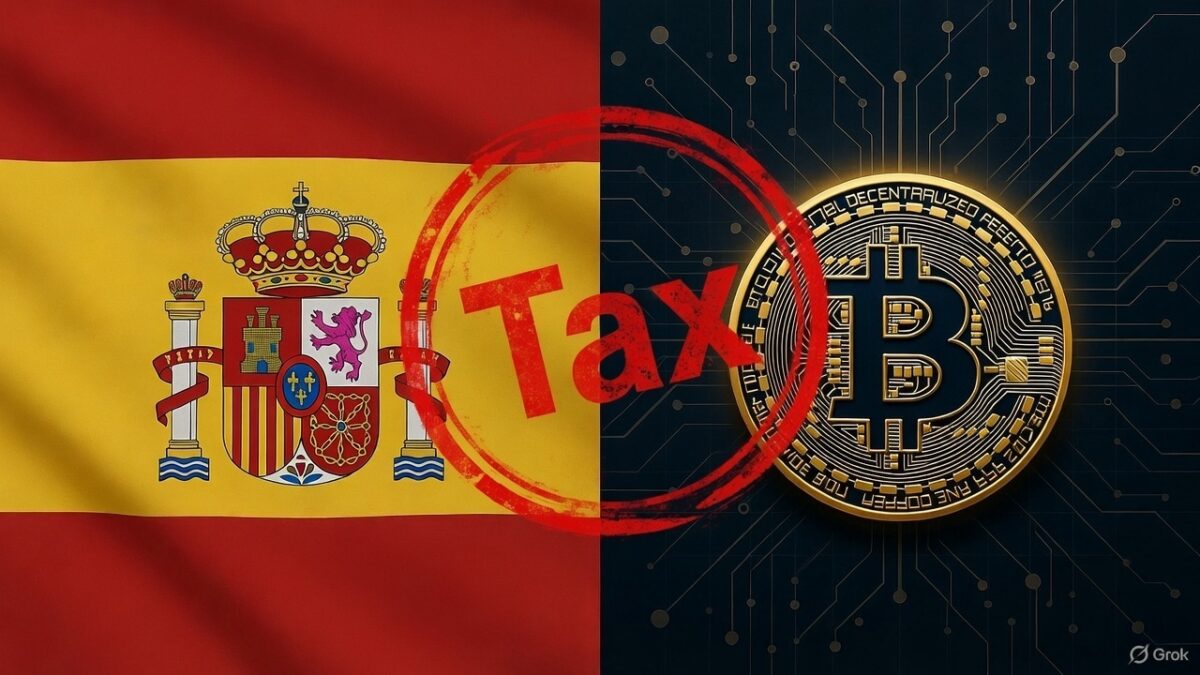
DAC8, which requires exchanges to report user information, comes into effect on January 1.
Consultants warn about a Treasury “feast” with cryptocurrency data.
In a scenario of progressive maturation of the cryptocurrency ecosystem, Spain is moving towards a more specific and structured regulatory framework. The year 2026 is emerging as one to take into account, due to the full implementation of the MiCA Regulation (Cryptoasset Markets) and the entry into force of the so-called Administrative Cooperation Directive (DAC8).
MiCA, fully applicable at the European level from December 30, 2024, will see its full deployment in the Iberian country in mid-2026. This regulation seeks to standardize the rules for the issuance and marketing of cryptocurrencies in the European Union (EU), classifying them into categories such as utility tokens, security tokens and stablecoins.
In Spain, the National Securities Market Commission (CNMV) is the body that supervises its application. The entity, at the time of writing this article, has more than 60 companies registered to operate with digital assets in the nation. These include banking entities, such as Cecabank, Banco Bilbao Vizcaya Argentaria (BBVA) and Renta 4 Banco, to cryptocurrency exchanges.
At the beginning of December, the Spanish Government applied the full transitional period provided for in the MiCA Regulation, extending it until July 1, 2026. This regime It benefits firms that, before the approval of such regulation, were already providing cryptocurrency services under the previous legal framework.
Precisely, the extension allows such companies to continue operating under the previous national regulations, without the immediate need for full authorization of the new provision. Looking ahead to 2026, this gives them additional room to adapt, but also marks a turning point.
Starting July 1st, Only companies that have obtained full MiCA authorization will be able to continue operatingwhich will require full compliance with European standards and will lead to the closure of those that fail to obtain approval.
It is worth mentioning that if MiCA establishes the rules for operating in the market, the other key pillar of regulation in Spain addresses the fiscal dimension. Here comes into play, as reported by CriptoNoticias, the Administrative Cooperation Directive (DAC8), approved by Congress in October 2025.
DAC8 will enter into force on January 1, 2026forcing exchanges and service providers to automatically report transactions, balances and user movements to EU tax authorities. This includes sales, exchanges and transfers, eliminating anonymity in regulated operations. The law allows cryptocurrencies to be seized for tax debts.
Treasury will have full access to cryptocurrency movements
As explained by José Antonio Bravo Mateu, a specialist in taxation of digital assets, the DAC8 significantly expands the scope of information available to the Treasury: «Starting in 2027 we will have information on all the movements that have been made during the year 2026 (…). It will be almost complete information,” he said in a recent interview.
The advisor emphasizes that “this information will be much greater than that requested from a bank”, since in the traditional banking system only balances greater than 250,000 euros (EUR) are reported, while in digital assets “not even an exchange of two euros for a cryptocurrency will be missed.”
Thus, Bravo sent users a resounding message: “From January 1, 2026, if you have crypto assets or euros in an exchange located in Spain, they will be able to seize them directly, without the need for prior complex procedures.”
And it is that The Treasury may order the supplier to block or liquidate the assets necessary to settle tax debts.extending this power also to European exchanges once automatic data exchange is activated.
For this reason, the tax consultant warns about the importance of privacy and the sovereign use of bitcoin (BTC) outside of centralized platforms. He insists that Certain anonymous practices are perfectly legal, as long as they do not constitute a regular economic activity..
«You can buy [bitcoin] peer-to-peer (P2P) just as you can buy any type of good from an individual (…). It is not a crime nor is an economic activity being carried out if it is not carried out on a regular basis (…). “I can buy a telephone, a computer or bread from an individual…” said the specialist.
These users were recommended to use privacy toolslike the mix (mixers) of virtual assets. These are tools designed to increase the privacy of transactions on networks like Bitcoin. They work by pooling funds from multiple users into a common pool, mixing them, and redistributing them to different addresses.
«A purchase [de bitcoin en P2P] Once a week, once a month, when I have money, it is not a crime. Just like taking it to a mix It is not a crime. If I later sell it again via peer-to-peer, I am not committing any offense against the Treasury, nor are they going to tell me anything,” Mateu stated.
However, he added: «If I am doing it every day [el peer-to-peer]this is an economic activity or it could be an economic activity (…). There are gaps there.
Prepare for 2026
In this year that is emerging as relevant for the sector in Spain, it is essential not to confuse the scope of MiCA and DAC8. The risk and regulation consultant Cero Uno clarify this nuance and warns about what he considers to be the “feast” that the Treasury is about to give himself.
The DAC8, which starts effective January 1, 2026, is the eighth update of the European Union Directive on Administrative Cooperation (DAC). This obliges cryptoasset service providers to report user transactions to tax authorities residents in the EU.
The platforms must submit reports on the 2026 movements after the end of the year, between January 1 and September 30, 2027. Their objective is to tighten the legal framework on the automatic exchange of information (AEOI) to combat tax fraud and combat evasion.
Zero One illustrates this with clear examples. Affirms that if cryptocurrencies are kept in an entity with tax residence in Spain, such as Binance Spain SL, the provider must inform the Treasury directly through the Models 172 (balances as of December 31) and 173 (operations carried out during the year). Both are mandatory disclosure statements.
On the other hand, for a foreign CEX within the EU, such as Kraken in Ireland, the specialist clarifies that these national models are not presented to the State Tax Administration Agency (AEAT). However, DAC8 requires automatic equivalent exchange, so the Treasury receives detailed information on balances and transactions from Spanish users.
In any case, it should be noted that self-custody is outside this system. Cero Uno highlights in this regard that, if the user keeps their cryptocurrencies in personal wallets, these assets are not “located” in Spain or abroad from a tax point of view.
That is, there is no third-party provider that reports such assets in the aforementioned Models or the 721. The latter is an informative declaration on virtual currencies located abroad and only applies if assets are held in entities outside of Spain.
Cryptocurrencies under the microscope: proposals and reactions
The recommendation to prioritize self-custody taught by specialists resonates with broader criticisms of the Spanish regulatory approach. Analyst José Luis Cava, author of “The Art of Speculating,” criticized the lack of attention in the country to the experiences of the United States.
According to the writer, while some government parties study how to declare citizens’ bitcoins confiscable, in the United States taxpayers will be able to pay federal taxes in BTC without facing additional capital gains.
Cava refers to the proposal American legislative act known as the “Bitcoin for America Act”, which seeks to allow citizens to settle their federal tax debts directly with bitcoin, without said operation implying the recognition of taxable capital gains in that specific transaction.
Furthermore, when he talks about the movements of some political parties, he refers to the amendments presented by the Sumar Parliamentary Group (minority partner of the coalition Government in Spain) to the Draft Law on Measures for the Prevention and Fight against Tax Fraud, debated in Congress during October and November 2025.
These updates seek to modify the General Tax Law to increase tax burdens on cryptocurrency profits. In addition, it proposes to declare all digital assets as seizable assets and allow the Tax Agency to sell them.
However, the truth is that these changes did not go unnoticed, in a context of criticism for the greater control and tax burden than other countries. As reported by CriptoNoticias, just a few days ago a call was made to industry actors to unite against the letter.
The meeting aims to coordinate cryptoasset service providers (CASP), auxiliary companies and holders to present proposals that curb regulations, protect user privacy and prevent investment flight.
Cryptocurrency regulation in Spain is moving towards a scenario of greater fiscal control and market supervision, with MiCA and DAC8 as fundamental pillars. However, the discussion about privacy, user rights and possible tax increases shows that the transition will not be easy. Faced with possible changes, caution, as well as staying updated, will be key.