
Analyst explains that it is not necessarily a strong market desire for these products.
With the regulatory path paved, it will now be possible to really see what the market demand is.
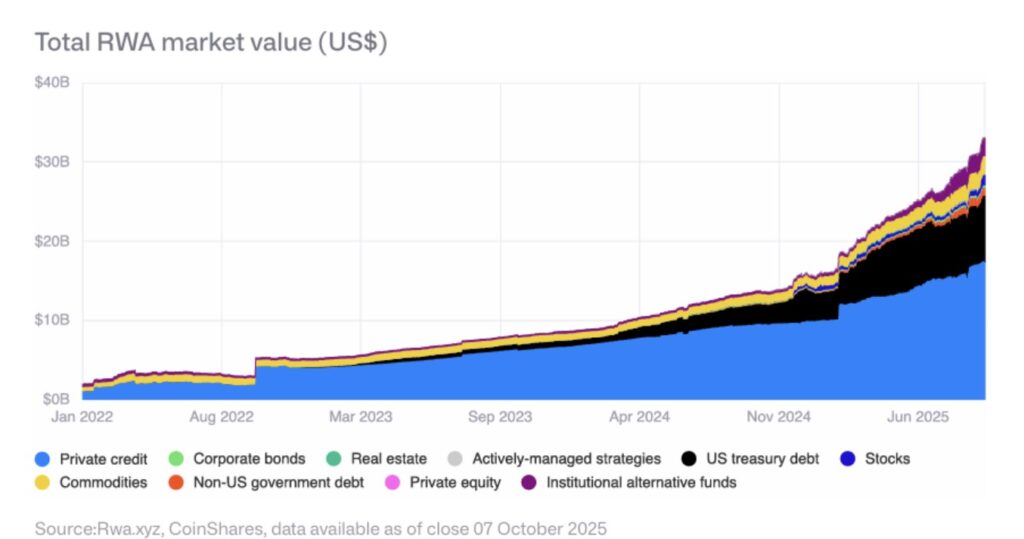
The market for tokenized real-world assets (RWA) shows figures that, at first glance, suggest strong euphoria.
The total capitalization of these assets went from around USD 15 billion at the beginning of 2025 to more than USD 35 billion today, as seen below:
Within that universe, tokenized shares marked an all-time high close to USD 800 million. This, with a growth of almost 30 times so far this year. This is what it looks like in the following graph:
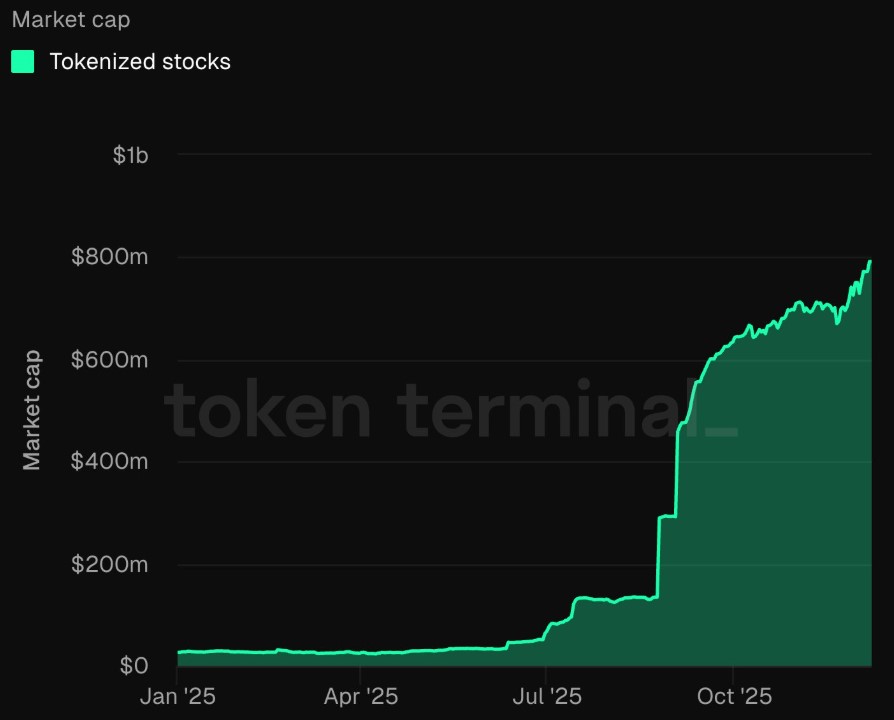
However, this jump does not necessarily imply that the market has spontaneously developed a massive appetite for these financial products.
According to an analysis published on
road add that much of the year was spent resolving regulatory, custody and settlement restrictions, and that, once some compatible rails were enabled, “the supply was able to scale almost overnight.”
Tokenization driven by real estate companies
The data from CoinShares show that most of the value of RWA is concentrated in Ethereum and its second layer networks. The fastest-growing segment is private credit, driven by companies offering real estate loans that can be paid off in days rather than months.
Added to this is the rapid expansion of the tokenization of US Treasury bonds, a move that aims to improve operational efficiency rather than creating new speculative markets.
In this sense, the firm highlights that large asset managers are adopting tokenization as a strategic tool. Initiatives such as BlackRock’s BUIDL fund, Goldman Sachs’ tokenized instruments with returns of 4% to 6%, or HSBC’s planned deployment for 2026, reflect a structural change.
However, CoinShares clarifies that, because these business models are based on very low fees on assets under management, tokenization “does not unlock large new revenue streams,” but rather improves distribution, customer loyalty and reduces costs back office.
This approach contrasts with the more disruptive narrative that historically surrounded digital assets, including that of Bitcoin as an alternative to the traditional financial system. Even critical figures such as Jamie Dimon, CEO of JP Morgan, have recognized the value of this underlying technology, as documented by CriptoNoticias.
The legal angle and the Argentine case
From a legal perspective, the advance of tokenization also responds to a process of regulatory maturation. Camila Soria, Argentine lawyer and founder of Khoros and the firm CipherLaw, explains to CriptoNoticias that, in the first years of the RWA movement, they worked with preventive compliance schemes. While today clearer regulatory frameworks already exist in different jurisdictions, including Europe and Argentina.
Soria details that at Khoros they develop models that not only tokenize real estate, but also the value already generated. «If you have a house valued at USD 80,000 and I invest USD 20,000, we tokenize both what you had and what I contribute. Little by little I am becoming an owner,” she explains.
The objective, he adds, is “to maintain real estate with a sustainable vision, so that there is no old building left and entire cities can be renovated.”
The lawyer distinguishes between different types of tokenization: direct, indirect and the so-called digital twins. In his opinion, direct tokenization, where the token grants rights over the asset, It is the one that best adapts to sectors such as real estate.

However, he recognizes that in Argentina there are important regulatory obstacles. “The National Securities Commission is not directly tokenizing real estate assets, but rather financial instruments, and requires structures such as trusts,” he points out.
In the long term, Soria predicts that in Argentina “big players are going to emerge” in the tokenization of assets. This is because the current requirements leave out many small entrepreneurs. Even so, it highlights the international interest in the country and an environment where, despite the uncertainty, Digital asset adoption remains high.
Altogether, the figures confirm that tokenization is going through a stage of accelerated expansion. But, more than a fever driven by market enthusiasm, data and specialized voices suggest that it is a growth enabled by regulatory and technical conditions. which only now allow us to measure what the real demand will be over time.