
China has condemned the visit of a group of senior Japanese politicians to Taiwan, calling it yet another example of Tokyo’s interference in internal affairs.
Beijing is accusing Japan of returning to the militarism that led to devastating conflicts in the Asia-Pacific region in the early decades of the last century.
Tensions between the two East Asian powers have escalated after Japanese Prime Minister Sanae Takachi said in response to a question in parliament last month that any “contingent situation” involving Taiwan would also inevitably threaten Japan’s national security.
Beijing claims the island is part of China and insists it will “reunify” it with the mainland by force if necessary. Pressure on Taiwan has increased in recent years and there is growing fear that China will attempt to take over the island.
Analysts say that successive Japanese governments have long taken this stance on the situation in Taiwan, but this has not been said before. However, the more outspoken Takaichi is more outspoken and is facing the wrath of Beijing.
Japan’s Taiwan outreach tests China’s patience
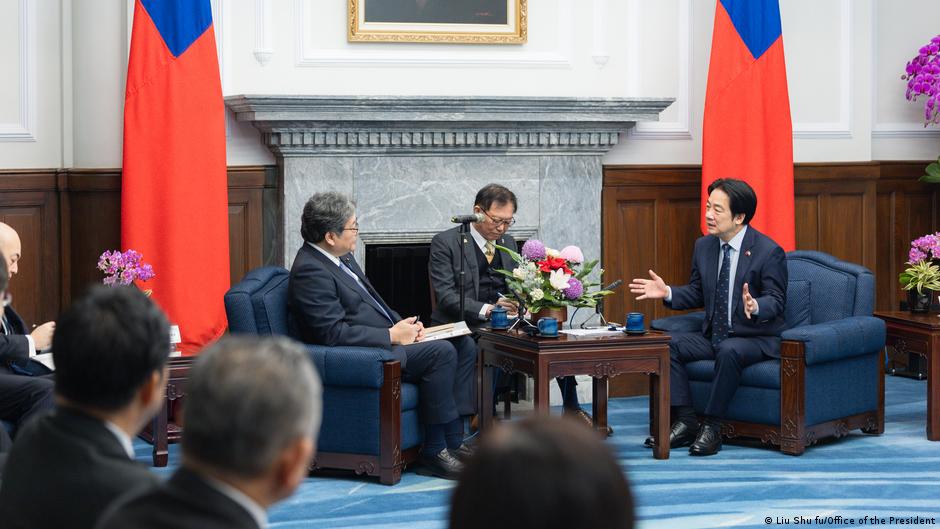
Koichi Hagiuda, one of Takachi’s most trusted advisers, led a Japanese delegation to the self-ruled island this week, where Taiwan President Lai Ching-te expressed his gratitude for Takachi’s friendship and his support for a “free and open Indo-Pacific.”
Speaking at his office in Taipei on Monday, Lai reiterated the importance of maintaining peace and stability across the Taiwan Strait, and said the Taiwanese people “sincerely appreciate” Japan’s support.
China has demanded that Takachi withdraw his statement on Japan’s position on Taiwan, a Foreign Ministry official said at a press briefing on Monday, saying Japan was violating previous bilateral agreements on the “one-China” principle.
The criticism comes in parallel with editorials in state media accusing Japan of carrying out provocations 80 years after the end of World War II, which risks plunging the region into war.
“Japan must confront its history of aggression, reflect deeply on its crimes and sincerely apologize,” Xinhua news agency said in an editorial.
“Takaichi’s erroneous comments on Taiwan, as a response to Japan’s ‘existential threat’, coupled with threats of military intervention, openly challenge the victorious outcomes of World War II, essentially trying to negate the post-war international order and revive Japanese militarism.”
At home, however, Takachi’s resolve in the face of pressure from China appears strong, with his support rate at a solid 68%. survey Powered by Asahi Shimbun Newspaper. And while many fear that strained relations with Beijing will have an impact on the Japanese economy, 55% of people indicated they support its position on China.
Takaichi’s support remains solid
“China’s move is playing in Takaichi’s favor and his support seems solid,” said Jeff Kingston, director of Asian studies at Temple University’s Tokyo branch.
“China has been irritating Japan with repeated visits to the disputed Senkaku Islands in the East China Sea, other naval operations close to Japanese waters and a joint exercise with Russian bombers, but Takaichi is standing up to Beijing,” he told DW.
“They have tried to do it in a soft-spoken way, but Hagiuda is a senior member of the ruling Liberal Democratic Party and the visit has gone ahead despite the state of relations,” he said. “The message Takachi is sending is that she’s not afraid.”
There will inevitably be concerns in Japan that Beijing will increase economic pressure, but analysts say that, perhaps surprisingly, has not happened yet.
Chinese travel firms have been instructed not to book trips to Japan, with about 562,600 mainland Chinese arriving in November, just 3% more than the same month last year. This is in sharp contrast to the 111% increase in Chinese arrivals in November 2024 compared to the previous year.
Yet Kingston points out that China has not stopped exports of critical rare earth minerals or taken other similar drastic steps.
“China has other arrows in its quiver, but its own economy is not good right now and they believe the relationship is mutually beneficial,” he said. “They may have guessed they can’t do much, but they are letting their people speak about Japan saying they need to be humble and recognize their history.”
‘Measured’ response from China
Toshimitsu Shigemura, a professor of politics and international relations at Tokyo’s Waseda University, also believes Beijing’s response has been “relatively measured” due to domestic economic concerns that could translate into public anger against the government.
“China is not able to exert so much economic pressure because of concerns about the impact at home,” he said. “But I expect Beijing to increase its military actions in southern Japan, such as more air and maritime exercises, as well as more coast guard ships entering Japanese waters around the Senkaku Islands,” he said.
“But I also think they’re wasting their time politically,” he said.
Shigemura believes Beijing believes Takachi’s LDP will be in trouble again when the next general election is held in 2028 and the Democratic Party of Japan (DPJ) and Komeito, both more centrist parties, will gain seats and influence in the future government.
Beijing’s hope is that the DPJ and Komeito will be more friendly toward China and will not see any attempt by Japan to seize Taiwan by force as a reason to intervene militarily.
“This may be a risky strategy, but China’s patience may pay off,” he said.
Edited by: Keith Walker