
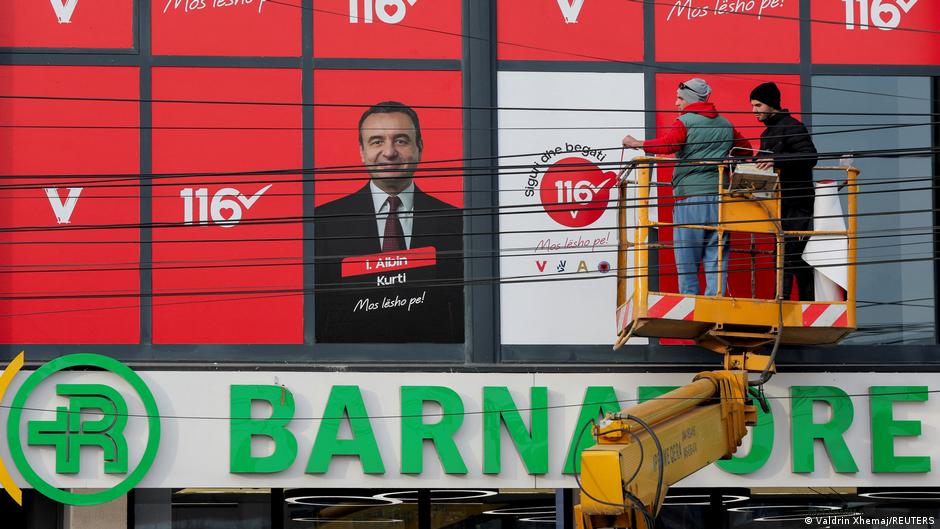
On 28 December, for the second time in only ten months, the people of Kosovo will be called to elect a new parliament. Many voters feel that they have seen nothing but political theater in the last ten months and they are fed up with it.
Liridon Spahiu, a 28-year-old student at the Christmas market on Zahir Pjaziti Boulevard in the Kosovar capital, Pristina, says it is clear that things cannot continue as they are: “In the last few months, we are all increasingly asking ourselves: What on earth is going on with this country and the politics here?”
endless deadlock
This is what is going on: In parliamentary elections on February 9, 2025, the ruling left-nationalist Vetevendosje party (“Self-Determination Movement,” or VV) won only 42% of the vote, losing its absolute majority, which it needs to get 61 of the 120 seats that make up the Kosovar Parliament.
But Vetevendosje was still the largest party, meaning it and incumbent Prime Minister Albin Kurti had the right to select a candidate for parliamentary speaker. But it took half a year, more than 50 rounds of voting, and before a Constitutional Court decision, at the end of August, a politician was finally found – Dimal Basha – who was able to pick up the necessary few additional votes from the centre-right bloc.
‘People’s interests are secondary’
In Kosovo, the Parliamentary Speaker is a key figure in steering the political process after elections, as only he or she can set the agenda and initiate the Parliament’s work. Efforts to form a coalition government finally began in late August, but all negotiations between Albin Kurti and the opposition parties failed. Several rounds of talks with Kosovar President Vjosa Osmani did not yield any solution. On November 20, 2025, the President had no option but to dissolve Parliament and set December 28 as the date for new elections.
Kosovar political scientist Donika Emini believes that this “clearly shows that, for the political elite, the interests of the country and the people are secondary.” “It is important that the parties demonstrate political maturity by being prepared to form a ruling coalition,” he told DW.
Emini now sees a ray of hope, noting that Kurti and Vetevendosje have shown more openness towards other parties in recent weeks, which may signal an end to the post-election impasse.
one of the poorest countries in Europe
The unprecedented political impasse means that, for Kosovo, it has been a wasted year – at a time when the country is in urgent need of social, economic and constitutional reform. The youngest European state is also one of the poorest countries on the continent. The official unemployment figure now exceeds 25%; It is even more so among young people. Nearly one-fifth of the population lives below the poverty line; There is no general system of statutory health insurance; The education system lacks qualified personnel, its institutions lack equipment. Due to all this, a large number of youth have migrated from the country in recent years, this trend is continuing.
Kosovo is heavily dependent on financial transfers from the diaspora. In the last decade, it was 12-18% of the country’s GDP; In 2024 it was around 13%. The political deadlock meant that approximately €820 million ($966 million) of already allocated EU subsidies could not be claimed. The country was unable to approve a budget for 2026, or enact justice reforms, or pass significant economic legislation.
Legitimate but clumsy ‘sovereignty politics’
Over this, there is a deadlock in the conflict with Serbia. For years now, the EU has been urging Kosovo to agree to the “agreement” – but Kosovo finds some of its conditions unacceptable, such as the creation of collective status for the Serbian minority. Many Kosovar politicians believe that this could lead to the country’s politics being disrupted by Belgrade, as the Serbian government controls the organizations and institutions of the Serbian minority.
On the other hand, Prime Minister Kurti and his Vetevendosje party have been pursuing “sovereignty politics” for years, the main objective of which is to dismantle the Belgrade parallel state in northern Kosovo. That policy may be legitimate, but many observers believe Kurti has at times pursued it too confrontationally and clumsily. Ultimately, he and his government proved to be the black sheep in the conflict with Serbia. Sanctions were not imposed on Kosovo only because the EU did not want to risk its own conflict with Serbia.
Just a few days ago, the EU announced that it would release blocked funds for Kosovo. This is because, following the October 2025 local elections, municipalities in the north of the country now have mayors who belong to the Belgrade-controlled “Serbian List” party, which boycotted the 2023 local elections.
Dissatisfaction and expectations
But these are not the topics on the minds of people walking around Pristina’s pedestrian zone. “We are all dissatisfied,” complains pensioner Nuhi Aslani, 65. “How could we not?” He does not believe that the parliamentary elections on December 28 will change things for the better. “The standoff is certain to continue,” he says.
Meanwhile, 50-year-old businessman Nazmi Gashi has some advice for politicians after the election: “The result is not the most important thing – the important thing is to have an awareness of the need to reach an agreement.”
Liridon Spahiu also hopes that the parties have realized how tired voters are of politics. “People no longer want to see the egos of politicians; they want to see hard work, dedication to the country and a better life for each of us.”
This article has been translated from German.