
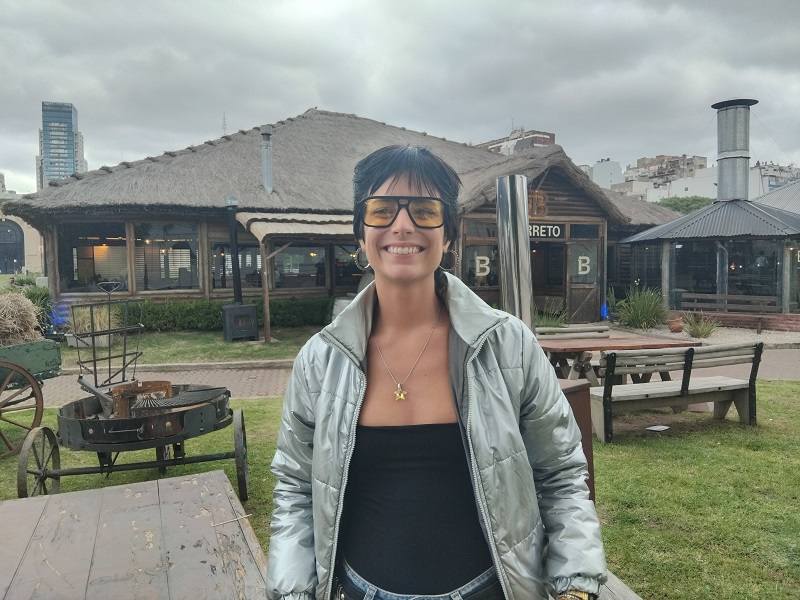
During the most recent celebration of Devconnect, an event that brought together developers and enthusiasts of the Ethereum ecosystem and other networks in Buenos Aires, Argentina, CriptoNoticias had the opportunity to speak with Camila Soria, lawyer specialized in Web3 and founder of Khoros and Cypher Law.
Soria, who specialized in international tax law and arrived in the world of bitcoin (BTC) and cryptocurrencies in 2018, offers a dual perspective: that of the legal specialist who navigates regulatory loopholes and that of the entrepreneur who seeks to innovate in the real estate market through tokenization.
From tax law to cypherpunk philosophy
Soria’s career did not follow the traditional course. His entry into the world of digital assets was not through financial speculation, but attracted by the ideals of decentralization and social change.
«I met a friend at a party and she said to me: ‘Do you want to come to work in Buenos Aires in international tax?’ I said yes. In that company I started working with startups; The first cryptocurrency companies arrived and it blew my mind,” Soria said about his beginnings.
For the lawyer, the leap towards a technology based on cryptography and advanced mathematics represented a significant challenge. Soria admits that he had to “start mathematics again,” delving into algebra and dynamic systems theory, areas outside of traditional legal training.
«I fell in love with the philosophy and the possibilities of technology. Since I did not study programming or software, I decided to help create from this place,” he explained, referring to his role in building legal frameworks for innovation.
Khoros: tokenization with real impact
One of the central points of the conversation was Khorostheir project focused on real estate tokenization. Unlike other projects that simply fragment the ownership of a property, Soria’s proposal introduces a component of active management and sustainability.
“At Khoros we are developing a platform to tokenize not only real estate as is traditionally done, but we also tokenize the earned value.”
Camila Soria, founder of Khoros and Cypher Law.
The model seeks to solve, for example, liquidity problems for owners who cannot afford renovationsallowing third parties to invest in the improvement of the property in exchange for a future participation in the value of the property.
Soria illustrated the concept clearly: «If you have a house and you can’t invest in it, I come and invest 20,000 dollars in your house valued at 80,000. So we tokenize both the value that I contribute and the value that you had. Little by little I am becoming owner of the property. This approach not only seeks profitability, but also “maintains the ‘real estate’ with a sustainable vision, that there is no old building left and that entire cities can be renovated.
The legal security of this model is based on personal contracts and the reputation of those involved.moving away from mere speculation. “The investor is assured that he is not investing in something purely speculative,” he said, adding that the profitability comes from the increase in the value of the property after the improvements and the environmental sustainability applied.
Legal engineering in a not entirely regulated environment
Through his law firm, Cypher Law, Soria applies what he calls “Legal Design«a methodology to create tailored legal frameworks for startups in an environment where regulation often lags behind innovation.
“I have been in this world since before tokenization regulations existed,” he commented, remembering times where the compliance It was a matter of foresight rather than strict normative obligation.
The strategy consists of interpreting the business model and looking for legal substitutes when specific regulations do not exist. “If there is no strict regulation that applies, you look for substitutes,” he explained, citing examples of how to apply traditional accounting concepts to new activities such as Bitcoin mining or cryptocurrencies. Its objective is clear: “I try to promote legality as a competitive advantage.”
The regulatory challenge in Argentina and the CNV
Another of the topics discussed in the interview was the position of the National Securities Commission (CNV) of Argentina regarding the tokenization of real assets. Soria showed constructive criticism regarding recent regulationspointing out that current demands could be slowing down the innovation of small entrepreneurs.
«It is complex because of what the CNV has proposed in the latest regulation. The CNV is not directly tokenizing Real Estate Assetsbut financial instruments,” he warned.
According to the specialist, the requirement to establish trusts or business funds for incipient projects creates an almost insurmountable entry barrier for the average entrepreneur. “We aim to retailers; “The idea is not to set up a trust for three people who are just starting out.”
Comparing the local situation with the international panorama, Soria mentioned that Asian jurisdictions such as Singapore or Japan, and even Dubai, are moving towards “direct tokenization” models, where the token represents the real right over the asset, without complex corporate intermediaries. “The token must give the rights, because that is what it symbolizes in the digital world,” he stated.
Technology and custody: the choice of Cardano
On the technical side, Khoros has chosen to build its infrastructure on the Cardano network. The decision, according to Soria, responded to a combination of economic and technical factors. «We liked the proposal and had fees lower. (…) It was much easier to build on those tools than on Ethereum, which has a larger market but is much more expensive,” he justified.
A crucial point for user security is the custody of assets. Soria was emphatic in clarifying that her platform does not retain investors’ tokens: “The user has it directly. “We do not do custody.” The tokens are issued through a Decentralized Autonomous Organization (DAO), ensuring that ownership remains in the hands of the users, albeit with certain mechanisms of «vesting» or waiting periods to avoid immediate speculation and ensure the sustainability of the project.
Argentina, land of ‘big players’ for tokenization
Looking to the future, Soria offered a projection on how the tokenization market in Argentina will take shape in the coming years. His vision is cautious regarding small actors, but optimistic about the country’s potential.
«In Argentina I think they are going to develop’big players‘. The current requirements are driving out many entrepreneurs (150,000 dollars to start is a lot for a startup), so the big players are going to take over the market quickly,” he predicted.
This barrier to entry, imposed by regulatory and operational costs, could consolidate the market in few hands, displacing innovation «bottom-up» (from bottom to top) that usually characterizes the Bitcoin and cryptocurrency ecosystem.
Nevertheless, Soria perceives renewed international interest in Argentina. «I work a lot abroad and I see interest in coming to Argentina. Yesterday they told me that they notice a ‘hope for change’ in the country,” he commented, pointing out that, unlike an overregulated Europe or a United States with legal uncertainty, Latin America is presented as fertile ground for adoption and innovation.
«You have to understand human factors»
In closing, the founder of Khoros emphasized that the success of The industry will not depend solely on code or laws, but on human adoption and cultural change. Soria called for cooperation within the Web3 ecosystem, urging to put aside fierce competition.
«Digital transformation is achieved through people, we do not have to stop at technology alone. “You have to understand human factors,” he reflected. Its final message resonates with the original ethos of the bitcoiner movement: technology as a tool of empowerment, but driven by the will of individuals. “The world has changed: we have to stop competing for everything and start cooperating… the path is there, we have to dare to walk it.”