
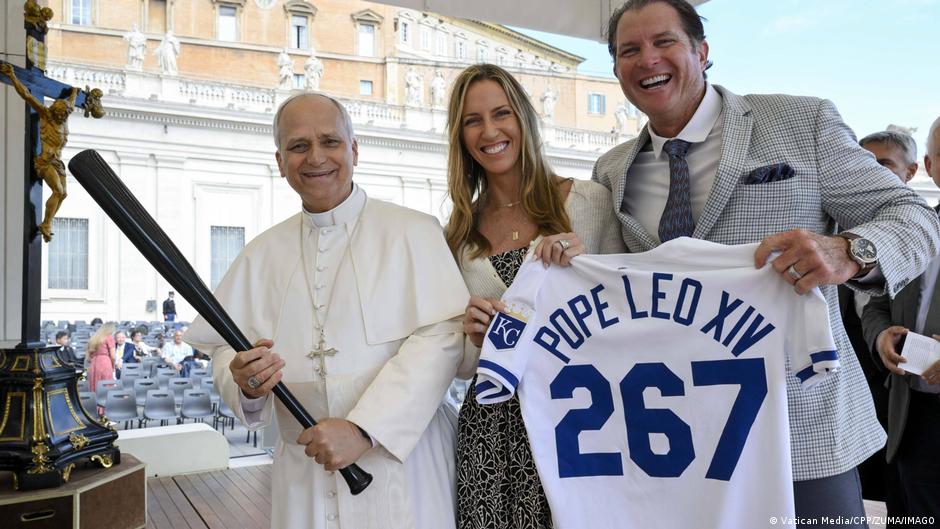
In mid-December, Pope Leo XIV, 70, once again criticized US President Donald Trump, 79, although without naming him. “The comments that have been made about Europe in recent interviews seem to me to be an attempt to sabotage the need for a very important coalition today and in the future,” the Pope said. Everyone understood who he was talking about.
Since May 8, an American citizen has led the Catholic Church for the first time. This means Trump, who began his second term as US president on January 20, becomes the first US president to face another American as head of the Vatican.
The United States is home to approximately 340 million people. There are approximately 1.4 billion Catholics worldwide. In the 2024 presidential election, about 55% of American Catholics voted for Trump.
Observers had long rejected the idea that a member of the Catholic clergy from the United States could become Pope, given the country’s importance as a world power. However, in the weeks following Pope Francis’ death on April 21, there were rumors that wealthy reactionary American Catholics had offered massive donations to the chronically cash-strapped Vatican if the next Pope were an American citizen.
Trump’s reaction to Leo: ‘What excitement!’
Those donors probably did not have Archbishop Robert Prevost in mind. Prevost was born in Chicago and lived and worked in Peru for several years.
Nevertheless, in a post on his Truth social platform shortly after the Pope’s election, Trump wrote that he was looking forward to meeting Leo XIV. “What excitement and what a great honor this is for our country,” Trump wrote.
They are yet to be found. Trump, who was a Presbyterian, now calls himself a non-denominational Christian.
Leo has repeatedly and openly criticized the U.S. government’s behavior toward immigrants. Some American bishops joined them early on. Others gradually joined in after the conditional release of brutal images of masked men pulling people out of vehicles or carrying them through hospital corridors and other facilities.
Few had anticipated how strongly the United States Conference of Catholic Bishops, consisting of about 270 bishops and auxiliary bishops, would position itself against Trump’s immigration policies in mid-November. The USCCB lamented the “climate of fear” and “condemnation of immigrants.” The bishops felt compelled to “raise our voices in defense of God-given human dignity.”
To counter this statement, the USCCB issued its first “special message” in 12 years and launched a social media campaign in which several bishops spoke individually.
Orthodox bishops in the United States
Overall, American bishops are more conservative than their counterparts in Europe. During his tenure from 2013 until his death in April, the American bishops often stood in open opposition to Pope Francis. Many people are politically associated with the Republican Party.
However, they differ from party to party when it comes to migration. “The bishops have shown this very strongly,” Benjamin Dahlke, a theologian at the Catholic University of Eichstätt-Ingolstadt, told DW. “No matter what the bishops’ own political leanings, there was very strong consensus from left to right.” Dahlke, who spent time as a visiting professor in the United States while researching a book, said it was “absolutely clear” to the bishops that the current US government’s conduct against immigrants violated the law.
Immigration is the issue on which the church has criticized Trump the harshest. Before the vote in the USCCB, there were clear signs that the Pope was pushing for such a position statement. Several bishops met with him in the weeks before the USCCB convened. The Vatican’s ambassador to the United States, French Archbishop Christophe Pierre, is a cardinal. It is rare for a nuncio to hold such a high position in the Catholic Church. This will probably increase his dominance over the land.
“Pope Leo began to speak more openly on the subject of migration in September,” Massimo Fagioli, Professor of Historical and Contemporary Eccles in the Department of Religion at Trinity College Dublin, told DW.
However, Leo has commented less than Francis on the state of democracy in the United States and elsewhere. “This is a topic they must engage with sooner or later,” said Fagioli, an Italian American who was previously a professor at Villanova University in the United States.
Fagioli, who moved to Ireland with his family in 2025, said there are “MAGA Catholics” there who support Trump’s “Make America Great Again” agenda and view Pope Leo critically. However, he said, it cannot be compared to the broader MAGA criticism of Pope Francis.
The differences between MAGA Catholicism and the Vatican on many issues are stark. However, “there are still many good vibrations between this Pope and the Americans,” Fagioli said, and this will continue unless Leo says something more politically divisive than so far.
The Pope and the President speak the same language
Fagioli said US Vice President JD Vance is Catholic. “Vance is always strategic, not naive,” he said. The Vice President has not yet openly criticized Pope Leo. Vance has also met with the Pope on a joint visit to the Vatican with US Secretary of State Marco Rubio, who is also Catholic.
In addition to the “latent opposition” between the president and the Pope on the issue of immigration, Dahlke said, there is a “latent collaboration” with the president and the Pope “going in the same direction” on topics such as their understanding of gender and the definition of family.
The fact that the Pope and the President are both American, Dahlke said, “is a relationship that should not be underestimated.” Americans may interact differently with each other than people in other countries: The Pope and the President share the same native language.
Will Trump and Leo XIV meet in 2026? In early December, upon his return to Rome from Beirut, the Pope said his next trip would be to Africa, including a visit to Algeria. Another destination was Latin America, especially Argentina and Uruguay. He did not mention the United States.
Trump is expected to visit Europe in 2026. German Chancellor Friedrich Merz indicated that the US President wanted to visit his native village of Kallstadt in Rhineland-Palatinate. Rome is not far from there.
This article was originally written in German.
While you’re here: Every Tuesday, DW editors provide insight into what’s happening in German politics and society. You can sign up for the weekly email newsletter, Berlin Briefing, here.