
On its last day, St. Anna’s is again nearly full. A choir is singing and a small organ is supporting them. But this is the last mass in the small Catholic church in Gildehaus, a district of Bad Bentheim near the German-Dutch border. In the future, the building will no longer be a place of worship.
At the end of the service, the end of this church finally becomes real. The congregation opens the altar and removes the relics. These are small relics of a saint, be they bone fragments or pieces of cloth, which are always included in the altar of a holy Catholic church.
Closing churches is an emotional matter. “It affects the heart and the eyes. It’s moving,” Catholic priest Hubertus Goldbach tells DW, wiping away a tear that started from the corner of his eye.
What his small congregation is going through is what many devout Christians across Germany are also going through. When churches shrink, they have to give up buildings.
The number of church members in Germany is falling rapidly. In 2024 alone, the two major churches lost over one million Christians due to people leaving the church or dying. Currently, more than 45% of Germans still belong to either the Protestant Church in Germany or the Catholic Church. Thirty years ago, this figure was around 69%. This is why churches are now being defiled or defiled.
Since 2000, hundreds of Catholic and Protestant churches have been closed. In response to DW’s inquiry, the German Bishops’ Conference reported the closing of 611 Catholic churches between 2000 and 2024. The Protestant Church estimates that about 300 to 350 churches were permanently closed during the same period; More accurate figures are not available.
Church building on offer
And what happens to former houses of worship? In some cities, notably Berlin, growing Orthodox Christian congregations have taken over church buildings. But that is an exception. They are often sold out. In the capital alone, several large church buildings are currently for sale. And it is not unusual for churches to be demolished.
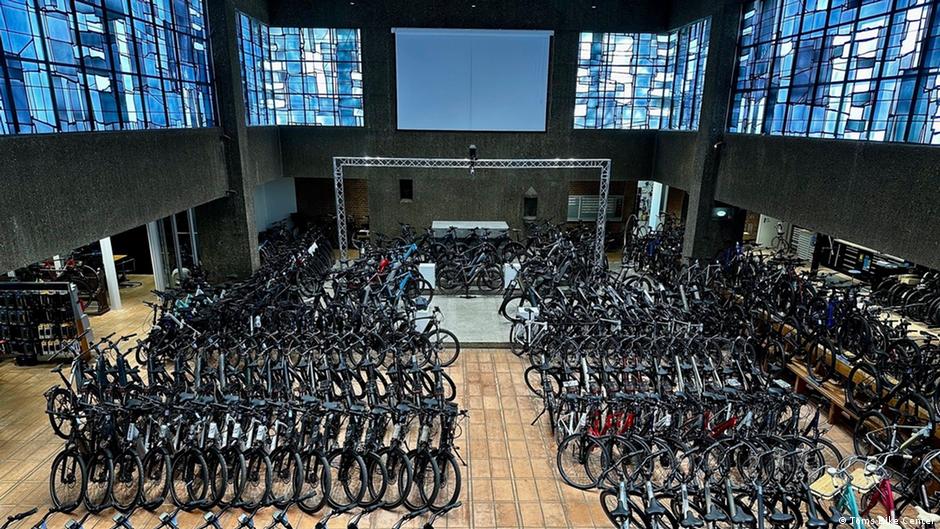
Some are reused. In Jülich, a city between Cologne and Aachen, bicycles are now sold in the former Catholic St. Rochus Church. Thomas Ollers moved his business, Tom’s Bike Center, into the church building.
Ollers told DW that the parish approached him and asked him if he could imagine running his business in the church. This is the church where he himself was baptized and took communion, and where he often attended church services. The exterior of the listed building has changed remarkably little.
In Wettringen, just north of Münster, a monastery has been converted into a “soccer church” where football is played. In Kleve, the former Protestant Church of the Resurrection serves as a boxing arena. The former churches now house pubs, libraries and book stores. Entire monasteries have also been converted into hotel complexes. In Düsseldorf, a hotel retains its traditional name Mutterhaus (Mother House) for its original use as a convent for nuns.
In times of housing shortage, there are more and more cases of architects converting church buildings into residential buildings. For example, in Berlin, Rostock, Trier, Cologne and Wuppertal.
One of the earliest large complexes is the Lucas-Kay-Haus in Essen. The Protestant St. Luke’s Church, built in 1961, was dismantled in 2008 and converted into apartments between 2012 and 2013. At the bottom of the staircase, two plaques now hang: one from 1959 and the other from 2012. And the abstract painted windows there are still the windows of the original church.
Alexandra Schröder has been living in the old church since its reconstruction. “No one would have thought I’d be living over an altar,” she says. For her family, it was just practical at the time because the apartment had several bedrooms and there were good schools nearby. That was the deciding factor.
There is a physiotherapy practice one floor below. Director Jessica Gunther says that while looking for a new premises, she accidentally came across a converted church building. She says the building has a “nice, cool feeling” in which it is nice to work. She knows that the stairs inside her practice once led up to the altar, but she doesn’t want to exaggerate its significance.
But one of his patients is positive about this. “Helping people in need” is an expression of faith, Stefan Hebenstreit tells DW. Even though the buildings are no longer churches, using them as a daycare center or physiotherapy practice is “very practical.” Hebenstreit, a practicing Christian who has suffered several strokes, says this slowly and thoughtfully.
the sound of bells is missing
To hear anything critical about the church conversion, you have to talk to people on the surrounding streets who have lived around St. Luke’s for decades. Miss the sound of bells. Another regret is that the clocks on the church tower have stopped forever.
The two major churches have official commissions and papers on the issue of revival of the churches. Researchers are also concerned about this question. And yet it is often the specific neighborhood that matters.
Art historian Klaus-Martin Bresgott from the cultural office of the Protestant Church in Germany and a group of architecture students used the example of a large church in Berlin to investigate how important a former church complex can be for a neighborhood and residential area.
The Protestant Church no longer needs the huge St. Stephen’s Church (Stephanuskirche) in the Wedding district. This building, which was built between 1902 and 1904, was always very large indeed. But at that time, people liked to build big. Today, the church is closed and in so much need of renovation that you are no longer allowed inside, even wearing a hard hat.
Bresgot and the students did not investigate the building first, instead they interviewed people in the neighborhood, which has a reputation for being an area with social problems. One thing is clear: neighborhoods lack public space, opportunities to gather, play sports, or engage in cultural or community activities.
Times always change and sometimes churches are considered more important. At other times, says DW Bresgot, they were unimportant.
“We know that during the Napoleonic Wars, churches served as horse stables for decades. But they remained standing.” To him, St. Stephen’s Church is a perfect example of how a church that was once much larger can still serve the society. “We should not immediately panic and say: stop, give up,” he warned.
This article was originally written in German.
While you’re here: Every Tuesday, DW editors provide insight into what’s happening in German politics and society. You can sign up for the weekly email newsletter, Berlin Briefing, here.