
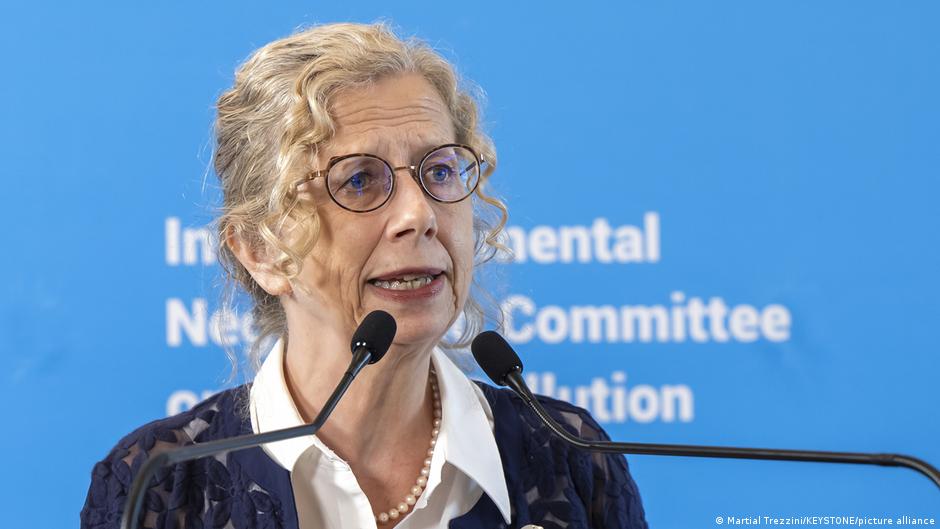
Inger Anderson is candid about why she wakes up every day with new determination.
“My biggest fear would be that we will just become complacent,” said Andersen, a Danish economist who has served as executive director of the United Nations Environment Program (UNEP) since 2019. She says the poorest people will suffer the most if we don’t act fast enough.
The exact cost of a business-as-usual approach to climate and the environment is already trillions of dollars each year and growing, according to one UNEP report released on TuesdayIt found that climate change could reduce global GDP by 4% by 2050 and by 20% by the end of the century,
The report shows the world is at a crossroads, Anderson said. “Continue on the path to a future ravaged by climate change, degraded nature, degraded lands and polluted air, or change direction to secure a healthy planet, healthy people and healthy economies.”
Although in reality, she added, “It’s not an option at all.”
Emissions hit a new record high in 2025, which is also on track to be the joint second-hottest year on record with 2023, according to new data from the US. European Union’s Copernicus Earth Observation Program,
will get huge profits
Anderson believes the new UNEP report, which was prepared by 287 scientists from 82 countries, sets out a “road map” for global action.
According to the scientists in the report, the benefits of aging the world include trillions of dollars in additional GDP each year, avoiding millions of deaths and lifting billions of people out of poverty and hunger.
It says coordinated action will be needed across government, business and society to accelerate the transition to sustainable agriculture, restore ecosystems and switch to clean energy, as well as design products and materials that last longer and reduce waste.
Anderson said it is a reminder of the importance of limiting our overuse of vital resources – whether it be land, water, energy or otherwise – so “there is a degree of inter-generational equity for our children and grandchildren.”
The report’s authors highlight the need to change behavioral patterns away from excessive consumption in line with economic changes in many parts of the world, such as moving beyond a focus on GDP to include measurement of human and environmental well-being and phasing out harmful subsidies that flow to fossil fuels.
They conclude that this could lead to annual global economic benefits of $20 trillion (€17 trillion) by 2070, rising to $100 trillion by then.
An annual investment of about $8 trillion will be required worldwide to help restore biodiversity and achieve net-zero emissions by 2050. This would be the point where any remaining emissions into the atmosphere could be absorbed by nature or removed through technologies such as carbon capture.
Yet this investment far outweighs the cost of inaction, according to the report’s scientists.
Over the past 20 years, extreme weather events – such as floods, hurricanes and wildfires – have caused an estimated $143 billion in damages.
According to UNEP, in 2019, health impacts from air pollution were 6% of global GDP and its economic cost is projected to rise to $18–25 trillion by 2060.
2025: a year of mixed progress
The report comes at the end of a year of mixed progress on climate and environmental issues.
“Obviously this has been a difficult year for multilateralism,” Anderson said. But he is optimistic about what countries working together can achieve.
Although “countries are not moving fast enough” to curb emissions, he pointed out, progress has been made in avoiding the higher temperature rise that was predicted when nations came together to sign the Paris Agreement in 2015, which aims to ideally keep warming to 1.5 degrees Celsius (2.7 degrees Fahrenheit).
She was disappointed that this year’s UN climate conference in the Brazilian city of Belém failed to reach a consensus on a path away from polluting oil, coal and gas.
But he is eager to see what comes out of a conference led by the Netherlands and Colombia in April on accelerating fossil fuel phase-out.
“The climate convention is working, but we need to speed it up,” he said, “otherwise we will pay a high price in the form of fires, floods, drought and heat.”
Reasons to be optimistic about 2026
Looking ahead, Anderson said that “it’s important to celebrate the fact that renewable energy is becoming very, very competitive.”
He pointed to the “interesting phenomenon” of sources such as wind and solar now producing energy at significantly lower costs than fossil fuels.
Anderson cited the example of Texas in the US, which despite being an oil-producing state, is now able to get about 40% of its electricity from renewable energy.
“It’s interesting to see that markets are moving in a direction that is supportive of the climate crisis,” Anderson said. He said renewable energy is a sector that is “unbeatable because of pricing and competitiveness.”
Her biggest fear may be complacency, but Anderson is also energized by the movement of diverse groups pushing climate action – from businesses to youth activists, scientists and religious leaders – which she now views as so powerful that it cannot be reversed.
“What gives me hope is that there are solutions and millions of people are crying out for them.”
He hopes this will translate into political action. “I often say, when you go to the voting booth, hold your grandson or your daughter or the dream of the child in your mind and vote for them as well as for your own interests…. And I think that’s a commitment that each of us has to make to the people in our lives that we love most.”
Edited by: Tamsin Walker