
January 20 was a turning point for the entire world: the day Donald Trump returned to the White House was a significant change in the course of global politics.
Within a matter of months, Trump introduced punitive tariffs and restrictive visa policies, withdrew the US from key international structures such as the Paris Climate Agreement and the World Health Organization (WHO), and eliminated most of the operations of the US development agency, USAID.
The message was heard loud and clear that America remains the world’s leading superpower. But to what extent can Washington impose its terms on the rest of the world?
Africa’s lukewarm response to Trump
Despite the turmoil caused by Trump’s policies around the world, the impact of his tariffs on everyday life in African countries was limited, according to Ovigwe Egugu, an analyst working for the independent consulting firm Development Reimagined.
“The continent is still on the right track. Africa does not have a large export market for processed products to the US. Only raw materials such as oil, gas, critical raw materials and metals are exported,” Egugu explained, emphasizing that often no duties are charged for those exports.
Even when the AGOA trade agreement, which aims to promote growth and opportunity between the US and African countries, expired in late September, the response on the continent was slow.
The African countries most affected by Trump’s policies were Lesotho, which has been manufacturing denim for the US market for years and now has to pay 50% in tariffs, and car exporter South Africa, which faces a 30% tariff increase.
South Africa: G20 success
South Africa’s relations with Washington grew particularly sour during the 2025s. Two weeks into his presidency, Trump declared that “terrible things” were happening to white farmers in the country, referring to the alleged genocide of the country’s white minorities, particularly farmers.
While violent crime rates remain high across South Africa, claims of targeted killings against white farmers have been repeatedly rejected by the government – though not enough for the US leader.
Pretoria was further irked when, soon afterward, Trump began granting fast-track political asylum to a group of white South African farmers, putting South Africa in a bad light the year he assumed the rotating presidency of the G20.
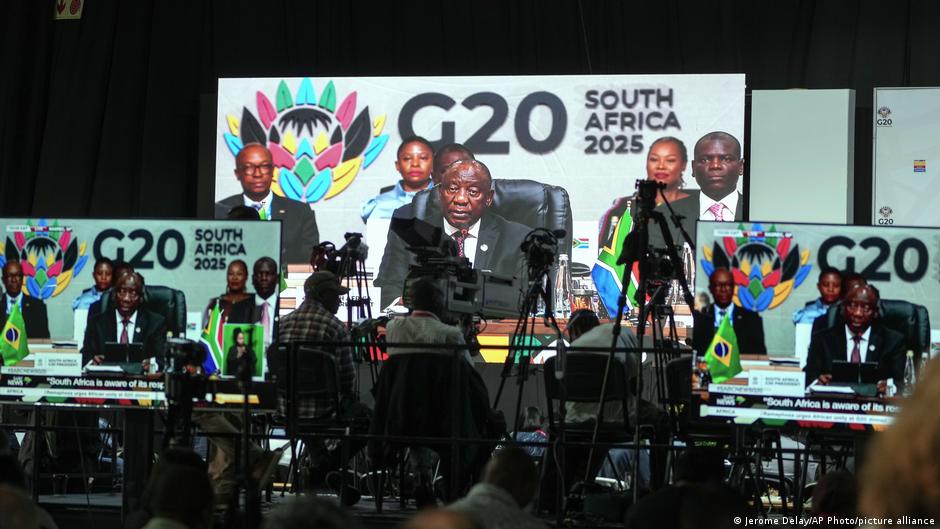
When the country finally moved closer to hosting the first G20 summit on African soil in November, the US President and his administration declined to attend. Trump continues to single out South Africa as his favorite state, not even extending an invitation to the country to the next G20 summit in Miami next year.
Still, the G20 summit in Johannesburg was a success, says Noncedo Vutula, a researcher at the Nelson Mandela School of Public Governance. “The discussion was rich and took into account all the different viewpoints that were debated before the summit,” Vutula told DW.
For South Africa, it was particularly gratifying that the announcement of a joint summit committed the G20 to multilateralism – much to the anger of Washington, which had tried to prevent a declaration being prepared without US participation.
The declaration of intent also expressed a commitment to further strengthen “Africa’s voice at the G20 and all other international fora”.
G20 announcement resonates across Africa and beyond
The symbolic power of such a declaration of intent, which places Africa firmly on the world stage, cannot be underestimated for a continent that has been attempting to emerge from the shadow of its colonial past for decades.
This set the stage for the African Union–European Union summit which was held in the Angolan capital Luanda just a few days later. As host of the event, President João Lourenço reiterated the G20’s message that “the world is not made up of just one or two countries. We work with anyone who is open to us,” and strongly positioned Africa as the architect of its own destiny.
At the meeting in Luanda, Africa’s European partners reaffirmed their support for key infrastructure projects – such as further improving the Lobito Corridor in Angola, a key economic route that links the Lobito port to the DRC and Zambia. This was seen as another sign that European countries and other partners are beginning to realize that they cannot impose conditions unilaterally on the continent.
“What is needed is a dynamic in which cooperation is structured to benefit both parties,” Egugu said. He said that due to centuries of shared history, Europe remains a desirable partner for many African countries.
However, he also highlighted that there is some competition that Europe will have to meet, as African countries are still expanding their ties with China, Russia and smaller players such as Turkey and the United Arab Emirates.
This became even more evident at the AU-EU summit. While those negotiations were taking place, China signed another billion-dollar deal with Zambia to expand the East African rail network, showing that Beijing is ready to compete with planned infrastructure upgrades on the Lobito corridor.
War and military rule slow down development
However, 2025 was not a year of success in all corners of the continent. Africa’s role in the world is diminishing due to major crises and conflicts, such as the civil war in Sudan, now in its third year, and tensions in eastern Congo, which persist despite numerous international mediation efforts – including those by the US.
Furthermore, eight African countries are currently under military rule, with little or no prospect of a return to democracy. In 2025, Madagascar and Guinea-Bissau were added to the list of African countries where a coup and subsequent junta leadership left the future uncertain for citizens, observers, and investors.
Researcher Wutula says that a more peaceful Africa would contribute significantly to overall economic growth, while Egugu argues that part of the problem is the fact that Africa is still dependent on the influence of foreign powers.
“This is the political reality of weak states. Because the continent is full of weak states, and weak states have neither the capacity nor the political experience.” [to succeed],” he says. “Their national circumstances make them vulnerable to external influences,” he says, arguing that this is why in so many parts of the continent, militaries have instead chosen to set the future direction of their respective countries.
Moving forward together with developing countries
Meanwhile, many African countries, particularly low-income countries, are still lagging behind in their economic development due to high levels of national debt on their balance sheets.
This was also recognized with the summit declaration during the G20 meeting, which stated “with concern that interest payments on total external debt have increased significantly for low-income countries and more than doubled over the past decade.”
Noncedo Wutula believes that the African Continental Free Trade Area (AfCFTA) can serve as a path to greater economic freedom, stressing that although most African countries have already ratified the agreement, there are still some challenges to overcome.
“This gives Africa hope that we can trade with each other. We can create regional value chains in Africa and ensure that Africa’s economies grow,” he told DW.
Edited by: Serton Sanderson