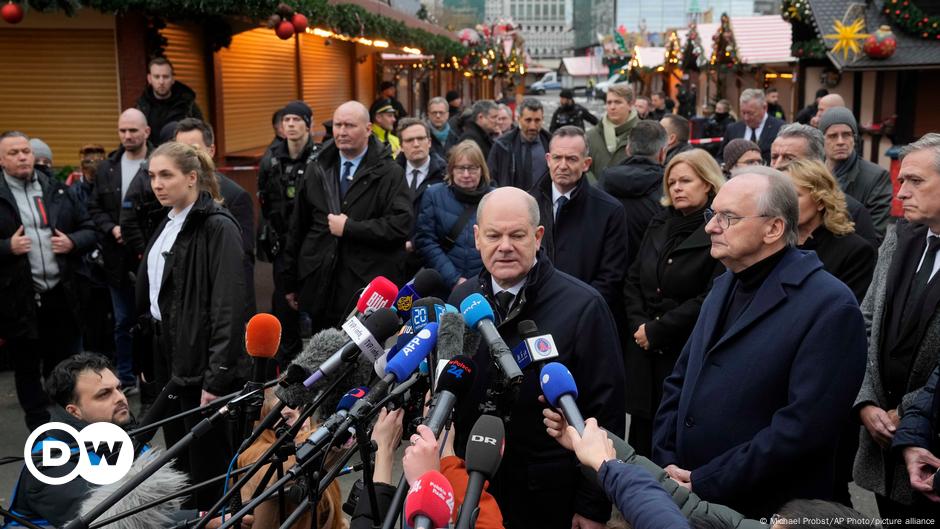
The first attempt to carry out Friday’s deadly attack at a Magdeburg Christmas market came less than an hour after the attack. False rumors spread that there were five attackers, three of whom were still at large, that they had arrived in Germany as refugees from Syria in 2015 and 2016, and that it was not just a car that killed at least 34 people But a bomb was placed at the site of the holiday celebration.
Austrian nationalist Martin Sellner, a leading figure in European identitarian networks, was one of the most prominent disseminators of disinformation. Politicians from the far-right Alternative for Germany (AfD) soon joined efforts to capitalize on the attack, in which at least five people were murdered by a suspect named Talib A*, a Saudi national who has since fled Germany. I am living in. 2006 and has apparently expressed admiration for the AfD.
“Only the AfD would have deported that man long ago,” Sven Tritschler, vice president of the AfD in the state parliament of North Rhine-Westphalia, posted on social media.
Dominik Koffner, an AfD member of the Brandenburg state legislature, posted on social media that “million-fold migration is the problem and million-fold migration is the solution.”
In her own post, Vanessa Behrendt, an AfD member of the state parliament in Lower Saxony, blamed rival German parties such as the centre-left Social Democrats (SPD), centre-right Christian Democrats (CDU), the Greens and the Left Party: “They Are responsible for.
The suspect, Talib A, is apparently an open critic of Islam and an AfD supporter. In 2016 he wrote on X, “I and the AfD are fighting the same enemy to defend Germany.”
‘Proliferation of right-wing narrative’
With an eye on federal elections in February, AfD leader Alice Weidel, the party’s candidate for chancellor, wrote on social media: “When will this madness end?”
Benjamin Hohne, a political scientist at the Technical University in Chemnitz whose research focuses on German parties, told DW: “The trend is moving more and more to the right. Right-wing narratives are spreading. An open migration policy that attempts to give global recognition “Human rights have already fallen out of popularity. “Disastrous events like what happened in Magdeburg will probably exacerbate this.”
German news agency dpa reported that the government of Saudi Arabia had previously informed German authorities that the suspect, an outspoken dissident, could be a threat. The pro-Russian Sahara Wagenknecht Alliance (BSW), which also campaigns on restrictive migration policies, has attacked German Interior Minister Nancy Feser, saying she should answer why “so many suggestions and warnings” were made before Friday’s attack. Ignored”.
In view of recent deadly knife attacks in the cities of Solingen and Mannheim, BSW leader Sahra Wagenknecht called for “a concrete security plan with a clear focus on the protection of the population”.
Höhne said: “It is to be expected that the parties, especially on the right, will try to attack the Interior Minister and the SPD on the subject of security. The SPD has responsibility for the Interior Ministry and domestic security at the federal level, so it “Will try not to get into a defensive position because of Magdeburg.”
Imminent federal elections in Germany
Historically, the CDU and its Bavarian sister party the Christian Social Union (CSU) have been parties that have considered themselves strong on domestic security. Hohne said it was likely that security and migration would be at the center of the debate in the upcoming campaign, as was the case in recent state elections in East Germany.
According to Hoehn, there is a growing emphasis on “securitization” in German politics. “This means that migration is discussed almost exclusively as a potential or actual security risk,” he said. “With this, other aspects of migration have been pushed to the background – like, for example, how to overcome the labor shortage in Germany or how to attract skilled workers. I fear that the attack in Magdeburg will reflect this prejudice. Will further strengthen it.”
Six parties have agreed to a fairness pact ahead of the federal election. The SPD, CDU, its Bavarian sister party CSU, the Greens, the FDP and the Left Party said they would not stop using personal insults or attacks on politicians’ personal and professional circles during their campaign. They also agreed to debate respectfully with each other and avoid using propaganda to score political points. The AfD and BSW have not signed the agreement.
There are also efforts by foreign actors to influence German elections. Along with Russian propaganda, US-based tech billionaire Elon Musk has attacked the German government. Musk, an ally of US President-elect Donald Trump and owner of social network X, has already supported the AfD in the upcoming elections. Immediately after the attack in Magdeburg, he demanded that German Chancellor Olaf Scholz step down, calling him an “incompetent fool”.
Hohne said, “Government institutions and officials should consider whether their continued presence at German federal government institutions should not tolerate this.” ,
This did not stop Musk from taking a step forward. He shared a screenshot of headlines saying Taleb is “Islamophobic” and wrote on the X “Legacy media lies again”.
This article was originally written in German. It was originally published on December 22 and updated on December 23.
*Editor’s note: DW follows the German press code, which emphasizes the importance of protecting the privacy of suspected perpetrators or victims and urges us to refrain from disclosing the full names of alleged perpetrators.