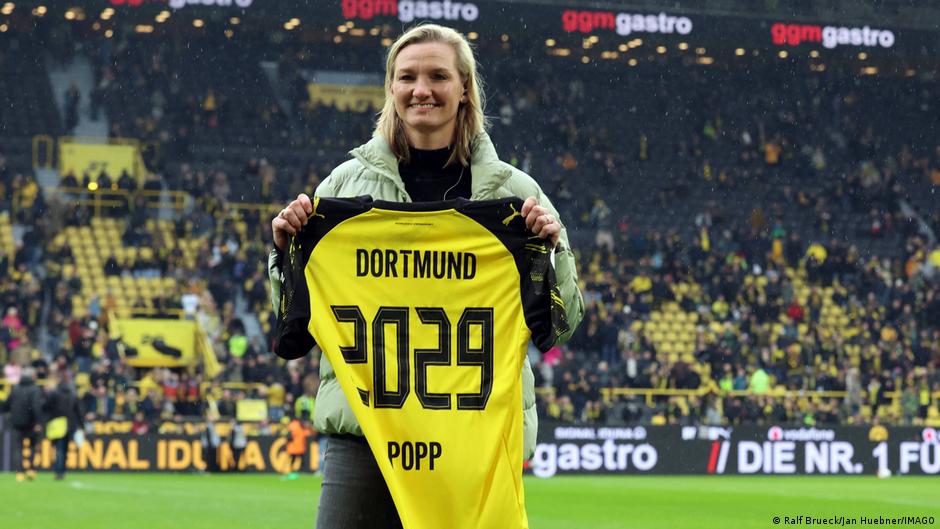
Alexandra Pope has not achieved much in her career. Three Champions League titles, an Olympic gold medal, seven Bundesliga titles, 13 German Cup titles and an incredible 14F5 caps are significant for the German.
Now however, the 34-year-old will join the club for whom her “heart beats” after agreeing to leave Wolfsburg for Borussia Dortmund in the summer on a three-year deal. Pope grew up in the area, but for one of Germany’s greatest football players this is more than a homecoming. Pope is once again playing her part in developing the game in Germany, moving to a lower league club that didn’t even exist five years ago.
Borussia Dortmund’s women’s team played a match for the first time in 2021, 13 years after Pop turned professional. This was a long-term project, and instead of investing a lot of money to make a quick jump to the Bundesliga, the club has had a slow climb from the lower leagues. They are currently in the third division, and are aiming to stay in the Bundesliga in the next two years.
Managing director Svenja Schlenker described Pope’s signing as a clear statement of the club’s ambitions. It’s clear that the Dortmund women are ready to take the next step.
“Alexandra Popp has become one of the defining figures of modern German women’s football. She represents much more than sporting performance. She brings credibility, leadership and visibility. To a project like Dortmund, a personality like Popp also signals to the wider football market that the project has serious ambitions,” Dominik Schreyer, professor of sports economics at Germany’s Otto Beisheim School of Management, told DW.
Schreiber said, “They are also likely to attract fans to the stands, whether it’s men’s football or women’s football, people want to see familiar faces. It is widely accepted in sports economics that star players drive demand and media interest. And there is certainly no debate that Pop is one of the few true stars of the German market.” He said that a strong Dortmund would boost league attendance and media interest.
The current Women’s Bundesliga average attendance is reportedly around 3,425 per match, with Bayern averaging just under 8,000 per match. Borussia Dortmund Women attracted 10,000 fans to a game against rivals Schalke in 2025, and with 230,000 club members there is real reason to believe that many supporters of the men’s side will also be cheering for the women’s team, despite the more established local sides.
Is supporting men’s clubs the only way forward?
The Pope’s move however also begs questions about how football clubs linked to men’s clubs can survive. SGS Essen are struggling at the bottom of the league and two-time Champions League winners Turbine Potsdam have fallen deep into the second division. In their place, RB Leipzig and Union Berlin are looking to establish themselves in the Bundesliga. While the dispute over the structure continues with the German FA (DFB), the picture painted is becoming clearer. Pop’s move to Dortmund serves as another reminder of the direction the game is traveling.
Schreiber said, “The idea that clubs supported by larger men’s organizations have structural advantages is well established, but it is not something that can be clearly verified in terms of transfers.”
“Integration alone does not guarantee success. Real progress still requires a deliberate effort to realize synergy between the men’s and women’s sides. That said, the pressure will increase for clubs without support. They will need clear strategies, for example strong youth development, smart recruitment or a distinctive club identity. In some cases, external investment can also play a role in helping clubs remain competitive.”
Just two years ago, Schreiber was part of a trio of researchers and experts who published a paper called “Football but better? Professional women’s football in Germany by 2031.” In that paper, the most likely of estimates was that “integrated football clubs are crowding out all independent women’s clubs in Germany.”
Slow growth with structural support
Pope’s signing is part of Dortmund’s ambitions. Shortly before, Ralf Kellermann, often credited with the rise of Wolfsburg’s women’s team, had also agreed to join Dortmund. Kellermann joined Wolfsburg as a coach in 2008, later becoming sporting director. In both roles he helped the club win 20 titles, including the famous treble in 2013 when coach Kellermann helped Wolfsburg win it all.
His signing is another clear sign of Dortmund’s ambitions, but also a recognition that making it all work requires more than money and a star signing.
“If the investment continues, progress can be rapid,” Schreiber said of Dortmund’s timeline for reaching the level to challenge Bayern Munich and Wolfsburg. “But building a top women’s soccer program is not just about money. It is about recruitment networks, playing structures and organizational know-how. Clubs often underestimate how much time it takes.”
At this point, both Alexandra Pope and Borussia Dortmund don’t feel like they have underestimated anything. This is exciting news for a domestic scene desperate to compete in Europe and a national team aiming to win a domestic European championship in three years.
Edited by: Matt Pearson