
The company is looking to issue and sell 3 classes of shares to raise more capital.
So far, Strategy accumulates more than 760,000 bitcoin (BTC).
Strategy, the company led by Michael Saylor that holds more bitcoin (BTC) than any other corporation in the world, filed today, March 23, 2026, with the United States Securities and Exchange Commission (SEC) a new package of capital issuance programs. Through its execution, the company seeks to raise up to an additional $44.1 billion to continue purchasing bitcoin.
He form details the opening of three new programs for selling securities on the open market (at-the-market or ATM): one of up to $21 billion in class A common shares (ticker: MSTR), another of up to $21 billion in STRC variable rate preferred shares, and a third of $2.1 billion in STRK preferred shares at 8% fixed annual rate.
Simultaneously, the company added three new placement agents —Moelis & Company, AGP/Alliance Global Partners and StoneX Financial—to its master sales agreement, which already included Morgan Stanley, Barclays and 14 other financial institutions.
The ATM programs allow Strategy to gradually issue and sell shares on the secondary market, without the need to conduct a traditional public offering.
The mechanism is known and documented: the company’s previous forms explicitly confirm that the profits from these sales go to purchasing bitcoin. And it has done so repeatedly in the past, as reported by CriptoNoticias.
At the current bitcoin price, With $44 billion Strategy could buy approximately 615,000 BTC. The company already owns 762,099 BTC, so if it made this acquisition it would position itself above one million bitcoins in its treasury.
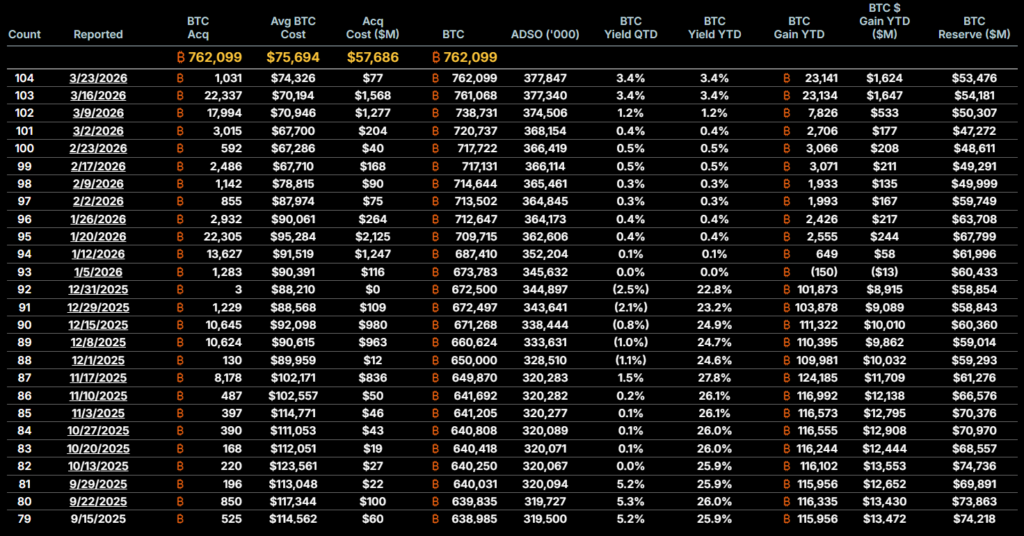
With these movements, Strategy reinforces its position as the world’s largest corporate bitcoin holder and continues to build a financial architecture around digital currency.
It is important to clarify that this financial architecture is not exempt from criticism. This information portal has reported the comments from analysts who see risks in Strategy’s business modelalthough the company’s directors have always minimized the existence of this problem.