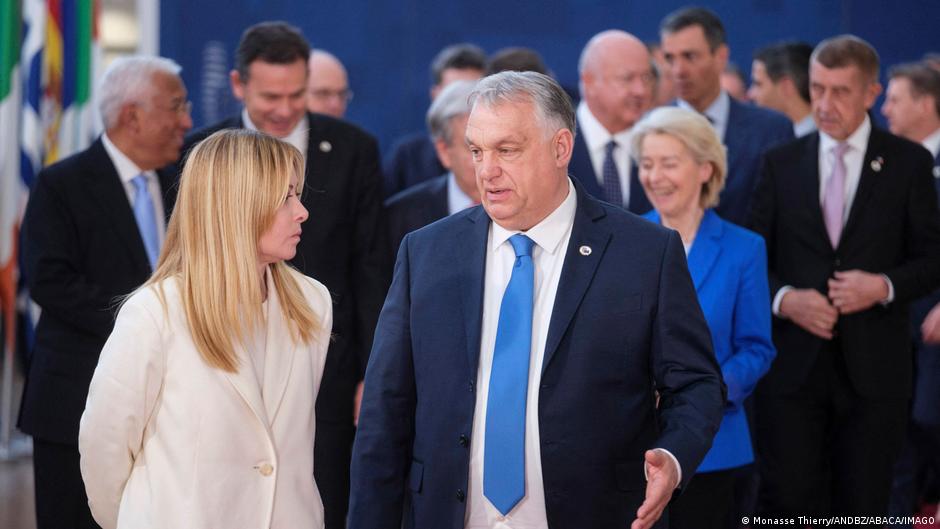
Hungarian Prime Minister Viktor Orban said on Monday he has ordered an investigation into what he referred to as the “wiretapping” of Foreign Minister Peter Szijjarto.
“The wiretapping of a government member is a serious attack on Hungary. I have instructed the Justice Minister to immediately investigate the information,” Orbán wrote on Facebook.
This comes after a weekend media report Washington PostIn what Szijjarto himself dismissed as “fake news” and “senseless conspiracy theories”, the Hungarian Foreign Minister was accused of regularly passing sensitive information about EU negotiations to Russia.
The report made no mention of “wiretapping”, instead accusing Szijjártó of deliberately passing information on to his Russian counterpart Sergei Lavrov.
Europe, Germany express concern over allegations
Washington Post The report, citing unnamed serving or former EU security officials, said Szijjarto regularly called Russia’s Lavrov during breaks in EU meetings to give a “direct report on what was discussed” and to suggest possible courses of action.
The European Commission on Monday refused to accept the allegations as confirmed, but still demanded an investigation and clarification.
“[A] “The relationship of trust between member states and between them and the institution is fundamental to the EU’s work,” spokeswoman Anita Hipper said, calling the allegations extremely worrying. “We expect the Hungarian government to provide clarifications.”
A German Foreign Ministry spokesman also avoided directly blaming Szijjarto.
“The allegations being made here are very serious,” he said. “Talks between EU foreign ministers are confidential and enshrined in the founding principles of the union. We will not tolerate any breach of these principles.”
EU and NATO member Hungary at odds with allies over Ukraine aid, Russian oil
The report comes near the climax of a closely contested election campaign in Hungary, where longtime Prime Minister Orban faces perhaps his toughest electoral test yet against Peter Magyar, a renegade who was once part of his own Fidesz party.
It also comes as Orban wants to block or delay a €90 billion (about $105 billion) EU loan to the government in Ukraine, demanding that it first resume oil deliveries through the Druzhba pipeline.
European leaders have accused Orban of holding Ukraine to ransom for electoral purposes, while Orban in turn has accused the EU of interfering in Hungary’s elections as he seeks a fifth term.
Hungary, which is a member of both the EU and NATO, has maintained arguably the closest ties to Moscow of any alliance or union member amid Russia’s full-scale invasion of Ukraine.
Polish Prime Minister Donald Tusk said Washington Post The report “should not be a surprise to anyone.”
“We have had doubts about this for a long time,” said Tusk, the former head of the European Council. “That’s why I only come on stage when absolutely necessary and speak only as much as necessary.”
Edited by: Dmytro Lyubenko