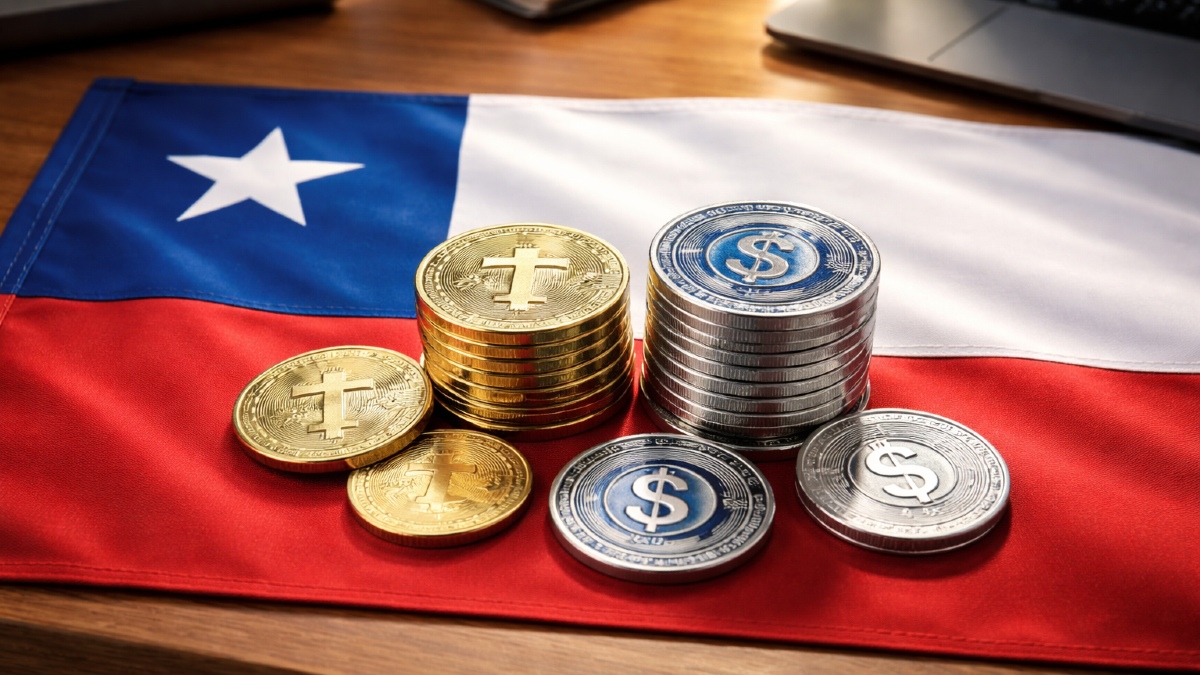
The Chilean peso faces additional depreciation due to stablecoins.
According to Jaramillo, these assets represent a “challenge for monetary policy” in Chile.
The consolidation of stablecoins has ceased to be a niche phenomenon and has become a pillar of the global financial system in 2026. With a market that already exceeds USD 300 billion, these assets have begun to redefine economic dynamics in countries like Chile.
According to economist Patricio Jaramillo, the massive adoption of these instruments not only represents a technological innovation, but introduces structural challenges that directly impact the value of fiat currencies and the autonomy of local financial institutions.
The analyst maintains that these assets have become a highly concentrated market in the dollar, with transactional volumes comparable to global payment systems and a growing role as a structural buyer of United States debt.
According to him, this new financial architecture has generated direct competition for assets in local currency. This is because they have forced monetary authorities to rethink the effectiveness of their traditional tools in the face of a growing “digital dollarization” that seems to have no turning back.
His vision coincides with what institutions of the fiat system have exposed, such as the International Monetary Fund (IMF), which has published research in which it ends up warning of the rise of stablecoins. and its direct impact on the monetary policies of the Statesespecially Latin Americans, as CriptoNoticias has reported.

Jaramillo, who is also a financial consultant and former member of the Central Bank of Chile (BCC), identified 3 consequences of the emergence of stablecoins in Chile. Let’s see what they are.
Additional pressure on the exchange rate and peso depreciation
The first direct consequence of the emergence of stablecoins in the Chilean market, according to Jaramillo, manifests itself in the exchange market.
The analyst recalls that, historically, the value of the Chilean peso has depended on clear macroeconomic variables, such as the international price of copper or interest rate differentials.
However, the ease of access to digital dollars through stablecoins has introduced a new pressure factor that, in the opinion of the specialist, accelerates the loss of value of the national currency against the US currency.
The consultant points out that the preference for these digital assets is altering traditional demand. He thus explains that, as demand for digital dollars increases, “the Chilean peso faces additional depreciation pressures, beyond traditional determinants such as the price of copper or rate differentials.”
This situation is due to the fact that both retail and institutional investors seek refuge in assets that combine immediate liquidity, low transaction costs and perception of security, such as stable cryptocurrencies. Which shifts the demand for pesos towards these new digital instruments.
Chileans take refuge in stablecoins through local exchanges and platforms, such as CryptoMKT, Skipo and OrionX. The latter, which last year received a million-dollar investment from Tether Limited, in order to expand the adoption of USDT in that country.
Fall in demand for local debt
The second consequence identified by Jaramillo directly affects the demand for debt in local currency.
Chile’s ability to finance itself has always depended on trust in the peso, however, the emergence of stablecoins in the local economy has introduced a “financial competitor” that offers immediate liquidity and the perceived security of the US dollar.
This scenario forces a readjustment in the returns offered by the Chilean market. According to Jaramillo, “if investors find more liquid and accessible alternatives in dollars, they will demand higher returns to maintain positions in pesos, which translates into an increase in local interest rates.”
In practical terms, this means that for an investor to decide to keep their capital in instruments denominated in Chilean pesos—and not migrate toward USDT or USDC—the debt issuer must compensate for that risk and lower liquidity with higher interests.
This increase in the cost of money is not limited to the financial sector. Instead, it ends up moving into the real economy, raising the cost of loans for companies and households throughout the national territory.
Challenges for monetary policy and the effectiveness of the Central Bank
Perhaps the most alarming consequence for institutional stability seen by Jaramillo is the weakening of the transmission channels of monetary policy.
The specialist remembers that the Central Bank of Chile uses the interest rate as its main tool to control inflation and growth. However, if a significant part of the population and companies operate outside the peso circuit, This tool loses power.
Jaramillo is emphatic in pointing out that the growing adoption of these digital assets “can weaken the transmission channels of the Central Bank’s decisions.”
According to their analysis, “if a growing part of savings and transactions is channeled into dollar instruments – even in digital format -, the link between the monetary policy rate and consumption and investment decisions could weaken.” This puts in check the ability of the issuing entity to manage the national economy in the face of external shocks.
What is there to do in Chile?
In this context, Jaramillo states that The public policy response is urgent. Options include the development of a digital peso (CBDC) or the creation of more competitive local currency instruments.
However, it recognizes an insurmountable “structural limitation”: Chile cannot compete with the United States’ reserve status.
For this reason, he believes that the strategy should focus on adaptation. “The question is not whether this phenomenon will have an impact, but how prepared we will be to face it,” concluded the economist. And remembered that stablecoins are already an unavoidable cog in the global financial system.