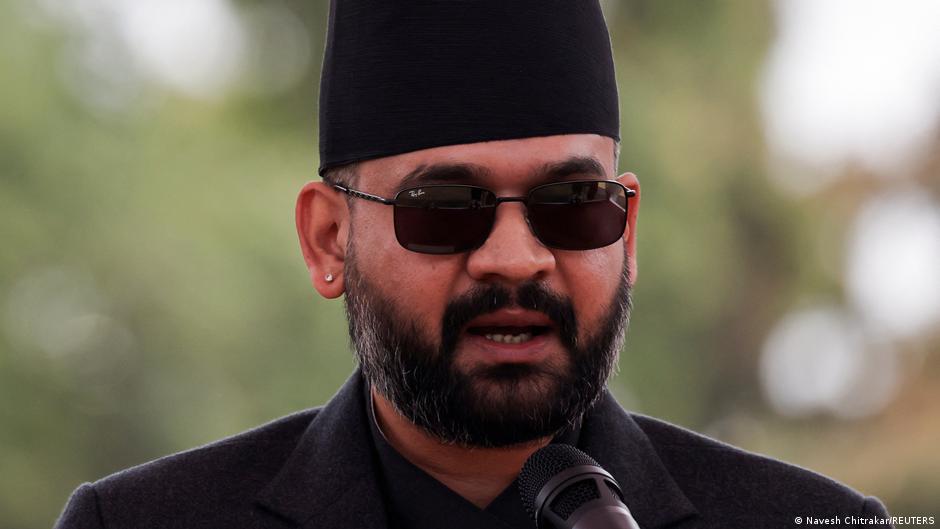
Former rapper Balendra Shah, better known as “Balen,” was sworn in as Nepal’s prime minister on Friday, ending months of political turmoil in the Himalayan nation after a Gen Z-led rebellion last year toppled the previous government.
At 35, Shah is one of Nepal’s youngest leaders ever, and his rise to power reflects dissatisfaction with Nepal’s traditional ruling class.
Former Prime Minister KP Sharma Oli, who has been Nepal’s prime minister four times since 2015, stepped down on September 9 amid violent protests over corruption and economic malaise.
Shah’s centrist Rashtriya Swatantra Party (RSP), founded in 2022, won a landslide majority in the March 5 election and 82 out of 275 seats in the lower house of parliament. Oli’s long-dominant Nepal Communist Party (Unified Marxist–Leninist) won only 25 seats.
Shah, along with RSP president Rabi Lamichhane, has challenged the dominance of Nepal’s old political protectors, who have been in and out of power since the country’s democratic transition in the 1990s. Since then, instability has become the norm, with 32 governments taking power and none of them completing a five-year term.
Both Shah and Lamichhane are relative newcomers to politics. Lamichhane is a former media personality who previously served as Deputy Prime Minister and Home Minister. Shah is an entertainer and former engineer whose previous political experience includes serving as mayor of Kathmandu city.
newcomer to diplomacy
While the RSP was given a broad mandate by voters to fight corruption while improving governance, analysts question whether this will translate to a different approach to Nepal’s complex relations with India, China and the United States.
The foreign policy of Nepal’s traditionally influential parties has been cut along ideological lines.
The moderate Nepali Congress is often considered to be inclined towards India and the US. The leftist CPN-UML and Maoist center parties have openly expressed ideological affinity towards Communist China.
“Since both Balen and Lamichhane are new to diplomacy, they have no bias in international relations,” Nepal’s former foreign minister Rameshnath Pandey told DW.
Although it is too early to predict how the new government will set its foreign policy priorities, the RSP’s election manifesto and Lamichhane’s recent statement suggest that its focus is more economic than ideological.
The party’s manifesto calls for Nepal to become a “living bridge” between China and India and proposes expanding ties with the US.
India, the United States, China, Russia and the United Kingdom have congratulated Shah and Lamichhane for their election success.
After speaking to Indian Prime Minister Narendra Modi, Lamichhane highlighted that the new government would focus on “development diplomacy”.
In its congratulatory message on Nepal’s successful elections, the US said it would work with the incoming government on “shared goals of prosperity and security”.
a tricky strategic balance
Kathmandu’s foreign policy has traditionally focused on maintaining a delicate balance between the US, China and India. Nepal sometimes refers to the US as its “third neighbour”, given Washington’s influence and development support.
The government’s first diplomatic test could come from India and China and its recent decision to reopen the trade route through the Lipulekh Pass. The pass, although currently under Indian control, is also claimed by Nepal.
In late 2015, Nepal’s relations with India became strained after Kathmandu accused New Delhi of blocking border trade. The Center has disputed the changes to Nepal’s Constitution, saying critics said they marginalize ethnic minorities with strong cultural ties to India.
After the de facto blockade, which India refused to enforce, ended in February 2016, Kathmandu began to diversify its trade routes and energy sources, and gradually moved closer to Beijing under the dominance of leftist parties.
Nepal shares a 1,750 km long border with India along with deep cultural, economic and security ties. Along with China, Nepal shares its northern border with the Tibet Autonomous Region.
Security remains a major concern, and both India and China want a stable and reliable partner in Kathmandu.
Since 2017, Nepal has been part of China’s Belt and Road Initiative (BRI), which aims to enhance trans-Himalayan connectivity networks including railways, roads, energy grids and digital links.
China insists that Nepal adhere to the “one China” principle and prevent “anti-China” political activities on its soil. Meanwhile, Kathmandu maintains engagement with the US and its allies for development support such as civil society funding.
In 2022, Nepal and the US signed a $550 million agreement called the Millennium Challenge Corporation (MCC), a developmental grant aimed at enhancing Nepal’s road and power infrastructure.
Both the MCC and the BRI are often interpreted as part of a broader strategic competition between China and the US.
In its congratulatory message on Nepal’s successful elections, the US said it would work with the incoming government on “shared goals of prosperity and security”.
China has also sought to include Nepal in its vision for the global security order, which Beijing has dubbed the Global Security Initiative (GSI). Nepal was also in talks to join the State Partnership Program (SPP), an outreach and cooperation initiative of the US Department of Defense, but the Nepalese government decided to exit in 2022, citing its policy of non-alignment.
What could happen next?
These strategic efforts of America and China were ignored by the previous governments. But with RSP on the helmet, there are questions whether they can re-emerge.
Nepal’s former foreign minister Bimala Rai Paudyal told DW that the new government should avoid taking hasty decisions regarding the SPP or GSI as both are considered potentially at odds with Nepal’s long-standing principle of non-alignment with strategic or security alliances.
However, he argued that Nepal should “update” its foreign policy priorities in response to changing geopolitics around the world.
“We need to update our foreign policy priorities, not because we have a new powerful government, but because of the evolving global context.”
Bikram Timilsina, a member of the RSP’s international relations department, says Nepal’s external relations under the new government will be guided by national interests and a constitutional framework that emphasizes non-aligned foreign policy – meaning Nepal will avoid joining any global security or strategic alliances.
“We will pursue a pragmatic foreign policy, learning from past mistakes, keeping national interests at the center,” he told DW, adding that we will avoid “ideological” or “ultra-nationalist” impulses.
However, analyst Chandra Dev Bhatta told DW that the new government will not avoid highlighting geopolitical complexities.
“Although the RSP does not necessarily carry any ideological baggage, the concern is that it may carry some geopolitical baggage. If this proves to be true, the country may face serious problems in dealing with the geopolitical situation,” he said.
Edited by: Wesley Rahn