
This article was written by Outset PR.
__________________________________________
The idea that holders move the price of bitcoin (BTC) is so ingrained that questioning it seems counterintuitive. Each trading desk has news on the screen. Each investor retail Have you ever bought or sold driven by news you just read.
In Bitcoin this instinct runs very deep: The asset operates 24 hours a day, 365 days a year, and the media universe around it grew from niche blogs in 2010. to an industry that produces dozens of articles daily. When the price falls, the headlines multiply. When a law is passed, the price goes up. The two phenomena seem connected.
But there are differences between “seeming” and “being the same.” If the news causes price movements, reading faster and reacting sooner is a valid strategy. If the price causes the news, The media is just a mirror that reflects what has already happened. That’s what a Outset PR studio he set out to demonstrate.
The methodology: twelve years of data and four tests
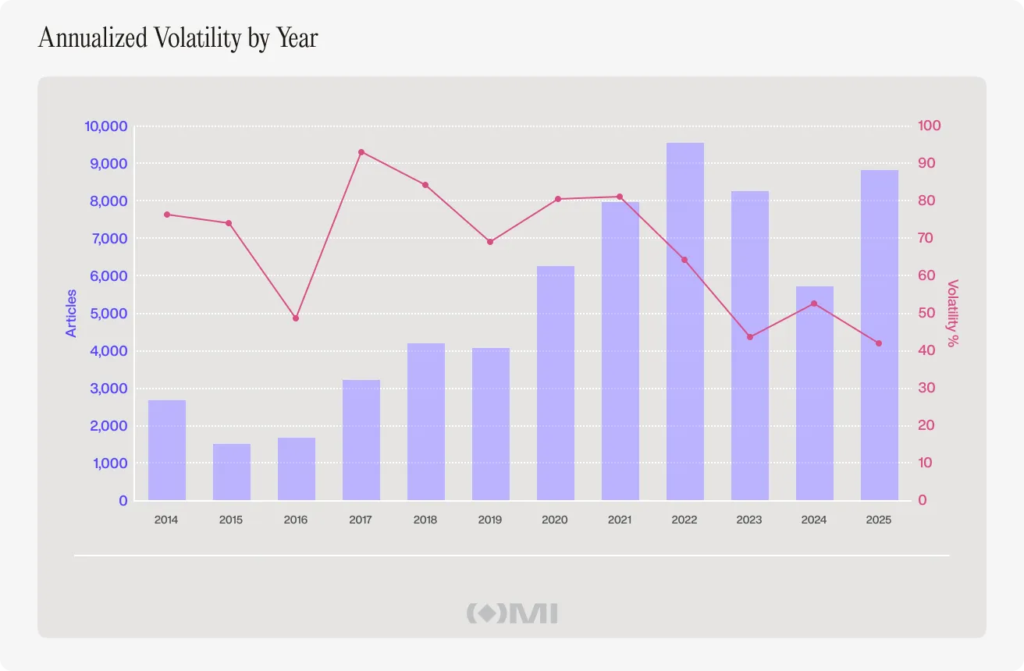
The study crossed 63,926 headlines from a media specialized in crypto, published between January 2014 and December 2025, with the daily closing prices of BTC of the TradingView Composite Index. That generated 4,381 days of comparable news and price data.
The data covers two complete halving cycles, three bull markets, three devastating bear markets (including the COVID crash and the FTX collapse), and the approval of the spot ETF in January 2024. If there is any relationship between news and price, this data set should reveal it.
Four independent methodologies were applied:
- Granger Causality: Does knowing yesterday’s news help predict today’s price?
- Event Study: What does price do in the days surrounding big coverage spikes?
- Sentiment Analysis with AI: Does the Tone of Headlines Predict Returns?
- Thematic analysis: What does the press really cover on its busiest days?
Bitcoin news does not predict its price: the statistical test
The Granger causality Question: If I add news data to a predictive model, does its ability to anticipate the price of bitcoin improve? The study ran this test over five time horizons (one to five days) and in all cases the answer was clear: no.
The raw correlation confirms this: daily changes in item volume versus daily BTC returns yielded a correlation of just 0.019. The news explains 0.04% of what the price does on any given day. For practical purposes: zero.
Bitcoin price arrives before the news
Testing in the reverse direction was more revealing. By identifying the 50 days of the most coverage in the report and tracking the price in the three days before and after each spike, the pattern was consistent: in the three days before the big news spike, the price of bitcoin was already elevated by about 1% above the baseline. The wave of articles then arrived and, afterward, the price fell on average by 0.8% in the following three days.
The most compelling cases speak for themselves. On January 11, 2024, the bitcoin spot ETF was approved, the most anticipated regulatory event in the history of the crypto market. The next day, BTC fell 7.67%. Because? Because a month before, when rumors were spreading without official confirmation, the price had already risen 5% in a single day. By the time the headline arrived, the information was completely discounted. A classic case of “buy the rumor, sell the news.”
The same thing happened in January 2017, when BTC surpassed $1,000.– Headlines celebrated the milestone and the price fell almost 20% in the following three days. And at the epicenter of the FTX collapse (the highest coverage day in the entire datasetwith 100 articles published in a single day), the next day return was a modest +0.72%. Every impact of the shock was already absorbed in the closing price.
Headline Sentiment and Bitcoin Price: No Useful Signal
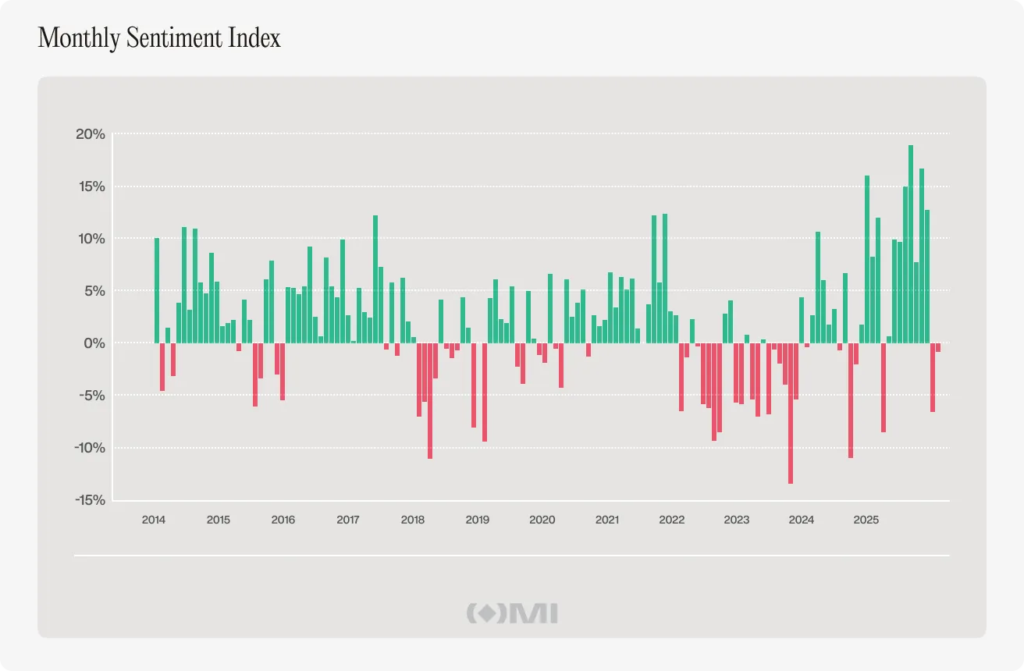
Each holder was processed with FinBERTan artificial intelligence model trained to classify financial texts as positive, negative or neutral. The coverage was balanced: 58% neutral, 21% positive and 21% negative. But the daily tone had no relevant relationship to what the price did the next day.
The correlation between sentiment and returns was just 0.07explaining 0.5% of the movement. Worse yet: Measured in rolling three-month windows, that correlation alternated between positive and negative without any stable pattern. The model does not predict the price; it simply reflects the tone of what has already happened in the market.
Most crypto news is noise with no price signal
On the days with the highest volume of coverage, 61% of the headlines correspond to general diffuse content: blockchain partnerships, financing rounds, stablecoin updates and NFT developments. None of these categories have a clear link to the price of bitcoin.
Regulation represents 21% and is the only category where direct causality would be expected. Even so, it did not produce a systematic signal either. The most surprising finding was the complete absence of halving among the thematic clusters of extreme coverage days, even though two halvings occurred during the period.
Why this finding matters for bitcoin investors
By the time a headline appears in the major crypto media, the information has already traveled through faster channels: order flow, on-chain data, social networks and insider networks. The headline is the last step in a relay of information. Trading on it is like reading yesterday’s weather forecast to decide whether to bring an umbrella today.
Hundreds of millions of dollars have been invested in platforms following news-based signals and sentiments. This study does not suggest that they are fraudulent. Instead, it suggests that they are solving a problem that may not exist at the daily frequency.