
Woo does not detect a confirmed trend change, yet.
The trader suggested that bitcoin could fall to $30,000.
Willy Woo, financial markets analyst, warned yesterday, April 5, that the price of bitcoin (BTC) has not yet bottomed out, despite the recent rally that took its price to touch $70,000. According to his reading, the current movement does not confirm a trend change and the bear market could continue.
In a series of posts on his X account, Woo explained how market floors are usually formed. “Three things happen at the end of bear markets,” he noted.
First, the price of the asset clearly breaks the base cost of recent investors, which currently stands at $81,000. That is, the average price at which the last market participants bought in a period of 155 days, which implies that many of them become at a loss.
The second is that the market’s enthusiasm runs out and a phase of capitulation appears. The third is that a new wave of purchases raises that base cost again, which appears on your graph when the line goes from red to green.
At that point, many investors stop expecting immediate rises and the market begins to clear weak positions. If new demand then comes in, the price begins to recover and pushes that base cost up again, a sign that the market is absorbing selling pressure.
To support his thesis, Willy Woo shares a graph showing the realized price of the most recent investors.
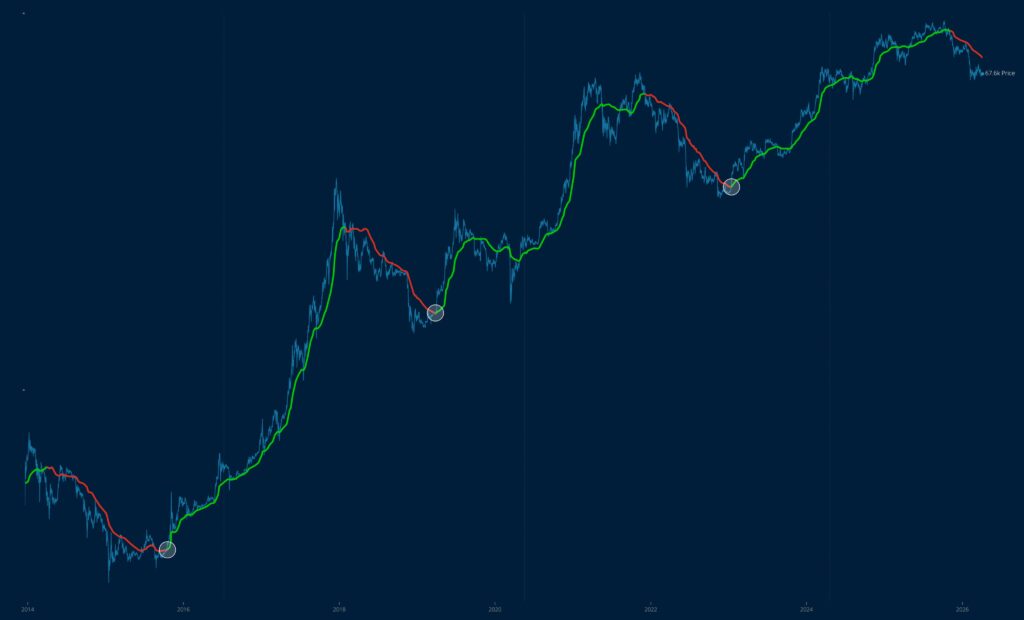
As seen, the blue line shows the evolution of the price of bitcoin over time. A line appears on this curve that changes between red and green depending on the relationship between the price and the base cost of recent investors.
When that line is displayed in red, it means that the price of BTC is below the acquisition cost of those recent buyers, a sign that Woo associates with market weakness and a bearish phase. When it turns green, it indicates that the price of the asset was once again above that base cost, something that historically coincided with the beginning of new bullish phases.
Furthermore, the gray circles mark moments in which the price pierces that base cost, episodes that, according to the analyst, They usually appear near the final phase of bear markets.
In Woo’s reading, that process still did not leave sufficient confirmation in the current cycle, Therefore, it is considered that the final floor is not yet secured. “Given that the price is very far from the acquisition cost of recent investors, and that this cost decreases every day, it does not make sense to buy until the change in trend is imminent. Bearish markets require patience,” he indicated.
Likewise, the analyst listed a series of indicators that should be confirmed before talking about a trend change. Among them, he mentioned that financing in the futures markets returns to higher levels and that open interest increases, signs that would indicate the return of liquidity on the buy side.
Woo even raised a more extreme scenario. In the event of a severe global recession, similar to those of 2000 or 2008, The market could become strongly risk-averse and drive BTC to lows in the $16,000 to $30,000 range.
Woo’s position contrasts with that of Michaël van de Poppe, financial market analyst, who in recent hours adopted a more optimistic tone. In a message posted today, April 6, he noted: “Strong momentum in the BTC markets. Volatility is increasing, and I think there will be a lot of tension this week, as we could be reaching the final phase of the entire situation in the Strait of Hormuz.”
The analyst even set a key technical level. “If bitcoin breaks above $71,000, then the markets will face a test at $80,000,” he said.
The geopolitical factor behind the market
The macro and geopolitical context continues to be decisive. The market awaits concrete definitions for tomorrow, Tuesday, when the ultimatum posed by Donald Trump to Iran expires.
Part of the recent rally in BTC could be linked to expectations of a de-escalation of the conflict or a possible unblocking of the Strait of Hormuz, a strategic route through which nearly 20% of the world’s oil circulates, as explained by CriptoNoticias.
If this scenario comes to fruition, it could alleviate inflationary pressures and improve global liquidity conditions, which would favor assets considered risky, such as BTC. However, if the tension is maintained or escalates, the impact could be the opposite.