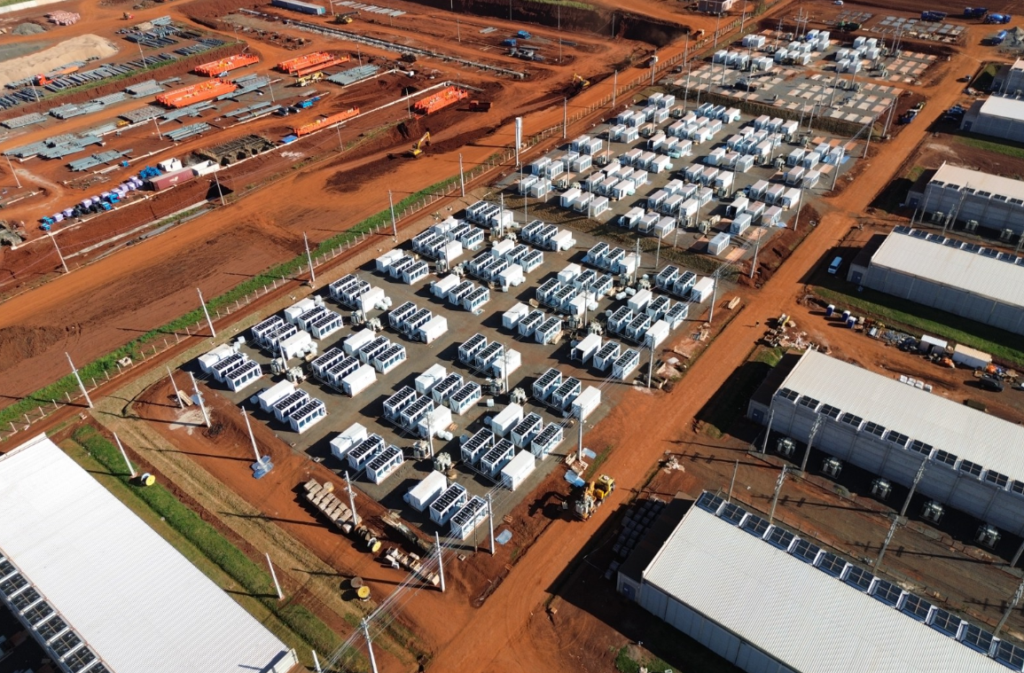
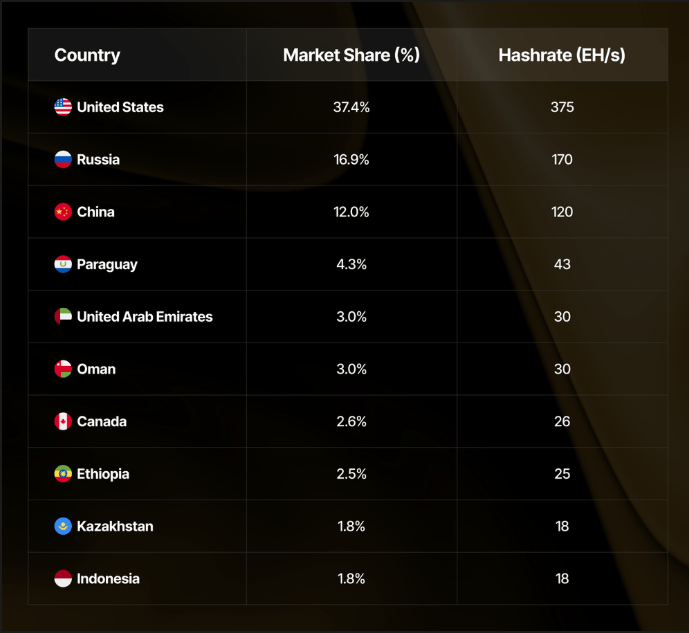
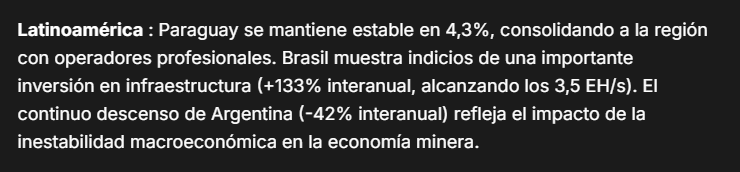
Paraguay maintains 4.3% of the world hashrate with about 43 EH/s, powered by energy from Itaipu.
Brazil applies zero tariff to imports of efficient ASICs from February 2026.
Bitcoin mining is redistributing its computing power to South America, driven by a drop in profitability that is putting the world’s least efficient operators out of business. While the global market adjusts its margins after the drop in the price of the pioneering digital currency from $124,000 in October 2025 to $65,000 in February 2026, Paraguay and Brazil emerge as strategic refuges. In these countries, the activity is already seen as a tool to manage surplus renewable energy rather than a problem for the environment.
This operational readjustment is detailed in the report Global Hashrate Heatmappublished by Hashrate Index on April 6. The data reveals that global computing power, which recently surpassed the zettahash mark (over 1,000 EH/s), It contracted 5.8% in the second quarter of 2026, stabilizing at 1,004 EH/s.
The reduction responds to the fact that the hashpricethe metric that measures daily revenue for each processing unit, reached historic lows, making equipment with an efficiency greater than 25 J/TH unviable.
In this context, the United States remains the stable anchor of the sector. Despite the global contraction, the country increased its hash rate by 39% year-on-year to reach 375 EH/s.
Under these conditions, the technological gap has become decisive. Latest generation models such as the Antminer S21 Pro, the Whatsminer M63S and the Avalon A1466I maintain positive margins thanks to their low consumption per terahash.
On the contrary, teams that were pillars of the industry, such as the Antminer S9 or the Whatsminer M20S, currently operate at losses in most electrical networks, becoming models withdrawn from the global market.
Paraguay and the use of Itaipu’s surplus
In Paraguay, the strategy to capture this activity focuses on the use of the Itaipú dam. The state-owned ANDE facilitates the integration of projects that consume excess hydroelectric energy, such as the Yguazú plant of the Canadian HIVE Digital Technologies, as CriptoNoticias recently reported.
By acting as a flexible buyer, Digital mining makes it possible to monetize surpluses that the national network cannot absorbwith an income projection for the State of 125 million dollars towards the end of the year.
However, the model generates internal debate. This is because sectors of civil society they question whether this intensive industrial demand could compromise the stability of residential supply in the future.
Brazil, for its part, opts for tax incentives to attract highly efficient hardware. From February 2026, the government eliminated tariffs for high-performance ASICs (Application Specific Integrated Circuits), incentivizing companies like France’s ENGIE to study installing data centers at solar plants like Assu Sol.
“We are evaluating storage systems or Bitcoin mining data centers to make installation more economical,” declared the firm told Reuters, in reference to the need to take advantage of the energy generated that is not injected into the grid.
Despite regional progress in South America, the network’s computing power remains markedly polarized: the United States, China and Russia together control 65.6% of the world’s hashrate. However, this hegemony coexists with a gradual diversification in other latitudes.
The constant rise of Ethiopia, which climbed from tenth to eighth place in the last year, added to the strengthening of positions in the Middle East and Southeast Asia, signals an expansion towards new energy frontiers that begins to challenge the concentration in the traditional poles.
This transition indicates that Bitcoin infrastructure is mutating towards a survival model based on extreme efficiency and energy integration.
While the global hashrate stabilizes after the contraction, the permanence of Paraguay with 4.3% of the world share and the progress of pilot projects in Brazil outline a change in the geography of miningwhose consolidation will depend on the evolution of operating costs in the coming months.