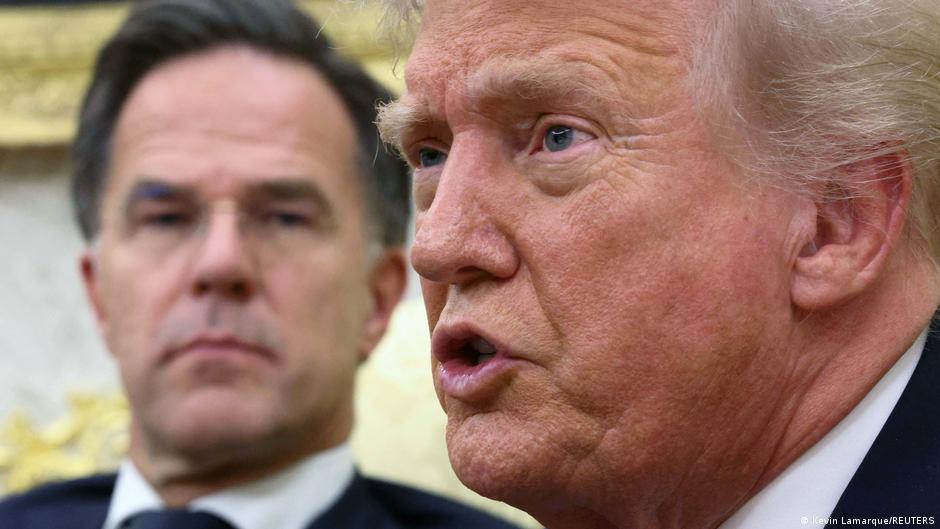
“NATO is broken,” Ivo Daalder said, not mincing his words. The former US ambassador to the trans-Atlantic alliance believes tensions between Donald Trump and European allies over the Iran war have thrown NATO, which turns 77 this month, into the “worst crisis” in its history.
But alarm bells have been ringing for some time. Already a year ago, Daalder published an article Outlining how European member states can rebuild NATO to function without the US, under whose leadership the organization was created.
How did we get here?
Dalder, a senior fellow at Harvard’s Belfer Center, told DW that several factors have brought NATO to this low level. It is not just Trump’s insult to the alliance and its European members to which they have become quite accustomed. Trump on Monday reiterated his view that NATO is a “paper tiger” that would not support the US in a war against Iran.
Nor, the former ambassador said, is it even Trump’s repeated threats to withdraw from NATO that have to do with the more practical concern that if another ally were attacked it would be unwilling to participate in the collective defense guaranteed by NATO’s Article 5.
Daalder said it’s a combination of Trump’s hawkishness and the fact that many European governments are now refusing to help Washington’s war against Iran, citing examples such as refusing to give Trump the right to use bases or the right to airspace for offensive action.
He said, “European actions are a reflection of the fact that NATO has been deeply damaged, and it reinforces the fundamental reality that Europe no longer trusts the United States, believes the United States is an unreliable ally, and is therefore no longer willing to participate in such operations. That is why this is NATO’s worst crisis.”
NATO Secretary General Mark Rutte has supported the US-Israeli action and downplayed the rift. “In a coalition, you will always have different views,” he said on March 26.
Can Trump go now?
Trump himself has often publicly considered walking out, recently saying the possibility was “beyond reconsideration.” But no one knows for sure whether he will someday try to withdraw from the alliance.
It is known that this will not be easy, thanks in part to his current Secretary of State, Marco Rubio, who, as a senator, introduced legislation passed in 2023 that requires two-thirds of the Senate’s support to step down.
Three years later, Trump insists he would be able to do it somehow — and Daalder agrees with him, saying the constitutional challenge it might pose would be too much in favor of the president’s power. Meanwhile, Rubio appears to have transformed into a NATO skeptic.
On the NATO side, there is an article in the 1949 Washington Treaty outlining the process of leaving, but it had never been used before. Article 13 states that: “After the treaty has remained in force for twenty years, no party may cease to be a party until one year after a notice of denunciation has been given to the Government of the United States, which shall notify the Governments of the other parties of the deposit of each notice of denunciation.”
Of course, there are many ways Trump could bring NATO to its knees without abandoning it and without getting congressional approval. He could easily decide to bring troops home, cut off the supply of personnel to NATO commands and institutions – some of which is already happening – and even, very dramatically, decide not to staff the post of Supreme Allied Commander Europe, a military post that has always gone to an American.
How will NATO react?
It will be difficult for NATO to project credible power without the US, which has the largest and most advanced arsenal of weapons and a clear advantage in comparative force. But experts say that it is not necessary that the alliance breaks. This could continue the transition that is already underway towards greater European leadership and reliance on European capabilities.
The International Institute for Security Studies (IISS) has researched what this might look like, “urging European decision makers to consider the military, financial and defense industrial investments needed to reduce dependence on the US and, in the extreme, to prepare for a NATO without any US role.”
The picture is not rosy. Done about a year ago, IISS evaluation Found that there would be serious shortfalls not only in replacing “major US military platforms and manpower” but also in space and intelligence, surveillance and reconnaissance assets. It found, “They will also be required to replace the significant US contribution to NATO’s command and control arrangements and to fill many senior military positions in NATO organizations that are currently occupied by US personnel.”
The study estimated that an estimated trillion dollars of additional financing would be required by European NATO members on top of already growing defense budgets.
Nick Whitney, a former British Defense Ministry employee who now works with the European Council on Foreign Relations, told DW that his “strong view is that we no longer need the United States.” While Whitney said that “the more American troops stay in Europe for a longer period of time, the happier I should be and the happier all Europeans will be,” he does not believe that “if Trump turned around tomorrow and said, ‘Okay, we’re all coming home, we’re with you and you can forget about my nuclear guarantee,’ I really don’t think all will be lost.”
He noted that part of this is due to recent overtures made by French President Emmanuel Macron to several other allies about increasing nuclear cooperation outside NATO, as France does not currently make its capabilities available to the alliance.
shaking nerves, firm stance
Estonian Foreign Minister Margus Tsahkana is perhaps the only European leader to announce that his country is ready to help the Trump administration in Iran even before the war ends. But despite all the US accusations of lack of support, he said no actual requests have been made.
Tsahkna said the reason for his offer was to pay it forward. “Of course, it [anti-NATO] The narrative is not good,” he told DW. “Estonians are asking me and many other politicians every day whether Article 5 of NATO is working or not.” Tsahkana advises all of Europe to “remain calm, focus on what we can do and of course we need to constantly talk to the US administration,” reminding them that the US also needs Europe.
It will certainly be a key talking point for Rutte as he visits the White House on Wednesday, hoping, as he has done before, to get a positive response on NATO from Trump. In remarks Monday, Trump called Rutte himself a “great guy” but once again criticized European and other countries for failing to get involved in the Iran war.
Trump ended his press conference with a cryptic, perhaps ominous, statement: “We want Greenland. They don’t want to give it to us. And I said, ‘Goodbye.'”
Edited: R. How