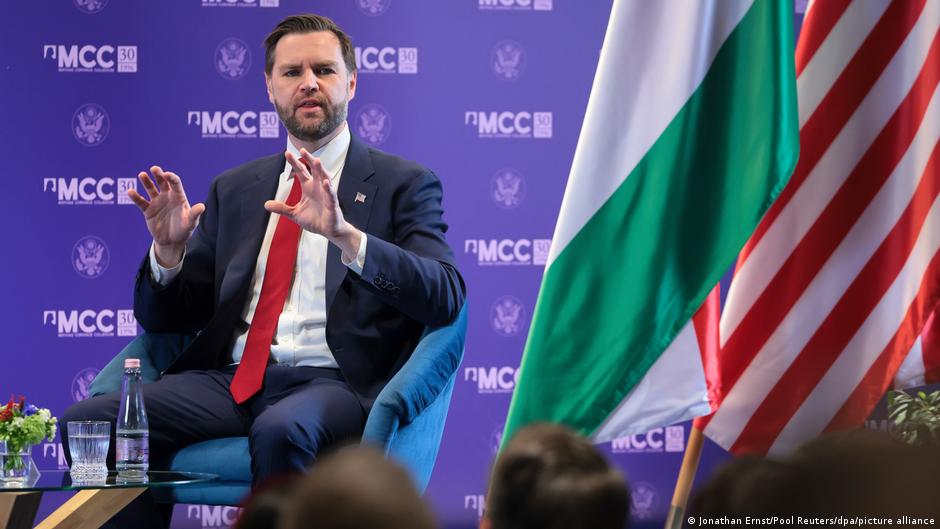
US Vice President JD Vance welcomed the sudden temporary ceasefire in Iran, but also focused on the war in Ukraine and its impact on Budapest on the second day of his visit to Hungary on Wednesday.
Visiting the country just days before Prime Minister Viktor Orbán ran for a sixth term, Wences was far behind his fellow right-wing opponent Peter Magyar in several polls, Wences touched on several of the veteran populist’s main campaign points.
What did Vance say about the war in Ukraine, Europe and Zelensky?
Vance said the Trump administration had made “significant progress” in its efforts to stop the Russian invasion of Ukraine and broker an agreement between Kiev and Moscow, but acknowledged that it was “the hardest war to resolve.”
“In some ways we thought this would be the easiest, but it’s been the hardest,” Vance said.
He criticized European leaders while praising Orbán for his behavior amid the diplomatic standoff, possibly the NATO leader who maintained the closest ties with Moscow during the war.
“We have been disappointed by a lot of the political leadership in Europe because they are not particularly interested in resolving this particular conflict,” he said.
Meanwhile, European governments counter that although they want to end the conflict, it should be called a just peace and not tantamount to a partial Ukrainian surrender.
Vance said he is optimistic that the fighting can ultimately be stopped, “because fundamentally this war no longer makes sense.”
However, he added that “it takes two to tango.”
“We’re talking at this point about bargaining over a few square kilometers of territory in one direction or the other, is it worth losing hundreds of thousands of additional Russian and Ukrainian men?” he asked. “Is it worth additional months or years of higher energy prices and economic devastation?”
Why is Ukraine one of Orbán’s main talking points?
Orbán’s political difficulties at home arise not from his foreign policy positions, but from domestic scandals such as corruption and child sexual abuse scandals in state-run institutions. His opponent Peter Magyar is a former nationalist ally who has not focused on international affairs in his campaign, or indicated any plans for wholesale change.
If anything, Orbán maintains his image as a strong experienced leader willing and able to confuse other European leaders in Brussels. He is making criticism of the EU and Kiev a cornerstone of his election campaign.
Vance quipped that Orbán was the European leader most helpful to America’s faltering diplomatic efforts.
“Victor has been most helpful, because it’s Victor who has encouraged us to really understand this, from the perspective of both the Ukrainians and the Russians, to understand what is required for them to end the conflict,” he said.
Hungary has been in a dispute with Ukraine for weeks, which has escalated amid rising fuel prices and the war in Iran after Russia blocked oil supplies through a pipeline passing through Ukraine.
Ukraine says the pipeline was damaged by Russian bombing, Hungary says it doubts this version of events. Landlocked Budapest was exempted from EU sanctions on buying Russian oil due to its high dependency.
As a result, Orban is blocking a major EU loan package for Ukraine, which was originally agreed upon in December. Vance opened debate on the issue on Wednesday.
Vance described Ukrainian President Volodymyr Zelensky’s response to Orbán’s obstruction as “reprehensible”. Zelensky informed that he could give Orban’s address to the Ukrainian military.
Over Easter, Serbia and Hungary alleged that they had uncovered an effort to deliver gas to another Russian pipeline, known as Balkan Stream. Ukraine said it knew nothing about the alleged case.
Russia reiterates Vance’s criticisms, Berlin calls claims hypocrisy
Before a campaign rally with Orbán late Tuesday, Vance accused the EU of “shameful” election interference in Hungary, calling it “one of the worst examples of foreign election interference that I have ever seen or even read about.”
A few hours later he would tell the cheering crowd, “We have to get Viktor Orbán re-elected.”
Kremlin spokesman Dmitry Peskov agreed with Vance on Wednesday.
“Many forces in Europe, many forces in Brussels would not want Orbán to win re-election,” Peskov told reporters in Berlin. bloombergOf the conversation between Orbán and Russian President Vladimir Putin last year.
Peskov said, “This is well known, it is obvious to the naked eye, and of course, they are playing into the hands of those forces who politically oppose Orbán and believe that publishing such materials could harm them.”
A number of allegations have surfaced this year indicating inappropriate relations between Budapest and Moscow.
Meanwhile, in Berlin, a government spokesman denied Vance’s allegations of election interference and tried to overturn them. He said the fact that Vance was in Hungary “already shows, or speaks for itself, who is interfering in what.”
What is the political situation in Hungary a few days before the general elections?
Most polls in Hungary put Orban behind a estranged nationalist rival and former member of his Fidesz party, Peter Magyar. Some even say the gap is huge, but the scale of their difference is astonishing and government-aligned institutions give Fidesz the edge over Magyar’s Tisza.
In any case, this is certainly the star challenge Orbán has faced in the elections in years.
The 62-year-old was prime minister from 1998 to 2002, then leader of the opposition for two legislative periods, before returning to the top post in 2010 and has held the post since.
Magyar’s Tisza hasn’t really tried to campaign on foreign policy or Ukraine or the EU, if anything trying to position itself as akin to an improved Fidesz.
It has focused primarily on domestic issues such as corruption in one of the EU’s poorest member states and the long-running child sexual abuse scandal in state-run institutions.
Edited by: Kieran Burke