Some things are hard to calculate in dollars and cents. NASA’s space programs certainly fall into this category.
The agency has a huge annual budget, and its portfolio includes powerful spacecraft, telescopes, and weather and asteroid forecasts.
More difficult to measure are the scientific and material benefits arising from basic research that have entered everyday life, such as memory foam, scratch-resistant lenses or home air purifiers.
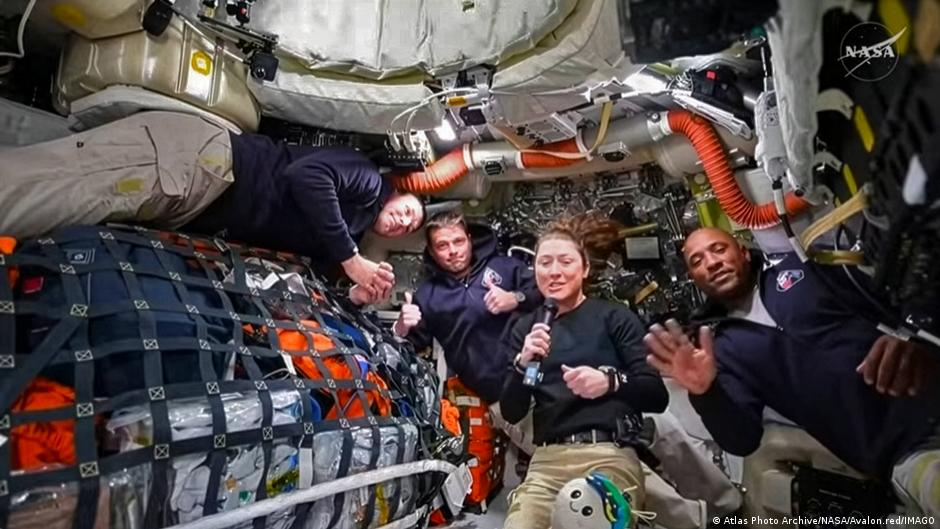
But when the Artemis II mission made history when the Orion capsule carried four astronauts farther from Earth than any human being in history, many people questioned the cost and overall point of space travel.
Artemis II, Orion and $93 billion
During its 10-day mission, a lot of attention has been focused on Artemis II’s onboard toilet. Not only is it in disrepair, it also cost an estimated $23 million (€19.6 million).
Like previous projects, Artemis II was designed by NASA but assembled by aerospace companies such as Boeing, Northrop Grumman, and Lockheed Martin.
The cost of building and launching a single Orion crew capsule is about $1 billion, according to a report by NASA Inspector General Published in November 2021.
Add $300 million for a “service module” providing power and life support, which was supplied by the European Space Agency.
The launch vehicle including the rocket boosters – called the Space Launch System – costs about $2.2 billion, and finally $570 million for the necessary ground infrastructure, including the mobile launcher.
This means that each flight from Artemis I to IV cost approximately $4.1 billion.
The report rebuked the agency for a lack of reliable accounting, but still estimated $93 billion for the Artemis project by 2025.
What do Americans get for their money?
NASA is the world’s most famous space agency and has had some spectacular ups and downs. It has used more than $1.9 trillion in cumulative funds since 1958, adjusted for inflation.
In his first term, President Donald Trump pushed for NASA to return to the Moon. But in his second term, he proposed cutting his 2026 budget by about 25%, although most of these requests were rejected by Congress.
Additionally, the agency was hurt by the Department of Government Efficiency (DOGE) and its efforts to cut federal employees. About 4,000 employees have left or will soon leave, about one-fifth of its former workforce.
In December, Trump doubled down on his effort to return to the moon and signed an executive order to expand the US presence in space. The goal is to return Americans to the Moon by 2028 and establish a permanent lunar outpost by 2030 – including nuclear reactors – that would serve as a stepping stone to a human mission to Mars.
Pride and American national security
Americans are generally supportive of NASA, but are more skeptical when it comes to human missions to space. On the other hand, most American politicians have been longtime fans.
At the beginning of the Space Age, many in Congress saw it as a duty to defeat the Soviet Union.
Today, many see a need for America to lead in planetary exploration and low-Earth orbit where thousands of satellites and the International Space Station operate quietly.
“Make no mistake, we are in a new space race with China,” warned Senator Ted Cruz at a Senate committee hearing last fall.
“China has made no secret of its goals,” Cruz said. “It is investing heavily in its space capabilities, maintaining a permanent presence in low Earth orbit with its Tiangong Station, and working to plant its flag on the Moon by 2030.”
To fund this “new space race”, Congress allocated $24.4 billion to NASA for 2026, which is about 0.35% of all federal spending.
of agency Budget request for 2027 The $18.8 billion mark is a substantial decrease and marks the Trump administration’s second attempt to cut funding by nearly 25%.
The plan envisions a major increase in space for scientific research and exploration and reductions to the International Space Station, aligned with a focus on the Moon and Mars. Most industry watchers think Congress will keep funding at the same level.
Commercial space interests and long timelines
Only governments do not have their eyes on the sky. The growth of commercial space companies like SpaceX and Blue Origin, or talk of data centers in space, means that a huge space economy is coming online.
SpaceX will play a key role in future missions to the Moon. Its Starlink division is responsible for many of the estimated 10,000 satellites. Undetected space debris is a growing concern.
“Space has completely changed in the last few years,” European Space Agency Director General Joseph Eschbacher said in an interview with DW at the World Economic Forum in January.
Eschbacher says strong business actors and governments are realizing how important location is. Autonomy and freedom are more important than ever and greater investment in defense and security is needed.
Additionally, space projects often require 10 years or more to get off the ground.
“Space has become so strategic, so important, so commercially interesting that we really have to shift gears and do things very differently,” Eschbacher said.
Combining these interests and huge investments will be a challenge. It may require extraordinary effort to persuade governments, companies and taxpayers to get involved.
Edited by: Rob Mudge