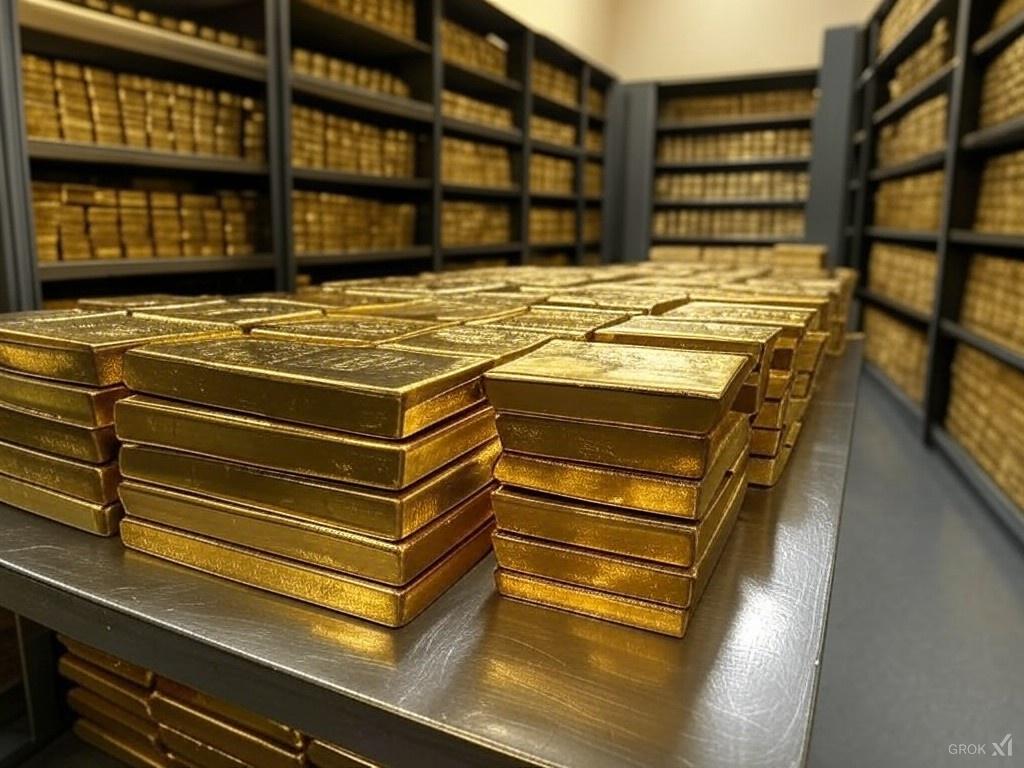
China and emerging powers lead gold purchases, reaching a value of 4 trillion dollars.
The use of bitcoin in Hormuz tolls allows Iran to settle payments outside of Washington’s control.
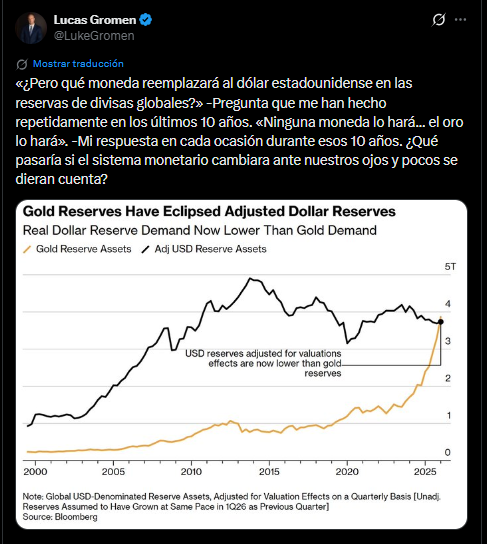
The map of global wealth is undergoing a silent but profound metamorphosis that, for the first time since 1996, the value of gold in central bank reserves exceeds that of US Treasury bonds.
This crossing of lines, confirmed by Bloomberg data on April 9, marks the closing of a three-decade cycle in which US debt was the undisputed refuge.
Together, the World Gold Council projects that heCentral banks will add up to 850 additional tons by the end of 2026consolidating a reserve value that is already close to 4 trillion dollars, exceeding the current valuation of the US debt (above 39 trillion dollars).
The phenomenon responds to a combination of economic and strategic factors. On the one hand, Gold Price Hits Record Highs as Bond Values Suffer due to the high interest rate environment.
On the other hand, analysts like Luke Gromen point to a geopolitical background: Given the use of the dollar as a sanction mechanism by the West, various nations are accelerating the diversification of their portfolios towards assets that do not depend on an issuing government. “There is no currency that can replace the dollar; gold will simply take its place,” Gromen maintains.
The leadership of this movement lies mainly with emerging economies, with China at the forefront. The People’s Bank of China maintains a streak of 17 consecutive months of acquisitions, officially accumulating more than 2,300 tons of gold. Although analysts suggest that actual holdings could be significantly higher.
Added to this effort are countries like Poland and Indiawhich compensate for the slower performances of Russia and Türkiye, which have begun to monetize part of their metal to finance internal deficits or defend their local currencies.
Bitcoin enters the scene
The search for alternatives to the traditional financial system does not only point to gold, but also to digital currencies. This fact has its most acute exponent in the Strait of Hormuz. On this route, through which 20% of the world’s oil transits, Iran now demands payment of tolls in bitcoin (BTC), yuan or stablecoins, as reported by CriptoNoticias.
For Tehran, excluded from the SWIFT payment system, the use of digital assets allows settlements in seconds that bypass conventional banking blocks, transforming an operational necessity into a precedent for energy trading outside the dollar circuit.
However, the extent of this transition is still the subject of debate. While some analysts see the rise of gold and the use of bitcoin an irreversible “de-dollarization”, others warn that The dollar remains the predominant currency in global commercely what the strengthening of gold It is, in part, a reflection of persistent inflation.
What the data confirm is a fragmentation in monetary confidence. Central banks are increasing their exposure to hard assets to protect themselves from geopolitical uncertainty and high sovereign debt.
In this new scenario, The monetary system seems to be moving towards a hybrid modelwhere the security of States no longer rests solely on a national currency, but on the combination of precious metals and decentralized settlement technologies.