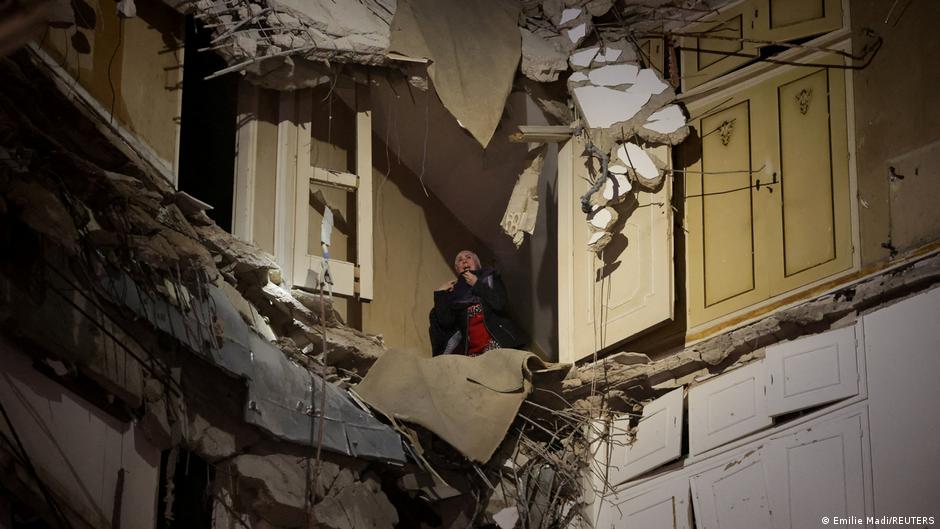
Lebanon’s national day of mourning on Thursday did not hamper efforts by local and international rescue teams searching for survivors in Beirut. The sound of machinery clearing debris broke the silence of the deserted streets, while a thin curtain of smoke still remained over the worst-hit parts of the city.
“What are we going to do with our lives? Where are we staying, and where are we going?” a local in Beirut told Reuters news agency.
The simultaneous Israeli attacks on Wednesday killed 303 people and injured 1,150, according to Lebanese health officials. Doctors Without Borders confirmed a large influx of injured patients, including children, into Beirut’s Rafik Hariri Public Hospital.
The latest attacks between Israel and Hezbollah underscore conflicting views on whether Lebanon should be included in Tuesday’s ceasefire between Iran and the United States. Iran says the agreement includes Lebanon while the US and Israel say it does not include Lebanon.
The attacks also mark a further escalation of the conflict in Lebanon, which intensified in early March when the country was embroiled in a broader Middle East war after Hezbollah attacked Israel following the assassination of Iran’s supreme leader Ayatollah Ali Khamenei.
Since then, Israeli airstrikes and limited ground offensives have killed 1,888 people, according to Lebanese officials. About 1.2 million Lebanese have been displaced.
Additionally, the Iran-backed Hezbollah militia, whose military wing is classified as a terrorist organization by the US, Germany and several other countries, fired rockets at northern Israel and attacked Israeli troops in what it called “violations of the ceasefire by the enemy”.
humanitarian crisis
The current crisis in Lebanon worsens an already fragile humanitarian situation. Lebanon has been beset by a series of political and economic crises since 2019, as well as the devastating port explosion in August 2020 and the war between Hezbollah and Israel in Lebanon in 2024.
“Thursday evening, additional evacuation orders triggered another wave of panic and displacement,” Rabih Torbay, CEO of the aid organization Project Hope, told DW. He arrived in Beirut an hour before the attacks began on Wednesday. “People across the city and country are living in fear of further similar strikes, considering every action carefully,” he said.
Torbay noticed that more and more families were sleeping in their cars on the streets, in parking garages and in public places throughout Beirut. “Some ‘lucky’ people have managed to set up tents on the beach in downtown, but it is still cold here (14-17 degrees Celsius), and many fled with nothing but the clothes on their backs,” he said.
“The situation has turned into what we call a ‘perfect storm,'” warned Blerta Aliko, the UN Development Program representative in Lebanon, in an interview with UN News on Thursday.
“This is a complex crisis,” he said. As she was speaking, air strikes on Beirut forced Aliko to relocate to a shelter.
For Lebanese civilians, who have borne the brunt of several rounds of conflict between Israel and Hezbollah, life has become incredibly difficult. “What did I lose my home for? For Iran? Hezbollah, wake up, this is your country, not Iran,” one woman was quoted as saying by news agency dpa on Thursday.
“My parents are in Beirut,” Lebanese entrepreneur and philanthropist Lynn Zovighian told DW. He flew to Saudi Arabia’s capital Riyadh just before the latest tensions escalated. “I hate that they have to go through this horrible experience without me being with them,” she said. “Our flexibility is not the solution,” he said.
“Food supply for a week”
Those who decided to remain in southern Lebanon despite Israeli relocation orders are at increasing risk of being cut off from humanitarian aid, food and health care. Israeli forces are damaging key infrastructure, including all major bridges connecting the north and south banks of the Litani River in the Tire area.
“Thousands of people are still living there,” Ramzi Kais, Lebanon researcher for Human Rights Watch, told DW. “Residents we spoke to in the southern city of Tyre told us that if the last main bridge, the Qasmeh Bridge, was completely destroyed, the food supply would only last a week,” he said.
According to Israel, an area of southern Lebanon, a traditional Hezbollah stronghold that covers about 10% of the country, will be used as a “buffer zone”. Israeli Defense Minister Israel Katz said in March that thousands of displaced south Lebanon residents “will not return south of the Litani River until Israel guarantees security for residents north of it”. Finance Minister Bezalel Smotrich earlier this week called for the Litani River to become Israel’s new border with Lebanon.
For Israel, it is important to see Hezbollah disarm, as stipulated in the ceasefire from November 2024. Israel claims that as long as Hezbollah has its weapons, it remains a threat.
Hezbollah is refusing to disarm overall, citing the need to be able to defend against ongoing Israeli attacks on Lebanon and Israel’s military occupation of five military bases along the border.
The Lebanese and Israeli governments have now confirmed direct talks in Washington next week. Such talks would mark a breakthrough as the countries do not have diplomatic relations and have been officially at war since 1948.
Lebanese President Joseph Aoun said, “The only solution to the current situation in Lebanon is to achieve a ceasefire with Israel.”
Israeli Prime Minister Benjamin Netanyahu said that direct talks with Lebanon would focus on the disarmament of Hezbollah and achieving a “historic, lasting peace agreement between Israel and Lebanon.”
However, Hezbollah has already made clear that they oppose direct negotiations and it is unclear whether Lebanon actually has the capacity to disarm them.
“Of course, the main dispute in Lebanon remains unresolved: Israel has vowed not to tolerate armed Hezbollah on its northern border, while Hezbollah is disgusted by Israel’s growing occupation of Lebanese territory,” David Wood, senior Lebanon analyst at the International Crisis Group, said in a statement.
He said, “Even if the US could impose a desperately needed ceasefire, Lebanon would remain on a knife’s edge: on the verge of plunging into another round of devastating conflict indefinitely.”
Edited by: Andreas Illmer