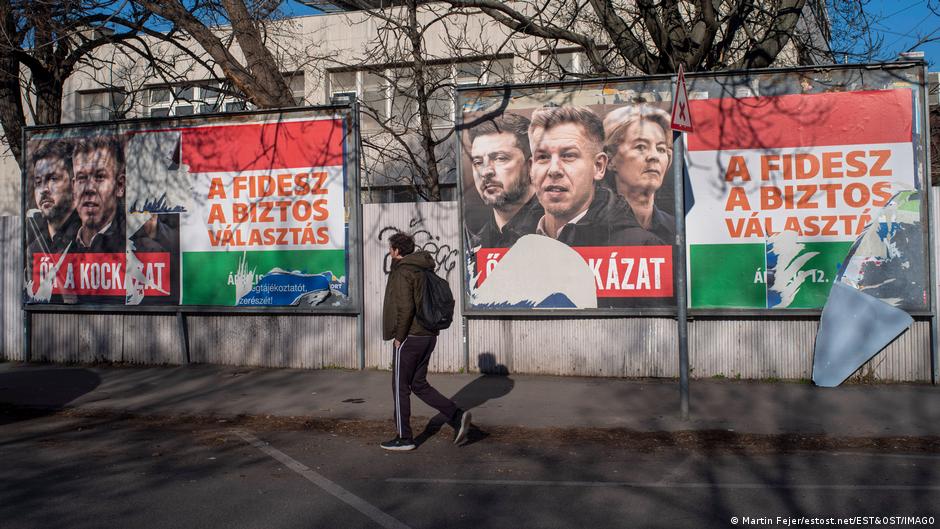
Hungary is preparing for its most consequential election in years, with longtime nationalist leader Viktor Orban facing an unprecedented challenge to his 16 years in power.
Political newcomer Peter Magyar and his centre-right Tisza party are leading in most opinion polls. A poll released Friday by Hungary’s Publicis Institute shows Tisza ahead of Orban’s Fidesz party by a margin of 38% to 29%.
However, with 25% percent of respondents saying they were undecided, the survey shows that the outcome of Sunday’s election is far from certain.
Another poll published by IDEA in Hungary on Thursday showed a similar result, with 39% to 30% in favor of Tisza, while more than 20% were undecided.
Ahead of Sunday’s voting, both major parties are accusing each other of election interference.
Opposition showing confidence
As election day approaches, Magyar on Friday warned against interference in the election at the hands of Orbán.
“The series of criminal acts, intelligence operations, disinformation and fake news, as well as months of electoral fraud by the ruling party Fidesz, cannot change the fact that Tisza is going to win this election,” Magyar said in a Facebook post.
“Viktor Orbán will be removed by the same people…he has abandoned and betrayed millions of Hungarian citizens.”
He urged Hungarians “not to succumb to any kind of provocation” and “called on the late Prime Minister to accept the decision of the Hungarian people with due calmness and dignity”.
Orban issued his own allegations of election irregularities on Friday.
“Our adversaries will stop at nothing to seize power,” Orbán said in a video posted on social media. He accused the opposition of “colluding” with foreign intelligence and threatening his supporters with violence.
“This is a concerted effort to use chaos, pressure and international notoriety to question the judgment of the Hungarian people,” he said.
Orbán’s statement alleging foreign collusion came days after US Vice President JD Vance delivered a speech at a campaign event for the Hungarian leader in Budapest. On Friday, US President Donald Trump urged Hungarians to “get out and vote” for Orbán, a rare example of a US president campaigning on behalf of a foreign leader.
What is at stake in the elections?
Tisza has presented himself as an anti-corruption alternative to what he sees as Orbán’s self-serving authoritarianism.
Since being elected in the wake of the EU financial crisis in 2010, Orban has tightened control over Hungary’s courts, sidelined NGOs and shuttered critical media outlets. He is a strong ally of Russian President Vladimir Putin and has used Hungary’s veto power in the EU to block sanctions on Russia and aid to Ukraine.
Orban’s ruling coalition has also used its two-thirds majority in parliament to set up an electoral system that increases Fidesz’s dominance through redrawn districts and expanded single-member seats.
Tisza says Hungary suffers from Orbán’s corruption and clientelism, while pointing out that democratic backsliding has led to the country being cut off from EU funding. Magyar has promised to crack down on corruption, unlock billions of euros of frozen EU funds, tax the rich and overhaul the healthcare system.
Hungary’s ‘last chance?’
“Just a few more days and we will see a change of power,” Magyar said at a rally in the city of Baja on Wednesday.
In an interview with Reuters news agency, Magyar said the election would decide whether Hungary would slide further into authoritarianism or reestablish its place in Europe and revive its economy.
“This is the last chance … to prevent our country from becoming a Russian puppet state … let’s not allow Hungary to leave the EU,” he said.
Orbán has framed the election as a choice between “war or peace”, claiming that the opposition would drag Hungary into the war in Ukraine, a charge Tisza denies.
“This election is about Hungary’s future. The choice is clear: dependence and decline, or sovereignty, strength and peace,” Orbán said on Tuesday.
Edited by: Carl Sexton