
“Trying to measure the digital economy with tools from the physical world is very difficult,” Bravo says.
Bravo affirms that supervising AI agents is one of the great challenges of the digital economy.
The convergence between artificial intelligence (AI) and the bitcoin (BTC) and cryptocurrency ecosystem has posed a dilemma that global tax systems are not prepared to resolve.
As figures like Changpeng Zhao and Brian Armstrong project a future where AI agents will conduct millions of financial transactions using BTC and cryptocurrencies, a fundamental question arises for governments: how do you tax an entity that has no physical existence or legal identity?
José Antonio Bravo, Spanish economist and tax advisor specialized in digital assets, addressed this problem in episode 24 of the CriptoNoticias podcast, titled “Separating the money from the State.”
According to Bravo, the oversight of these entities represents one of the deepest challenges of todaysince they operate in a dimension that escapes traditional bureaucratic controls. The basis of the problem lies in the ontological nature of these entities.
Bravo points out that, unlike traditional companies or even individuals who operate on the Internet, an AI agent is not a human being who creates a digital identity to interact. It is, in his words, an “entity that does not live in the physical world and that is transacting outside the physical world, in the digital world. “Something absolutely native digital.”
This feature breaks the link necessary for tax collection: the connection between economic activity and a responsible natural or legal person. Hence, the viability of current identification mechanisms is questioned. faced with this new reality.
How are you going to stop an agent who opens his own wallet with a private key and starts transacting with other agents who have their own wallets with a private key? How are you going to identify who is working with that agent and who is working with the other agent?
Jose Antonio Bravo
The lack of an identity linked to know-your-customer (KYC) processes allows these entities to operate autonomously, using digital currency as their natural financial fuel.
For Bravo, trying to apply the current laws of the physical world to this digital phenomenon is a basic error, since we are trying to “measure the digital economy with compartments or with units of measurement that are from the physical world.” which he described as an extremely difficult task.

It is not possible to locate the taxable event
One of the pillars of modern taxation is tax residence. However, in the bitcoin ecosystem, offshoring is the norm. While an AI agent can be hosted on a server in Iceland, have been programmed by a team distributed between Spain and Venezuela, and execute transactions that are settled in a borderless bitcoin address, as Bravo explains.
Bravo highlights that this fragmentation makes it virtually impossible to determine where value is generated. “We are talking about entities that are on the network, which can be replicated on several servers, not necessarily on one located in a country,” he explained.
This reality nullifies the ability of States to apply taxes based on the destination or origin of funds. In short, in a transaction between two AI agents that are not located anywhere, the possibility of taxation becomes null.
Even the idea of sanctioning non-compliance becomes a logistical diatribe. The thing is that, in the event of tax evasion or an infraction committed by an autonomous agent, Justice would face a vacuum of responsibility.
Based on that premise, Bravo raises the doubts that arise in this scenario: «Do you sanction the person who created it? Do you sanction the developer? Do you sanction where the language model hosted server is? “It is very complicated,” he stressed.
AI takes refuge in bitcoin and not in banking
AI adoption of bitcoin is not just a preference, but a technical necessity.
As industry leaders such as Brian Armstrong, CEO of Coinbase, have noted, AI agents cannot open traditional bank accounts because they lack legal personality.
Nor can they appear in a “marble” office, as Dan Morehead of Pantera Capital mentions, to deliver an identity document.
Bitcoin, being a permissionless and open source protocol, allows an AI agent to manage a wallet and send payments globally and instantly. This competitive advantage places digital currencies as the default financial infrastructure for the autonomous economy, leaving central banks and tax agencies out of the operating equation.
Bravo agrees that this is the great challenge faced today by supranational organizations such as the Organization for Economic Cooperation and Development (OECD).
“The taxation of the digital economy is going to be very complicated,” says the advisor, emphasizing that digital wealth is learning to become invisible to the control tools of the 21st century.
Europe’s fiscal landscape is very varied
While AI operates in a legal vacuum, human investors must navigate a complex map of jurisdictions. During the podcast, Bravo analyzed how different European countries are competing to attract capital through tax incentives. Contrast these policies with the situation in Spain.
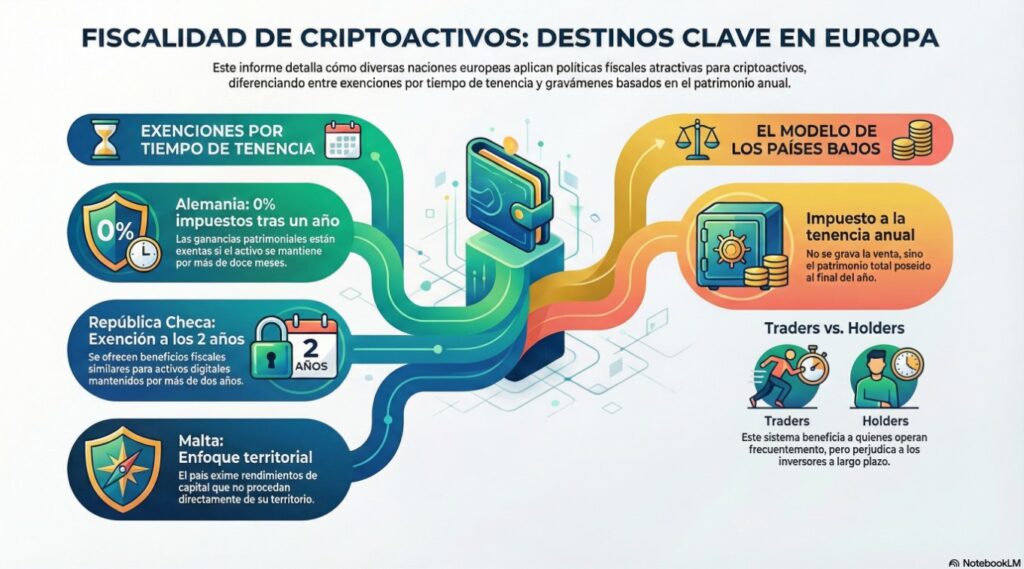
Germany is positioned as an attractive destination for long-term savers, as it offers 0% taxes on capital gains if the digital asset is held for more than a year. This measure, according to Bravo, survived attempts at political reform because it affected all savers in the country, not just bitcoin users.
On the other hand, Malta exempts capital returns that do not come from its territory, and the Czech Republic offers Similar exemptions for assets held for more than two years.
A curious case is that of the Netherlands, where it is not paid for the profit obtained when selling, but for the annual holding. “You pay for ownership at the end of the year, it is a kind of wealth tax,” Bravo explained.
In this system, a theoretical return is calculated on the total assets and a low tax is applied, which benefits those who carry out frequent operations (trading). but it slightly harms the “holders” in the long term.
In the context of Spain, Bravo revealed a fact that usually goes unnoticed: It may be more fiscally profitable to dedicate yourself exclusively to bitcoin trading than having a job with a high salary.
This is because Investment gains are taxed under the savings basiswith a ceiling close to 30%. Meanwhile, work income is subject to Personal Income Tax (IRPF), which in high brackets can exceed 45% or 50%.
“It is better for many people to be a trader than to be working,” said Bravo, highlighting that even earning considerable sumsthe tax burden on investment is lighter than about work effort.
However, he warned that in countries like Portugal or Germany, if trading becomes the main professional activity, authorities can recategorize that income and apply much more severe taxes.
Bravo’s conclusion is clear: the digital economy, led by AI agents and Bitcoin, is exceeding the response capacity of the States.
The challenge is not only technical, but conceptual. In essence, humanity is entering an era where value is generated, transmitted and stored in a digital world that recognizes no borders or physical identities. Which leaves traditional tax systems facing the need to reinvent themselves or accept their own obsolescence.