Peter Magyar is still only Hungary’s opposition leader, but he’s already talking as if he’s been elected prime minister, listing the new government’s top domestic and foreign policy priorities and saying he wants to reach out to those who didn’t vote for him.
Magyar, a 45-year-old lawyer and former diplomat who has been the face of the opposition in Hungary for the past two years, is not lacking in confidence. But during this campaign and, above all, over the past few weeks, there has been a change in Magyar, the head of the centre-right Tisza party – he behaves as if he has already won Hungary’s April 12 vote and is now overseeing the transfer of power.
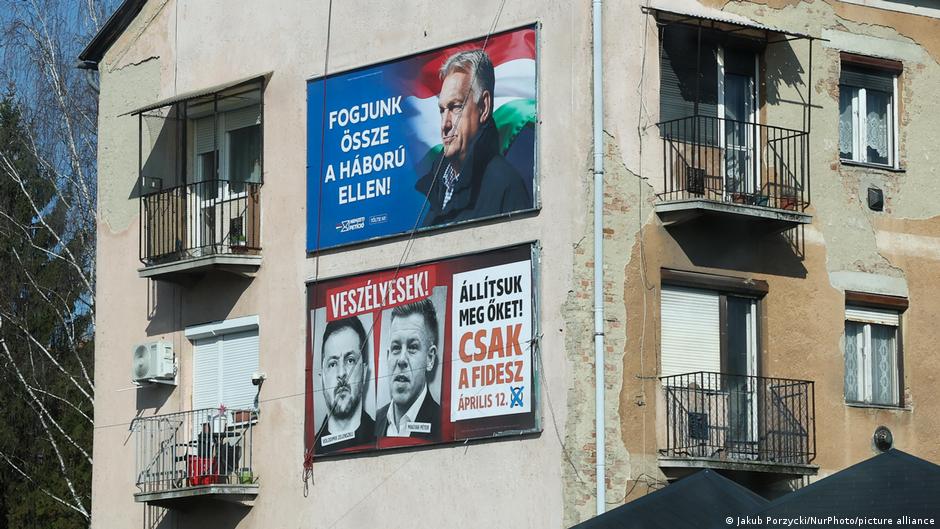
Magyar’s attitude reflects the state of mind of many people in Hungary. Dissatisfaction with current Prime Minister Viktor Orban and his regime has been growing for some time. There is now a sense of optimism in anticipation of fundamental change, but also extreme unease at Orbán’s own campaign, which presents a dark, parallel version of Hungary. Recent opinion polls show that many voters fear that Orbán may cancel the election at the last minute or fake the results.
massive voter turnout
Political scientist and sociologist Laszlo Carey, who tutored a young Orbán while studying law, sees parallels between today and the events of 1989 and 1990. He recently told the Hungarian daily newspaper uj sazo He expects Sunday’s vote to be comparable to the first free parliamentary elections in March 1990. At the same time, Kerry says it is also “an election that could affect the future of Europe, at a time when Europe is trying to find its way.”
Attila Juhasz and Robert László, election researchers at the Budapest-based policy research institute Political Capital, say they have observed a shift from “safe elections to insecure elections” during the final stages of the campaign, objecting to Orbán and his Fidesz party’s slogan, “Safe Choice”.
In fact, in the last few weeks, Orban and his party have failed to dominate. As the vote approaches, Orban, his cabinet and his party Fidesz have been rocked by major scandals. The revelations appear to have driven away a large number of undecided voters.
Most Hungarians want a new beginning
Most independent polling and research organizations are projecting a clear victory for Magyar and Tisza. In one survey, a two-thirds majority was even estimated. This type of voting should be viewed with caution, as voters from some parts of the country are under-represented. Yet they document one thing: a clear majority of voters want to see the Orbán regime end and they are hoping for a new start for Hungary politically, socially and economically.
Perhaps the biggest shift in voter sentiment came from an interview given by Bence Szabo, a former criminal investigator whose department, normally tasked with fighting online child pornography, was ordered by the Orbán regime to carry out a covert intelligence operation aimed at targeting Tisza and paralyzing the party before the vote.
Judging by the nationwide reactions to the interview, it seems that Szabo – a criminal investigator who was forced to go public after being ignored by his superiors – is a figure that hundreds of thousands of Hungarians can identify with.
Buying votes and papering over real threats
Another revelation about the conditions of the Hungarian army, which was described as precarious and disastrous in some places as the government prepared to send troops on an expensive mission to the Central African nation of Chad, has similarly sparked consternation. The mission was apparently put together only because Orbán’s son Gaspar had a bizarre, religiously inspired dream to “save Africa”. Much has been written about the trajectory of the young Orban’s life, from his days in Hungarian professional football and his evangelical Christian awakening in Uganda to his time at the elite UK military academy at Sandhurst.
Several other scams have emerged in the past weeks. The documentary film “The Price of the Vote” was uploaded to YouTube in late March and claims that Orbán’s Fidesz party has spent years buying the votes of drug addicts, Roma and poor Hungarians.
In early February, news broke that the Orbán government knew that a Samsung battery factory north of Budapest was subjecting workers to extremely hazardous working conditions as well as polluting the surrounding soil and water, yet did nothing about it. Instead the regime merely tried to hide the problem.
Hungarian voters also learned about the spectacular renovation of the National Bank building in Budapest. Details that enraged citizens included the news that György Matolsky, former chairman of the National Bank and once Orbán’s most important financial adviser, had overseen the installation of his private bathroom during the renovation and insisted on having a golden toilet brush. Apparently his family has left for Dubai.
suck up to the kremlin
Ultimately the image of elites who shamelessly enrich themselves while damaging Hungarian society and the environment – accusing their critics of being anti-Hungarian – has established itself in the country.
Over the past few days, details and audio of phone calls between Orbán, Foreign Minister Peter Szijjártó and the Kremlin leadership were made public by Hungarian and international media outlets. The essence of the document shows extreme obedience to Russia on the part of these supposedly patriotic Hungarians, with Orbán comparing himself to a little mouse who wants to help a mighty lion – he is Russian President Vladimir Putin – in any way he can.
Orbán and his party have attempted to clarify the situation as part of a plan to protect Hungary from Ukrainian espionage, military attacks and a possible government coup. For months, Orbán’s entire re-election campaign has focused on defending the country against “Ukrainian and EU interference.” Orbán has claimed that the election is about “whether I will run the next government of Hungary or not.” [Ukrainian President Volodymyr] Zelensky does.”
The campaign has also seen the wide-scale deployment of generative artificial intelligence to create videos with fake content. This would probably be the first modern European election campaign to attempt to use such tactics.
The Hungarian news portal Telex expressed the situation thus: “At the end of the campaign, one question remains – is fear more powerful than hope?”
This article was originally published in German.