The US dollar recorded, during the week of April 8-10, 2026, its biggest drop since January of this year. The movement is associated with the alleviation of geopolitical risk following the announcement of a ceasefire in the conflict between the United States and Iran.
The fall It occurred after the announcement of a temporary truce between both countrieswhich immediately reduced uncertainty in the energy and geopolitical markets. This change caused the US currency to lose its appeal as a “haven of value.”
This is a favorable position that had supported the dollar since the beginning of the conflict, by increasing its demand, and that is now losing strength, generating an increase in sales of the currency. A trend to which the rotation of investors towards other currencies and risk assetslike gold and bitcoin (BTC).
Statistics show that the dollar index (DXY) fell between 0.8% and 1.5% in the last 5 days, recording its worst day since 2025. In the weekly accumulated, the indicator fell between 1.3% and 1.6%, marking its largest weekly drop since January 2026.
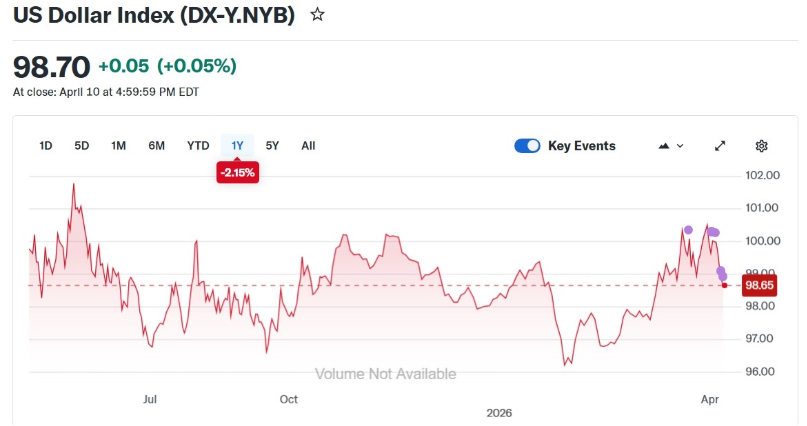
The DXY closed on Friday, April 10 near 98.65–98.70 points, hitting four-week lows. The movement contrasted with the behavior observed during the dollar’s peak between February and March 2026, when the DXY reached levels close to 100–101 points, driven by demand for safe haven assets amid the conflict.
In parallel, noticed a rotation of capital into other major currencies such as the euro, the pound sterling and the yen, along with renewed interest in gold as a reserve asset in an environment of less immediate uncertainty, as reported by CriptoNoticias.
In this scenario, bitcoin also shows positive signs by trading above USD 70,000 and reach up to $70,000. At the close of this edition, its price oscillates around USD 72,865.
A temporary fix?
According to Reuters, the decline of the dollar reply mainly to a correction associated with lower risk aversion following the easing of geopolitical tensions, rather than a structural change in its position within the global financial system.
In that sense, it must be considered that the evolution of the scenario between the United States and Iran continues to be a key factor that generates uncertainty in the markets. Although the ceasefire reduced the immediate pressure, The truce is considered fragile and sources of tension persist.
In this context, the markets remain attentive to the talks taking place this Saturday, April 11 in Pakistan, where officials from both countries will mark the stability of the agreement, conditioning the evolution of the dollar in the short term.
So far, so far in 2026, the behavior of the DXY has shown a consistent pattern: The dollar tends to strengthen in episodes of global tension and correct when geopolitical risk decreases, reflecting greater sensitivity to risk aversion cycles.