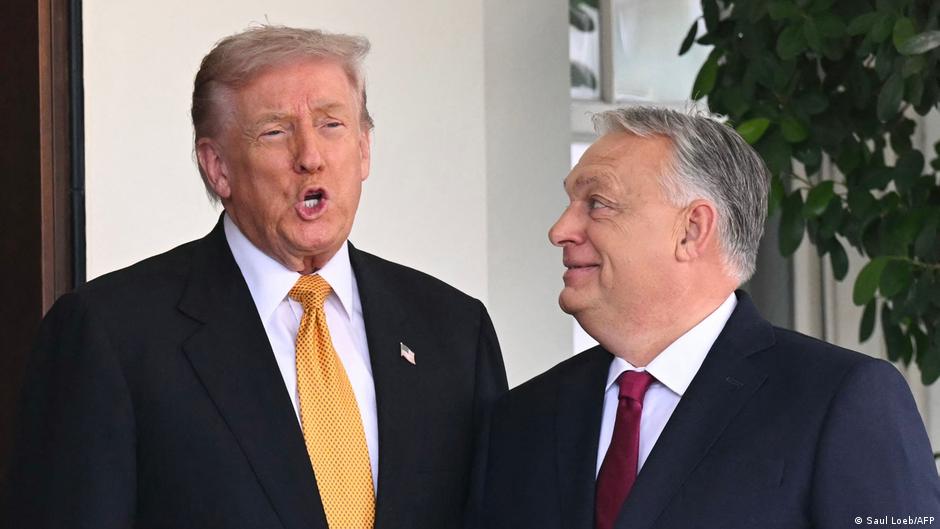
Get out and vote for Viktor Orban, US President Donald Trump wrote in capital letters on his Truth social platform ahead of national elections in Hungary, as the election campaign entered the final stages.
This Sunday Hungarians will decide Orbán’s fate at the ballot box. The current prime minister has withheld as much European aid to Ukraine as possible, he openly criticizes the European Union (EU), of which Hungary is part, and he has aligned himself with US President Donald Trump. He has also presented himself as a MAGA man in Europe.
“Make Europe Great Again!” Orbán, mimicking the Trump campaign slogan “Make America Great Again,” appealed to a conservative movement that now seeks to align itself more strongly with like-minded anti-immigrant groups in Europe.
Orbán has also used the slogan “MAGA there, MEGA here” as he portrays himself as a European leader who can build an international far-right coalition.
The results of Hungary’s election will show whether the rapprochement between Orbán and Trump worked or not. Voters will reveal not only what they think of Orbán’s regime, but also whether Donald Trump has the influence necessary to carry out the international far-right project.
Trump administration’s national security strategyThe release warned against “civilization” in Europe in 2025 and said that “the major issues facing Europe include activities by the EU and other international bodies that undermine political freedoms and sovereignty,” but also, “migration policies that are transforming the continent and creating conflict.”
It also called for developing resistance against the mostly liberal continent. Trump and MAGA’s support for Orbán should be seen in that context, experts say.
Orbán “is at the center of Trumpism, more important than almost any American”. [MAGA] Movement, historian Timothy Snyder wrote on X.
Will Trump’s support help Orbán?
But could Trump’s endorsement and a last-minute visit from Vice President J.D. Vance boost Orbán’s numbers and, with it, strengthen the European far-right?
Sidner wrote, “For Trump and Vance, Orbán must win, because there must be only one inevitable path to history, toward the end of right-wing oligarchy and democracy.” “When Orbán loses,” he said, “it exposes MAGA’s weaknesses.”
Observers say Orban’s Fidesz party is trailing, while the opposition group led by Peter Magyar has maintained double-digit leads in polls for most of the year.
“The polls are not looking good for PM Orban,” Zsuzsanna Wegh, a political analyst at the German Marshall Fund of the United States (GMF), told DW. “This indicates that the opposition can win this election, without large-scale manipulation.”
“Vance’s visit is preaching to the choir — those who already support Orbán,” he said.
Its main purpose, Vegh said, was to send a message to other European far-right political groups that both Trump and the MAGA movement support the Hungarian far-right and have an ideological interest in expanding a liberal Europe.
At a rally he attended during his visit to Hungary a few days earlier, Vance held his phone near the microphone so Trump could reiterate his support to the cheering crowd of mostly Orbán supporters.
Trump said, “I’m a big fan of Victor. I’m with him all the way. The United States is with him all the way.”
However, some experts doubt whether even such overwhelming support could improve Orbán’s prospects. The fact that Trump supports Orbán has been public knowledge for some time and will not increase his numbers further, Vegh said.
“Vance’s visit and Trump’s endorsement could be useful to mobilize those who already support Orbán to come out and cast their vote,” he said. “But it’s unlikely to persuade undecided voters to vote for Orbán. They care about the cost of living, and Vance’s visit doesn’t help that, nor does Trump’s endorsement.”
Is the emergence of ‘Trumpists’ right in Europe?
In June, Karol Nawrocki, a pro-Trump nationalist candidate backed by Poland’s far-right Law and Justice Party (PiS), won the presidential election by a narrow margin.
Nawrocki met with Trump at the White House shortly before the election, which was seen as a sign of support for Trump. Nawrocki later told Polish media that Trump expected him to win and widely advertised a photo of him shaking hands with Trump during the election campaign.
Analysts said Nawrocki’s victory reflects the rise of populism, “Trumpist“Right in Central and Eastern Europe.
However, in Romania, far-right candidate George Simion failed to win the presidential race despite associating with Trump and wearing a Trump baseball cap. Even former Trump adviser Steve Bannon not making the connection between himself and MAGA on his podcast helped.
Romanian political consultant Christian Andrei of the Political Rating Agency enumerated various reasons for Simeone’s failure in the Romanian election. He said that perhaps Simeon, unlike Orbán, failed to establish a real relationship with Trump.
But Andrei also said that in any case “the idea of supporting Trump was not the most important thing” for the far-right voter base. “These people were more upset with the old political system than they were with a better relationship with the American president.”
“Favorability for American presidents is very high in Romania and all parties need to have good relations with the United States,” Andrei said. “So it wasn’t like Simeone was offering anything special.”
Experts said that although there is no definitive evidence yet that ties with Trump are linked to electoral failure or success, Trump’s popularity among the European far right appears to be declining as many leaders become increasingly critical of the US president.
The rift between Trump and the European far-right?
The Trump administration’s new National Security Strategy, released in the fall of 2025, warned against Europe’s current – liberal – trajectory and indicated that it would embolden far-right groups.
Vance’s visit to Hungary and Trump’s support for Orban, Wegh said, are part of that “civilizing mission.”
He said, “Trump and Vance see European far-right parties as allies against the European Union, which they see as a liberal institution that in their view is causing the decline of European civilization.” This is why the current US administration “wants to support parties that argue against the EU and in favor of greater sovereignty.”
But Trump’s own policies may have pushed away parts of the European far right.
“Trump’s policy on tariffs, the war on Iran, the previous intervention in Venezuela, the threat to Greenland – these actions were clearly not seen as positive by European far-right forces, and may even have counterproductive effects for any party or candidate seen as close to Trump,” Wegh said.
The rift appeared when Trump threatened to annex Greenland, an autonomous Danish territory.
Elise Weidel, co-leader of the far-right Alternative for Germany (AfD), who lauded the US national security strategy as a “conservative renaissance” in Europe, said Trump had “violated a fundamental campaign promise – not to interfere in other countries.”
Nigel Farage, leader of the populist Reform UK party, described it as a “very hostile act”.
Jordan Bardella, president of France’s far-right National Rally, who described Trump as “the wind of freedom”, called it a “direct challenge to the sovereignty of a European country” and advocated the strongest response in “self-defense.”
However, Orbán dodged the question, calling it a “domestic issue” to avoid criticizing Trump. Yet it remains to be seen whether this will help him at the ballot box.
According to a recent news voting According to the European Council on Foreign Relations (ECFR), the US has lost its influence in Europe since Trump came to power. The survey said only 16% of EU citizens see the US as an ally, while 20% see it as an enemy or rival.
Edited by: Carla Bleiker