A was without any apparent justification. A president who threatens: “Tonight an entire civilization will die.” For many, the recent war between the US, Israel and Iran signals a further deterioration in international relations. “We’re really at the bottom in a rules-based system,” Stacey Goddard, a political science professor at Wellesley College in the US, told DW.
The rules-based order is generally defined as a set of norms and institutions established after World War II and took on new importance when the Cold War ended. Goddard said, “It is an order based on a number of rules, often defined as liberal rules, which are designed to create patterns and regulate international relations.” “The idea is to create a system that actually controls states and how they can behave toward each other.”
Objectives and failures
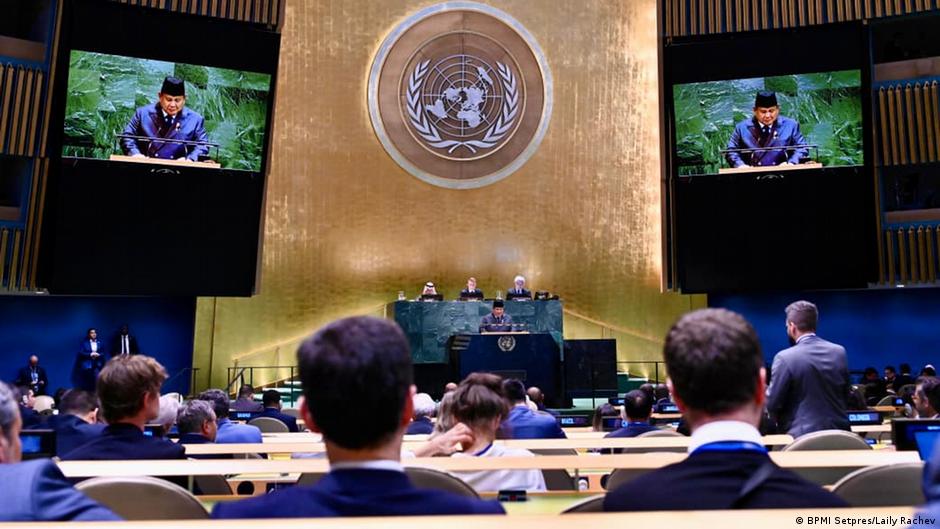
After the horrors of two world wars in the 20th century, its aim was to help create a more stable, free and prosperous world. International organizations such as the United Nations and the World Trade Organization were established; Member states agreed to refrain from aggressive acts against other members and to have the right to self-defense in response to attack.
Goddard said, “There’s no doubt, at least in my mind, that the aspirations of the liberal order and the rules-based order were universal. But obviously, it’s never worked that way in reality. It’s elitist. It’s hierarchical. The actions of many of its proponents, including the US, are hypocritical, taking advantage of the rules to harm others.”
Countries belonging to the Global South have long felt that the guardrails erected by the West to protect the rules-based order have never benefited them in any meaningful way.
“It was a very select club. It primarily benefited the United States and its Western allies,” Amitav Acharya, a professor at the School of International Service at American University in Washington and author of the book “The Once and Future World Order,” told DW. He says countries in the Global South have long had a perception that “the rules were rigged against them. They benefited to some extent, but they never really had agency. They never really had a place under the sun, so to speak.”
An example often cited is the International Criminal Court (ICC), which African leaders and human rights lawyers often accuse of disproportionately targeting their continent’s leaders. A 2024 Amnesty International report shows that of the 54 individuals convicted by the ICC so far, 47 are African.
Erosion of rule based system
Recent decades have seen a further decline in trust in the rules-based system. As just one example, Russia’s annexation of Crimea in 2014 and a full-scale invasion of Ukraine in 2022 challenge the principle of sovereignty.
So if the age of the rules-based order is coming to an end, what could happen next?
Scenario 1: Hemispheric dominance
The scenario discussed by many geopolitical scholars is the revival of hemispheric dominance. Some of US President Donald Trump’s foreign policy has been called the “Donroe Doctrine”, along the lines of the 19th-century “Monroe Doctrine”, which sought to weaken European influence in the Western Hemisphere.
Today, when Trump mentions this principle, he seems to mean American dominance in the region. The ouster of Nicolas Maduro in Venezuela and US threats towards Greenland are examples of this.
The superpowers dividing the world into hemispheric influence could mean that China would tighten its grip on South Asia, which would impact Taiwan and Russia would get a free hand in Eastern Europe. Such outcomes are the darkest version of the hemisphere dominance scenario. But this scenario is also one of the least likely.
In Goddard’s view, “it will have to face a lot of blowback from sovereign states that do not understand why they have been placed in the sphere of influence […] At what point did anyone decide that Japan, for example, was part of China’s sphere of influence, or South Korea for that matter?”
Also, for Goddard, actors like Vladimir Putin or Donald Trump do not necessarily act in the interest of their respective nations, which would be central to a hemispheric concept. “They want to make themselves and their loyalists look great in this international system, which is why we see a lot of puzzling behavior in international politics,” Goddard said.
He and his colleagues at Georgetown University coined the term “neo-imperialism” to describe the move away from rules-based systems toward elite groups of power, not unlike historical monarchical systems, in which small factions shape international politics for the benefit of themselves and their loyalists.
Scenario 2: Multiplex instead of hegemony
The strong alternative to this scenario is a multipolar, or rather, as Acharya puts it, a multiplex world order. “In a multiplex arrangement, you don’t have one or two or a handful of great powers. In a multiplex arrangement, you have many. There are middle powers; there are regional powers; there are non-state actors, civil society.”
There will be cooperation at the global level and regional level like the United Nations. It is not just about distribution of power, but also about sharing ideas and information and adopting shared norms.
In this scenario, much depends on the so-called middle powers, to which some analysts argue the EU belongs. Or in Acharya’s words, “Southeast Asia will have Indonesia, Africa will have South Africa. So I see a world of different types of actors, not only globally, but also regionally.”
But according to Acharya, multiplex order would not be right. He believes there will still be conflict and instability, but less tied to hegemonic powers.
Scenario 3: Complete Collapse?
Ultimately, the scenario is that anarchy and anarchy will replace the rules-based world order. The world on the brink of another global war. Acharya says that many people fear such a scenario but at present it is not a possibility. Goddard also argues that people know the cost of an era of multiple intercontinental wars too well to want to pay it again.
She also expects middle powers to play an important role. “What happens with the rules-based order depends on what happens with the people who still feel it’s valuable and who have some power to make things happen. The extent to which they’re actually willing to push back against these other elements, even if pushing back is costly.”
So, will the EU and countries like Japan, South Korea and India make their own trade agreements, becoming more militarily independent from the US and, at the same time, respecting rules-based principles?
This could be a decisive factor in the emergence of a new world order, not designed exclusively by the Western powers.
Edited by: Chris Robinson, Don McCoitir