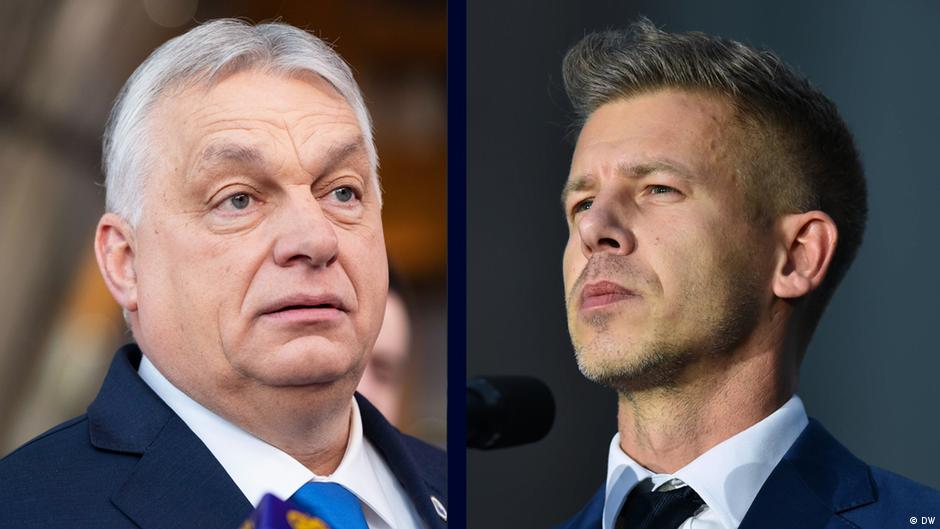
In depth: How much influence does Trump have on Hungarian voters?
Get out and vote for Viktor Orbán, US President Donald Trump wrote in capital letters on his Truth social platform ahead of national elections in Hungary.
This Sunday Hungarians will decide the fate of Prime Minister Viktor Orban at the ballot box.
The current prime minister has blocked as much European aid to Ukraine as possible, is openly critical of the EU, and has aligned himself with Trump. He has also presented himself as a MAGA man in Europe.
The results of Hungary’s election will show whether the rapprochement between Orbán and Trump worked or not.
Read more about whether Trump’s support could boost Orbán’s numbers.
https://p.dw.com/p/5C2Qc
See: Hungary: Europe or the authoritarian path?
On April 12, Hungary is electing a new parliament, and voters will decide on the country’s future path: liberal democracy or an authoritarian model inspired by Russia.
Outgoing Prime Minister Viktor Orban has signaled his intention to end Western support for Ukraine and remove Hungary from the EU.
Meanwhile, Peter Magyar, leader of Tisza, the country’s largest opposition party, has pledged to tackle corruption and put Hungary back on the European path.
DW senior international correspondent Fanny Faxer travels to Hungary in the weeks before the elections and captures the mood of a country at a political crossroads.
https://p.dw.com/p/5C2Qf
12 April 2026
Voting begins in Hungary
Voting has started at polling stations around Hungary.
Voting is set to end at 7pm local time (0500 GMT/UTC).
https://p.dw.com/p/5C2P2
12 April 2026
Czech and Slovak leaders support Orban
Czech and Slovak leaders expressed support for Viktor Orbán on the eve of the Hungarian parliamentary election.
Slovak Prime Minister Robert Fico said, “I have never before met such a warrior for my country’s sovereignty and national interests as Hungarian Prime Minister Viktor Orbán.”
Under Fico, who returned to power for a fourth term in 2023, Slovakia has been a key ally for its neighbor Hungary. Both countries maintain warm relations with Moscow.
Czech populist Prime Minister Andrej Babis also expressed his support.
In a post on X, Babis wrote: “He (Orbán) has always fought for a strong Europe, based on peace, sovereign nations, sovereign member states, competitiveness.”
“In turbulent times, choosing stability and proven leadership matters more than ever,” he said.
Since Babis returned to the opposition last year, the Czech Republic has reduced its support for Ukraine. Following Hungary and Slovakia, his country also refused to join the EU’s 90 billion euro ($105.47 billion) loan to Kiev.
https://p.dw.com/p/5C2SO
In depth: Scandal, fear and hope before Hungary’s elections
Most independent polling and research organizations are projecting a clear victory for opposition leader Peter Magyar and his party Tisza. In one survey, a two-thirds majority was even estimated.
But such voting should be viewed with caution, as it reduces the representation of voters in some parts of the country.
Yet they document one thing: a clear majority of voters want to see the end of the Orbán government and hope for a new beginning for Hungary.
Read more about Hungary’s high-stakes election.
https://p.dw.com/p/5C2Qe
12 April 2026
WATCH: Is Peter Magyar a salvation for Europe?
For the first time in years, Hungary’s Viktor Orban faces a serious challenger for the post of prime minister.
Recent polls show Peter Magyar in the lead. But would that really represent a complete break from Orbán?
https://p.dw.com/p/5C2Sp
12 April 2026
WATCH: Could Viktor Orban lose power after leading Hungary for 16 years?
Hungary’s once influential Prime Minister Viktor Orban is lagging behind in opinion polls.
The vote pits his nationalist agenda and ties with Russia against an opposition promising closer ties with the EU.
Zsuzsanna Végh, a researcher focused on Hungarian politics and foreign policy, explains what is at stake for Hungarian democracy and its future in Europe.
https://p.dw.com/p/5C2P0
12 April 2026
Who is Peter Magyar, who wants to remove Orbán from power?
After Orban’s 16-year rule in Hungary, which the European Parliament has called “a hybrid regime of electoral autocracy”, Peter Magyar and his centre-right Tisza party have promised a reset in its relations with the EU and a severance of closer ties with Russia.
On the eve of Sunday’s parliamentary election, he told the crowd: “Many millions of Hungarians will vote tomorrow for a European, functional, humane, free and independent Hungary.”
However, on migration and Ukraine, Magyar is likely to maintain parts of Hungary’s current approach, while avoiding the confrontation with the EU that has been characteristic of Prime Minister Viktor Orban’s government.
Rose, 45, was once an insider within Orbán’s Fidesz party.
He rose to prominence two years ago when his then-wife and Orbán’s former Justice Minister Judit Varga resigned from all political roles following a public outcry over her decision to pardon a man convicted in a sexual abuse case.
Magyar soon broke with the ruling Fidesz party, accusing it of corruption and propaganda and saying he was disillusioned with its leadership.
Just months after emerging from relative obscurity in an interview on a pro-opposition YouTube channel called Partizan, his newly formed party won almost 30% of the vote in the June 2024 European Parliament elections, coming second to Fidesz.
https://p.dw.com/p/5C2Qb
12 April 2026
Who is Viktor Orban, Prime Minister of Hungary?
Although Hungary has a population of just 9.6 million, Viktor Orbán has established himself as a major player on the international stage.
He has long maintained good relations with US President Donald Trump, who supported Orbán’s re-election bid. On Friday, Trump promised to bring America’s “economic power” to Hungary if voters support his running mate in Sunday’s election.
Five days before the vote, US Vice President J.D. Vance visited Hungary to promote the long-serving leader’s campaign, and urged voters to “stand with Viktor Orbán, as he stands for you.”
The 62-year-old is widely seen as Russian President Vladimir Putin’s closest partner within the EU and has repeatedly clashed with European allies over the war in Ukraine, including using his veto power to block aid to Kiev.
He has spent months campaigning on criticism of Ukraine and warnings that Hungary would be drawn into the neighboring country’s conflict.
Orban is contesting elections for the fifth consecutive time. He was first elected Prime Minister in 1998 and became one of Europe’s youngest prime ministers at the age of 35.
He returned to power in 2010, when Fidesz, the party he co-founded, won a two-thirds parliamentary majority.
Orban may face defeat in Sunday’s elections after 16 years in office.
Opinion polls show he and Fidesz face their strongest challenge since 2010, with most independent polls placing him behind the centre-right Tisza party led by Peter Magyar.
https://p.dw.com/p/5C2P6
Welcome to our coverage
Hungarians are voting in a crucial parliamentary election on Sunday.
At stake is the future of longtime Prime Minister Viktor Orban, who has led the country of 9.5 million people since 2010.
Orban faces the biggest political test of his career from Peter Magyar’s centre-right Tisza party, which has a clear lead over Orban’s Fidesz in the polls.
Polling stations open at 6 am local time (0400 GMT/UTC) and close at 7 pm. About 8 million Hungarians are eligible to vote on Sunday.
Stay tuned for the latest developments on the high-stakes elections in Hungary.
https://p.dw.com/p/5C2Om