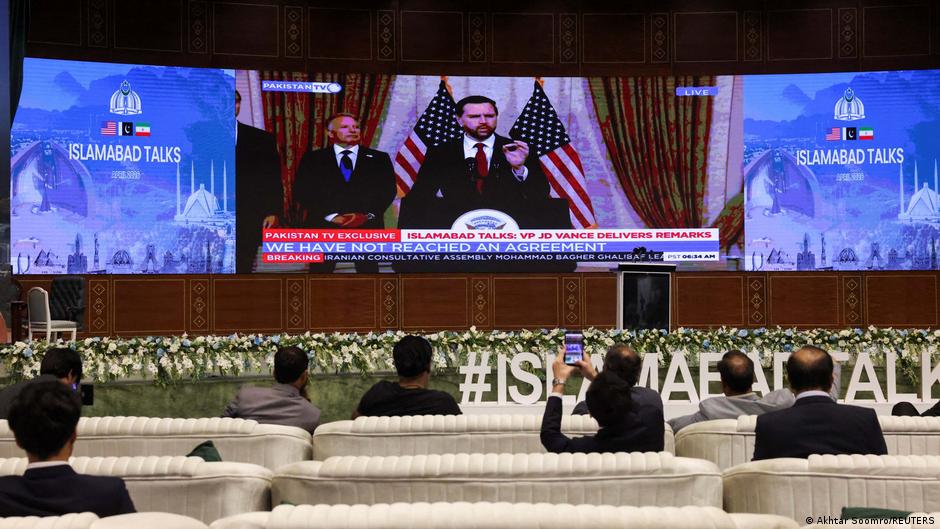
Both sides blamed each other for the breakdown of peace talks in Islamabad, Pakistan on Sunday after no agreement was reached in a marathon session to end the war that began six weeks ago due to US-Israeli attacks on Iran.
US officials said the talks failed because Iran would not commit to giving up its nuclear program. However, Iranian leaders blamed Washington for the breakdown, without giving details of specific disputes.
Vice President J.D. Vance said after the discussion, “We need to see a positive commitment that they will not seek nuclear weapons, and they will not seek equipment that would enable them to quickly acquire nuclear weapons.”
Iran’s parliamentary speaker and head of its delegation, Mohammad Bagher Qalibaf, said the responsibility now lies with Washington. He said, “Now is the time for the United States to decide whether it can earn our trust.”
No agreement on Hormuz or Iran’s nuclear program
The Islamabad meeting was the first face-to-face talks between the two countries in more than a decade and the highest-level talks since Iran’s 1979 Islamic revolution. The discussions followed a ceasefire agreed upon earlier this week.
Iran’s Tasnim news agency reported that what it called “excessive” US demands had blocked progress. Other Iranian outlets said there was agreement on many issues, but deep differences remained over Iran’s nuclear program and control over the Strait of Hormuz. After negotiations failed, US President Donald Trump announced that the US Navy would blockade the strait.
A spokesman for Iran’s Foreign Ministry described the atmosphere as filled with mistrust, adding that it was never realistic to reach an agreement in a single session.
Pakistan Foreign Minister Ishaq Dar urged both sides to maintain the ceasefire agreed on Tuesday, calling it “essential” for continued efforts for peace.
Before leaving for a nearby airport and flying out of Pakistan, Vance said, “We are leaving here with a very simple proposal, a method of understanding that is our final and best proposal. We will see whether the Iranians accept it or not.”
many points unresolved
US-Iran talks are stalled over various issues and analysts believe that it is difficult to resolve the stuck issues. “The conflict was structural, not strategic. The US sought limits on Iran’s nuclear program, regional de-escalation and safe navigation, framing it as security needs,” Fatemeh Aman, an Iran-Pakistan expert and senior fellow at the Atlantic Council, told DW. “Iran sought sanctions relief, recognition and security while negotiating status rather than just borders. Their core objectives were not aligned.”
“Both sides came together but had different understandings of how they wanted to proceed on the nuclear aspect or on the strait,” said Farwa Amer, director of the South Asia Initiative at the Asia Society Policy Institute in New York. “Marathon talks paved the way for dialogue but reaching consensus may require a long-term process.”
According to Aman, Washington wanted concessions first, while Tehran wanted relief first. With little trust and competitive leverage, neither side advanced. Aman insisted, “The negotiations failed because their ultimate goals, not just tactics, were fundamentally incompatible.”
Can the ceasefire hold?
And yet, analysts are cautiously optimistic that the ceasefire will hold and attacks will not resume, with possible backchannel diplomacy helping to preserve the truth.
“The ceasefire holds, but it is fragile,” Aman said. “This is not based on any political agreement. It reflects a temporary standstill made of caution and short-term calculations. Both sides are managing the situation rather than resolving it.”
The talks began in Islamabad on Saturday, days after a fragile ceasefire was announced as the six-week war has left thousands dead and continued to roil global markets. Amer is also relatively optimistic: “It is important that the truth prevails, that mediation channels remain intact, and that both sides continue the diplomatic process,” he said.
Vance did not clarify in Islamabad what would happen after the two-week ceasefire expires, or whether the ceasefire would continue.
“The danger is gradual erosion,” Aman said. “Local incidents, miscalculations or actions by allied groups may test the limits of restraint. Without a follow-up diplomatic process, the ceasefire remains vulnerable. It may hold in the short term, but it lacks long-term sustainability.”
and conversation
Analysts believe that immediate US-Iran talks are now unlikely given rising tensions and recent setbacks. However, diplomacy is not over, as both sides still have strong incentives to resume negotiations.
“There is a possibility of further talks, but not immediately,” Aman said. “After a failed round neither side wants to appear to have given up. There will likely be a pause as both reevaluate their positions and leverage. If negotiations resume, they are unlikely to start with the toughest issues. They will likely start with narrow, technical steps that minimize risks without requiring major concessions.”
For Amer, quiet diplomacy and mediation may remain in play to enable future visits. “But this will depend on how the United States and Iran decide their immediate next steps,” he concluded.
Edited by Ben Knight