April 13, 2026
Iran continues to point finger at US for failure of Islamabad peace talks
Iran’s Foreign Minister Abbas Araghchi has said the United States is to blame for the failure of the weekend’s peace talks in Islamabad, Pakistan.
Foreign Minister Abbas Araghchi said in a post on X that Iran had negotiated with the US in “good faith” for an end to the war.
“But when just inches away from ‘Islamabad MoU [Memorandum of Understanding]’, we encountered maximalism, shifting goalposts, and blockade,” he wrote.
Araghchi was part of Iran’s delegation at the talks, which was the highest level direct meeting between Iranian and US officials in decades.
Araghchi signed off on a threat: “Good will begets good will. Enmity begets enmity.”
https://p.dw.com/p/5C4Na
April 13, 2026
Lebanon’s prime minister working to get Israeli troop withdrawal
Lebanon’s Prime Minister Nawaf Salam has said he was working to ensure Israel’s withdrawal from his country.
“We will continue to work to stop this war, to ensure the Israeli withdrawal from all our lands,” Salam said in a televised address on Sunday.
“We are continuing our efforts … to negotiate to stop the war,” he added.
Salam’s comments come ahead of planned talks on Tuesday in Washington between Lebanese, Israeli and US officials.
Lebanon was pulled into the Middle East conflict when the Iranian-backed militant group Hezbollah fired rockets at Israel shortly after the United States and Israel first launched strikes in Iran.
Israel has responded with massive strikes and a ground invasion.
https://p.dw.com/p/5C4E9
US military confirms it will block Strait of Hormuz
Saim Dušan Inayatullah
The US military has confirmed it will begin implementing a blockade of “all maritime traffic entering and exiting Iranian ports.”
It said the blockade will be “enforced impartially against vessels of all nations entering or departing Iranian ports and coastal areas, including all Iranian ports on the Arabian Gulf and Gulf of Oman,” in a statement released on X.
The blockage will start “on April 13 at 10 a.m. ET (1400 GMT/UST),” it said.
The statement said US forces wouldn’t impede vessels transiting the Strait of Hormuz to and from non-Iranian ports.
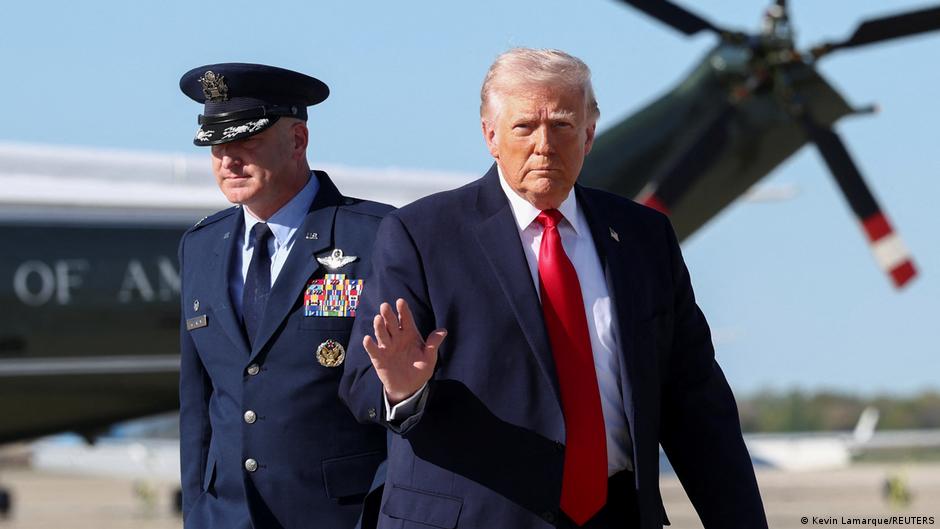
Trump had said earlier in a Truth Social post that the United States would take action against every vessel in international waters that had paid a toll to Iran.
Iran’s Revolutionary Guards responded to Trump by warning that military vessels approaching the strait will be considered a ceasefire breach and dealt with harshly and decisively.
Before the start of the Iran war, about a fifth of global oil and LNG supplies passed through the strait.
https://p.dw.com/p/5C4B6
April 12, 2026
Oman’s top diplomat says ‘painful concessions’ may be needed
Oman’s Foreign Minister Badr al-Busaidi said that parties involved in the Iran war would likely have to make significant concessions in order to secure peace.
“Success may require everyone to make painful concessions, but that is nothing as compared to the pain and failure of war,” al-Busaidi said on Sunday, calling for an extension of the current two-week ceasefire and a continuation of talks.
Al-Busaidi posted his comments on X, after it emerged that an agreement had not been struck between the US and Iran.
He also called for the ceasefire to be maintained and that the dialogue continue.
Oman’s top diplomat said that he had met with US Vice President JD Vance, hours before the war began and that there was an impression both Vance and Trump “had a genuine and strong preference to avoid the entanglements of war.”
https://p.dw.com/p/5C3lt
April 12, 2026
Trump threatens China with 50% tariffs should it help Iran militarily
US President Donald Trump told domestic media that he would slap a 50% tariff on Chinese goods entering the US, should Beijing be found to be helping Iran militarily.
“If we catch them doing that, they get a 50 percent tariff, which is a staggering — that’s a staggering amount,” Trump told Fox News show “Sunday Morning Futures with Maria Bartiromo.”
Trump is due to meet Chinese counterpart Xi Jinping in Beijing next month after an earlier summit was delayed due to the war with Iran.
https://p.dw.com/p/5C3e5
April 12, 2026
Trump announces Strait of Hormuz naval blockade
US President Donald Trump said the US Navy would begin blockading the Strait of Hormuz, following US-Iran peace talks that concluded without a deal.
Trump said that the meeting had gone well but the only sticking point remained Iran’s nuclear program.
“Effective immediately, the United States Navy, the Finest in the World, will begin the process of BLOCKADING any and all Ships trying to enter, or leave, the Strait of Hormuz,” Trump said in a post on Truth Social.
“I have also instructed our Navy to seek and interdict every vessel in International Waters that has paid a toll to Iran. No one who pays an illegal toll will have safe passage on the high seas,” he said.
Trump warned: “Any Iranian who fires at us, or at peaceful vessels, will be BLOWN TO HELL! Iran knows, better than anyone, how to END this situation which has already devastated their Country.”
https://p.dw.com/p/5C3V2
April 12, 2026
Iran blames US for failure of talks, says Americans ‘unable’ to gain Tehran’s trust
The influential speaker of Iran’s parliament, Mohammad Bagher Ghalibaf, has blamed the United States for the failure of the weekend’s peace talks in Pakistan.
Ghalibaf, who was part of the delegation at the negotiations in Islamabad, said the US representatives had been “unable to gain the trust” of Iranian officials.
“Before the negotiations, I emphasized that we have the necessary good faith and will but, due to the experiences of the two previous wars, we have no trust in the opposing side,” Ghalibaf wrote on social media.
“My colleagues on the Iranian delegation raised forward-looking initiatives, but the opposing side ultimately failed to gain the trust of the Iranian delegation in this round of negotiations.”
The talks in Islamabad ended after 21 hours without a breakthrough on Saturday, leaving a fragile two-week ceasefire in doubt.
The US delegation, led by Vice President JD Vance, said negotiations collapsed over what they considered to be Iran’s refusal to abandon its nuclear program.
“We need to see an affirmative commitment that they will not seek a nuclear weapon, and they will not seek the tools that would enable them to quickly achieve a nuclear weapon,” Vance said.
But Ghalibaf insisted that Iran “will not for a moment cease [its] efforts to consolidate the achievements of the forty days of national defense,” adding: “The US has understood Iran’s logic and principles and it’s time for them to decide whether they can earn our trust or not.”
https://p.dw.com/p/5C301
April 12, 2026
WATCH: US-Iran peace talks collapse — What does it mean for the war?
https://p.dw.com/p/5C2ze
April 12, 2026
WATCH: US warships test Hormuz passage as mine risks loom
US warships briefly entered the Strait of Hormuz to probe mine threats, while Iran denies military transits. Talks in Pakistan did not yield an agreement on the Strait reopen.
https://p.dw.com/p/5C2zV
Pakistan expects US-Iran talks to continue through backchannels, source tells DW
Islamabad is urging both the US and Iran to keep their diplomatic channels open, concerned that rising tensions could directly affect the regional and global security, economic stability, and the broader region.
Pakistan’s approach as a mediator remains measured and cautious, centered on preventing further escalation.
A government source told DW, “US-Iran talks are expected to continue quietly through backchannels. The current pause does not mark the end of diplomacy. Although no agreement has been reached, engagement between the two sides is still ongoing.”
The most immediate concern is the Strait of Hormuz. Any flare-up in this critical waterway could disrupt global oil shipments, push up energy prices, and heighten regional instability.
For Pakistan, the situation demands a delicate balancing act. It may gain diplomatic significance as a potential mediator, but its priority is to avoid conflict and protect its economy from potential fallout.
“The mood in Islamabad is not of complete disappointment. While Pakistanis had high hopes from these talks, there was also a realization that these talks may be a drawn out affair. There is immense pride in holding these talks and organizing everything perfectly as far as logistics are concerned,” said Osama Malik, a political and legal expert.
https://p.dw.com/p/5C2uj
April 12, 2026
Iran says ‘unreasonable’ US demands sank talks
Iran’s delegation left Pakistan on Sunday after marathon talks with the United States ended without an agreement.
Iranian authorities told the semi-official Mehr News Agency (MHA) that the failure was due to “unreasonable” and “excessive” US demands.
Iranian officials said the negotiations lasted more than 20 hours, the longest round in the past year, but failed to bridge gaps on some key issues, as Tehran’s delegation refused to compromise on “the rights and interests of the Iranian people.”
“We reached an understanding on a number of issues, but on two or three important issues, views were far apart, and ultimately, the talks did not lead to an agreement,” a spokesperson for the Iranian foreign ministry told MHA.
According to the officials, the talks in Pakistan took place “in an atmosphere of mistrust and suspicion,” with issues such as the reopening of the Strait of Hormuz adding to the complexities of the discussions.
The Iranian news agency quoted a source as saying that Tehran was under no pressure to reach a quick agreement and that it was now up to the US to “approach the issues realistically.”
No timeline or venue has been set for further negotiations, the source told MHA.
https://p.dw.com/p/5C2ih
April 12, 2026
Iran downplays stalled US talks after Islamabad meeting
Iran has said no agreement had been expected from the initial round of talks with the United States after negotiations stalled in Islamabad.
“Naturally, from the beginning we should not have expected to reach an agreement in a single session. No one had such an expectation,” Foreign Ministry spokesperson Esmaeil Baqaei was reported as saying by Iranian state broadcaster IRIB.
Tehran, Baqaei said, was “confident that contacts between us and Pakistan, as well as our other friends in the region, will continue.”
https://p.dw.com/p/5C2WP
Pakistan urges Iran and US to uphold ceasefire
Pakistan has called on Iran and the United States to maintain their ceasefire after talks ended without an agreement.
Foreign Minister Ishaq Dar said it was vital that both sides continue to honor their commitment following the rare face-to-face meeting in Islamabad.
Pakistani Foreign Minister Ishaq Dar said his country would continue to play a mediating role and try to facilitate dialogue between Iran and the US in the coming days.
“It is imperative that the parties continue to uphold their commitment to ceasefire,” Dar said.
https://p.dw.com/p/5C2U8
April 12, 2026
‘Bad news is that we have not reached an agreement,’ Vance says
US Vice President JD Vance said on Sunday that peace talks with Iran had failed to bring about an agreement that would end the war permanently, adding that that was bad news more so for Iran than for the US.
Talking to reporters in Islamabad following 21 hours of negotiations, Vance said he would return to the US without a peace deal.
“We’ve had a number of substantive discussions with the Iranians. That’s the good news,” he said. “The bad news is that we have not reached an agreement, and I think that’s bad news for Iran much more than it’s bad news for the United States of America.”
Vance added that the key question was whether Tehran was willing to abandon its nuclear weapons program, saying: “We haven’t seen that yet. We hope that we will.”
Vance, however, did not mention the reopening of the Strait of Hormuz, another major sticking point in negotiations.
The US vice president said he talked with President Donald Trump half a dozen times during discussions. Earlier on Saturday, Trump said that it did not matter if the US and Iran made a deal or not. “The reason is because we’ve won,” Trump said.
https://p.dw.com/p/5C2Sq
Published April 12, 2026last updated April 12, 2026
JD Vance departs venue for negotiations
JD Vance addressed the media and said there was no deal with Iran.
https://p.dw.com/p/5C2Qg