Amidst the rhetoric and frenzy of JD Vance’s publicity tour of Budapest in support of “brilliant” Hungarian Prime Minister Viktor Orban, the significance of one of the many sites may have been lost.
The US Vice President addressed a pre-election rally at the MTK Sportspark in the Hungarian capital Budapest on Tuesday. The venue, opened in 2025, is used by various sports departments of the MTK Budapest club, whose football team is one of Hungary’s most successful teams with 23 national titles. The chairman of the MTK is Tamas Deutsch, a member of the European Parliament and member of Orbán’s Fidesz party.
“I don’t think it’s accidental staging,” Győző Molnár, a professor of sociology of sport and exercise at the University of Worcester and originally from Hungary, told DW.
“Stadiums are literally Orbán’s favorite arena. More broadly, the vast network of football clubs, academies and infrastructure projects across the country represent a physical patronage network that links local communities and local elites to Fidesz. This has electoral consequences, especially in rural constituencies.”
Heavy state influence in Hungarian clubs
MTK is not alone in having strong ties to the state. Although not necessarily directly controlled by Fidesz, every club in the top division is influenced by the party in some way, either by politicians appointed to executive roles, by state arms having a stake in the club, or by the provision of funds.
The most important revenue stream has been the TAO corporate income tax program. Introduced in 2011, it allows corporations to write off donations to clubs in selected sports as a tax deduction, sometimes up to 100%. This led to billions of dollars being given to government-backed clubs and construction contracts allegedly awarded to people close to Orbán and his government.
Hungary is consistently ranked as the most corrupt nation in the 27-member EU, with which it has strained relations, and is also ranked among the poorest countries in the bloc.
Orbán defended TAO in a 2020 interview with the Hungarian Sports Daily Nemzeti Sports.
“Until the beginning of TAO, entrepreneurs and the world of sports had not maintained any connection with each other,” he said. “I don’t think it’s a normal attitude to regret spending money on playgrounds or on children playing sports.”
Nevertheless, Fidesz also developed interest from clubs from several surrounding countries, including Romania, Slovakia, Serbia, Slovenia, Croatia and Ukraine. Molnár says it combines Orbán’s love of football with maintaining political power – and that’s another vote winner.
Clubs abroad help increase expatriate vote
He said, “Ethnic Hungarians in neighboring countries have been able to vote in Hungarian elections since Fidesz introduced simplified naturalization and expanded the franchise in 2010. The diaspora vote has historically overwhelmingly supported Fidesz.”
“Investing in football infrastructure such as stadiums, academies and youth programs in these communities is a tangible, visible form of patronage that reinforces the message that Orbán’s government cares about Hungarians beyond the country’s borders.”
While the ownership structures of some clubs, both in Hungary and abroad, are opaque, last season’s runners-up Puskás Akadémia has been built, funded and controlled by Orban since their foundation in 2007.
Named after Ferenc Puskás, Hungary’s greatest ever footballer and member of the Mighty Magyars, the national team that lost to West Germany in the 1954 World Cup final, the Puskás Akademiya is Orbán’s pet project. He also built a stadium for them. The Pancho Arena, named after the nickname given to Puskás while playing for Real Madrid, is a 3,800-capacity arena with twice the population of the city of Felshut, where Orbán has his property.
David Goldblatt, now a visiting professor at Pitzer College in Los Angeles, visited the stadium on the outskirts of Budapest in 2017. After handing Orbán a copy of a book on football he wrote a decade earlier, he became the first foreign journalist for more than a decade to interview the prime minister, who was first elected to the post in 1998.
Orban is a lover of football and its power
Goldblatt said that, although clearly politically weaponized, Orbán’s love of the game shined through.
“He’s really passionate about football – playing it, watching it, thinking about it. He really, really, really loves football,” Goldblatt told DW. He pointed out that Orbán played Hungary’s fourth tier and based his party’s central control on the Fidesz five-a-side game.
As well as his hold on the club game, Goldblatt said Orbán’s funding and promotion of the national team have enabled him to tell a useful story.
“It is a great and powerful narrative for an ultranationalist with predatory tendencies that the Hungary national football team presents. Once the absolute pinnacle of global football, then a terrible shadow of its former self. In the hands of Orbán and Fidesz, it has turned into a narrative about how great Hungary was before the communists crushed the great football tradition.
“‘Make Hungarian football great again’, that’s what he told me. I think he actually had a baseball cap on.”
Champions League final a glorious moment or a bitter pill
As well as their involvement with the Hungarian national team and all the country’s top clubs, Orbán and Fidesz have built more than 25 stadiums across the country, the largest of which – the Puskás Arena in Budapest – will host European club football’s biggest game, the Champions League final, on 30 May.
Molnár said Orbán sees it as “a huge validation of his nation-building strategy as a whole” and would consider not remaining in power for the finals as a bitter pill.
He said, “If he loses on April 12, the Champions League final will be under a new government, and it will be a bitter symbolic loss for him, someone else will cut the ribbon on his legacy project.”
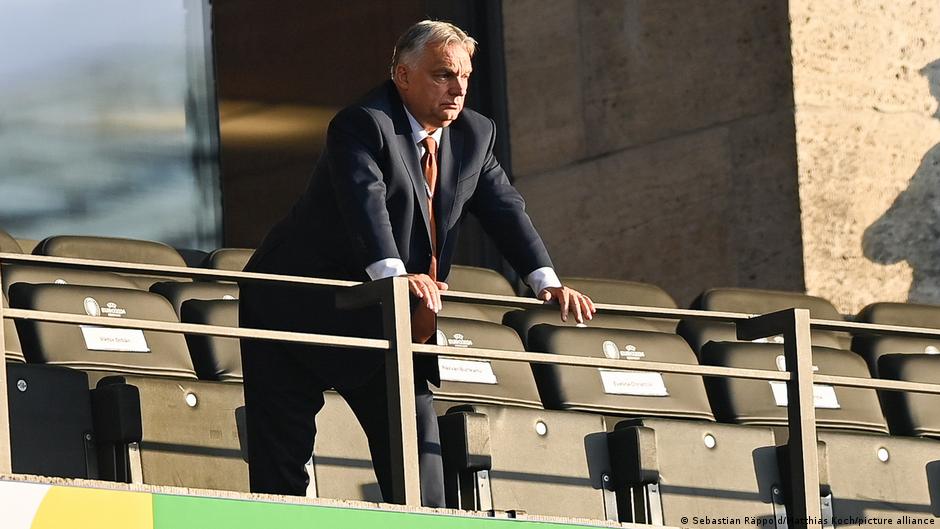
Orban has been a regular at major soccer finals for decades and, no matter what happens in the coming days, may well be at one of the stadiums he built on May 30. He has made himself a prominent figure in Hungarian football as well as society and has a huge stake in the game.
Molnár said, “If Orbán wins, the event becomes the coronation of his football legacy. If he loses, it becomes an awkward legacy for a new government, which will have to decide what to do with the infrastructure, networks and political economy of the sport that Orbán has spent a decade and a half building.”
“Either way, Hungarian football after April 12 will tell us a lot not only about the game, but also about whether populist nationalist projects can be dismantled by democratic means.”
Edited by: Chuck Penfold
This article was originally published on April 9, 2026. Later the same day it was amended to reflect the fact that JD Vance spoke at the MTK Sportpark in Budapest, not the Groupama Arena as previously reported.