All revenue from Aave products will go towards the DAO.
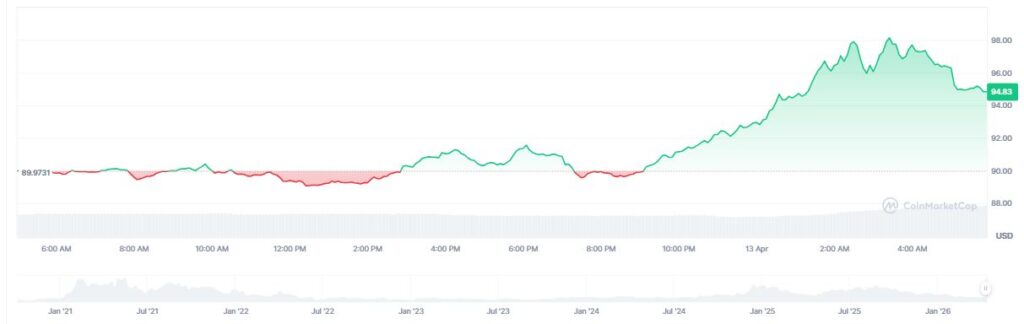
As a consequence, the price of the AAVE token rises more than 5% in the last 24 hours.
The Aave token (AAVE) registers a rise of 5.53% in the last 24 hours, following the completion of a key vote in the governance of the decentralized finance (DeFi) protocol.
At the time of publishing this article, April 13, 2026, the token is trading at $94.83 and has reached $98 this morning:
The proposal, approved on Sunday, April 12, introduces a structural change in the distribution of income within the Aave ecosystem.
This decision puts an end to an internal dispute that lasted five months and revolved around how the value generated by the different products linked to Aave should be allocated.
Until now, only the income from the main protocol went to the DAO, a decentralized organization in charge of the governance of the project, as explained in Criptopedia, the educational section of CriptoNoticias.
With the new approval, all revenue, including those generated by applications and products developed outside the core of the protocol, will become part of the DAO treasury.
One of the most relevant points of the change is that The DAO is now also responsible for financing the activities of Aave Labsthe firm that develops products and infrastructure for the ecosystem. As part of the approved proposal, a grant of $25 million in stablecoins and an allocation of 5,000 AAVE tokens to Aave Labs was authorized, equivalent to about $6.8 million at the current price.
This implies that the new scheme not only concentrates income in the DAO, but also makes that community body the direct financier of the main developer of the ecosystem. In other words, the DAO is no longer solely a revenue receiver and more directly manages how resources are allocated for Aave’s growth, while Aave Labs becomes subject to a model where its funding depends on community governance approval.
According to shared data Under the proposal, the DAO had already accrued nearly $140 million in revenue during 2025 from protocol activity alone. Besides, Products like Aave Pro and the official website already generate between 10 and 20 million additional dollarswhich will now also be redirected to the treasury.
The economic redesign aims to consolidate a “token-centric” model, in which AAVE concentrates both the governance and economic rights of the ecosystem. In practical terms, this implies that those who hold the token have direct exposure not only to the performance of the protocol, but also to the growth of all associated products.
From the project environment, the message was clear regarding the scope of the decision. “If you own AAVE, you not only have the economic rights to the protocol, but also the brand, the users and the integrations,” says the document released after the vote.
The change also consolidates an approach focused on the AAVE token, which concentrates not only governance functions, but also exposure to revenue generated throughout the ecosystem. In practice, this implies closer integration between the different products and services developed under the Aave brand.
Along those same lines, the CEO of Aave Labs, Stani Kulechov, has repeatedly defended the need to align incentives around a single assetwith the aim of strengthening project execution and avoiding value fragmentation within the ecosystem.
However, the vote also reveals previous tensions within the community. The fact that the debate lasted several months reflects differences over the strategic direction of the protocol and the degree of control that the DAO should exercise over the resources generated.
With the proposal already approved, Aave begins a new stage focused on the implementation of this model. The challenge will be to sustain the growth of the ecosystem under this structure and check if the centralization of the income flow in the DAO manages to translate into greater stability and appreciation of the token in the medium term.