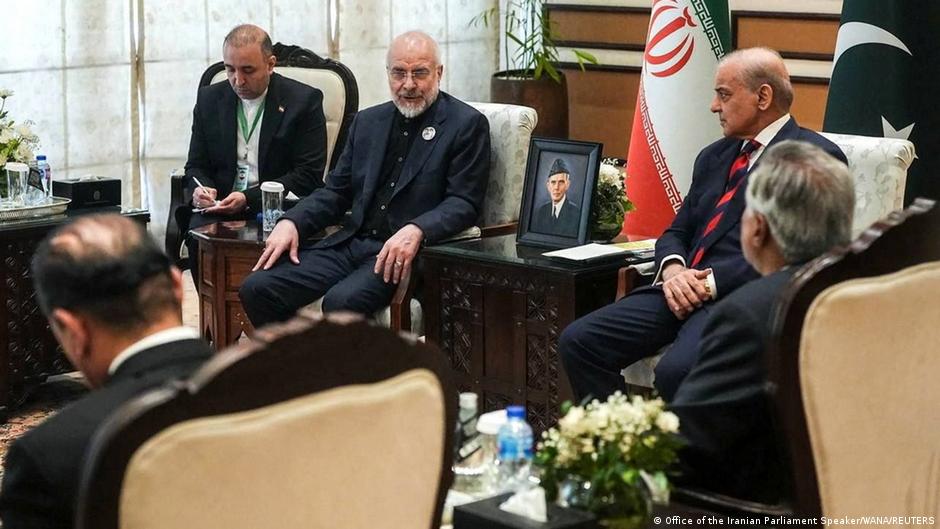
Although the US-Iran talks held in Islamabad on April 11–12 failed to yield a peace deal, Pakistan’s active role in mediating the global conflict was widely appreciated internationally.
Not only did the Iranian delegation thank Islamabad for facilitating the talks, but US President Donald Trump also praised Pakistan Prime Minister Shehbaz Sharif and Field Marshal Asim Munir for their efforts.
“He is an extraordinary man and he constantly thanks me for saving 30 to 50 million lives in a terrible war with India,” Trump said in a post on social media.
At the moment, talks between Iran and the US are stalled, but there is still a possibility that it could be revived in the coming days before the April 22 ceasefire deadline.
“The simple fact is that we need to see a positive commitment that they will not seek nuclear weapons, and they will not seek equipment that would enable them to quickly acquire nuclear weapons,” Vice President J.D. Vance, who is leading the US delegation, told reporters in Islamabad on Sunday.
Regional hostilities with Afghanistan, India
Some political experts are of the view that to be considered a genuine peacemaker, Islamabad needs to improve relations with some of its neighboring countries, particularly Afghanistan, with which it says it is in an “open war”, and India, its long-time rival, with which it engaged in a brief but deadly war in May last year.
“The irony is that while Pakistan was playing the role of peacemaker at the international level, China hosted a week-long talks between Kabul and Islamabad to end the ongoing hostilities between the two,” Pakistani political analyst Farooq Sulehria told DW.
Relations between the Taliban rulers in Kabul and Islamabad have deteriorated since the Islamist group seized power in Afghanistan in 2021 following the withdrawal of US-led international troops from the war-torn country. Over the past year, Kabul and Islamabad have been engaged in a direct war with the Pakistani Air Force targeting “terrorist bases” inside Afghanistan.
Relations with India remain poor following a May 2025 military escalation over the Pahalgam attacks in Indian-administered Kashmir.
Sulehria underlined, “This shows that Pakistan is a peacemaker neither by ideology nor by necessity. The ideological foundation of the Pakistani state rests on hostility to India. The current tensions with Kabul are partly an extension of this India-centric approach as the Taliban regime is cozying up to New Delhi, infuriating Islamabad. Hence, there is a contradiction in Pakistan’s role as a global peacemaker.”
‘Different reactions to different pressures’
But Fatemeh Aman, an Iran-Pakistan expert and senior fellow at the Atlantic Council, argues that although Pakistan’s role in negotiating the US-Iran conflict and its hostile relations with Kabul and New Delhi may appear like a dichotomy, they are actually “different responses to different pressures”.
“While mediating US-Iran tensions creates diplomatic space, managing Afghanistan is about stability. This approach reflects obstructionism, not double standards. Pakistan wants regional relevance, but faces problems it cannot easily solve,” he told DW.
“This situation is not as contradictory as it seems. Pakistan is dealing with two different realities. Its relations with Iran and the US are about diplomacy and staying relevant with low risk. However, Afghanistan is an immediate security concern that includes insurgency, border instability and internal pressure. So, it is less contradiction and more a two-tier approach: influence abroad, control at home,” Aman stressed.
Politician Raza Rumi agrees: “Islamabad’s engagement with the US-Iran situation and its tensions with Afghanistan operate in different contexts. The former is low-risk diplomacy where Pakistan can play a facilitating role; the latter is an urgent security challenge shaped by extremism and border instability. This approach reflects necessity and opportunity in the one case, and proximity and vulnerability in the other,” Rumi told DW.
He said what appears to be duality is actually the result of different policy imperatives, explaining that states adapt their policies based on geography, threats and leverage. He said Pakistan can engage diplomatically in the US-Iran region without direct risk, while Afghanistan involves active security concerns and therefore requires a different approach.
home comfort of pakistan
Experts also point to the Pakistani government’s crackdown on former PM Imran Khan’s Pakistan Tehreek-e-Insaf (PTI) party and military operations against terrorists in western Balochistan and northwestern Khyber Pakhtunkhwa provinces.
He says resolving domestic disputes could enhance the government’s image as an entity that prefers dialogue rather than force.
“Peace and reconciliation are necessary in Balochistan and Khyber Pakhtunkhwa provinces,” Sulehria said. He said, “A functioning democracy is important for Pakistan to project itself as a global peacemaker. However, the chances of such a change are very slim under the current dispensation.”
Analysts also criticize Khan’s imprisonment, calling it “undemocratic”.
“Foreign policy reflects domestic politics,” he underlined.
Rumi believes that Pakistan faces “structural obstacles” in dealing with complex issues, adding that Islamabad’s actions “are influenced less by choice and more by the limitations of its strategic environment.”
Additional reporting by DW reporter Haroon Janjua in Islamabad.
Edited by: Carl Sexton