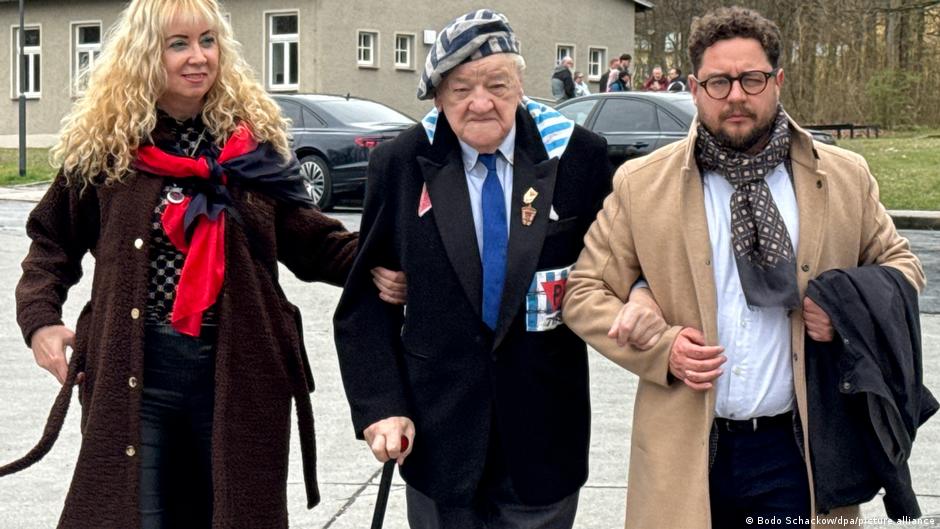
At Sunday’s memorial service, actor and writer Hape Kerkling spoke about his grandfather, Herman Kerkling, who survived the genocide.
Kerkeling recalled, “He was not a man of much talk, but a man of work. A carpenter from Recklinghausen who knew how to work.” On the former roll-call square buchenwald concentration camp In Ettersburg, near Weimar, in the heart of Thuringia, he was speaking “not as a public figure, but as the grandson of a survivor.”
Hep Kerkeling is widely known in Germany. At the age of 61, he is a comedian, writer, television host and actor. His 2006 book “Ich bin den mal weg” (“I’m Off Then: Losing and Finding Myself on the Camino de Santiago”) describes his journey from the Camino de Santiago to Santiago de Compostela. It has been translated into English, Spanish, Polish, Japanese, and other languages.
Grandfather Hermann – a carpenter, a Catholic and a Communist – survived his time in the camp, where, by April 1945, approximately 56,000 prisoners had died or died of torture, murder, exhaustion or despair. As his grandson explains, Hermann “distributed leaflets against Adolf Hitler immediately after the National Socialists seized power in 1933.” He had to spend twelve years of his life in this.
Citing his family history, Kerkeling said of his grandfather’s silence: “A pioneering silence. That intense silence was like a glass wall around his soul.” He warned against forgetting, against right-wing populism. It seemed as if it was a speech to be endured, the voice of a grandson expressing grief for future generations.
Buchenwald: Bright on Earth
The Nazis imprisoned people in Buchenwald from 1937 to 1945. These included political rivals, communists, homosexuals, foreign prisoners, Jews, Roma and Sinti, Jehovah’s Witnesses, and clergy who died out of prejudice. The Buchenwald system consisted of the main camp at Ettersberg and over 50 smaller satellite camps mostly connected to war-related production sites. More than 250,000 prisoners suffered there.
When the first US Army tanks approached the camp on April 11, 1945, the prisoners – who had formed a well-coordinated resistance group – stood up and captured dozens of soldiers from fleeing SS units. For this reason, the commemoration spoke of both “liberation and self-liberation”.
On the 81st anniversary of the liberation, two former prisoners managed to attend: Alojz Maciak (98) from Poland and Andrzej Moiseenko (99) from Belarus. Elderly gentleman, still wearing the cap from his prison days. Many other survivors could not travel to Israel because flights were suspended.
At the 70th anniversary of the liberation in 2015, about 80 survivors were still able to attend. In 2025, the 80th anniversary, there were only 15. Now there were two, but they did not speak this time.
Holocaust remembrance in difficult times
This year’s commemoration at Buchenwald was in many ways a lackluster affair. During his welcome address, Jens-Christian Wagner, director of the memorial, described the current situation in bitter terms: “As the number of survivors of the Nazi terror is now small enough to defend themselves, memorial sites and the culture of remembrance are being misused as a platform for current political conflicts driven by special agendas and self-promotional efforts.”
Wagner reported that right-wing extremists are attacking the culture of remembrance and stigmatizing it as a “cult of crime”. “Yet – or perhaps precisely because of this,” he said, “he received support from 40% of voters in Thuringia.” Nowhere else in Germany is the far-right Alternative for Germany (AfD) as strong as it is in the region, where its regional chapter is among those classified as right-wing extremist by Germany’s domestic intelligence service.
But Wagner also emphasized how deeply the conflicts in the Middle East have impacted the commemoration. Some groups, he said, “tried to hijack this day for current political purposes.” An organization called “Kufiyas in Buchenwald” planned to hold a vigil in Buchenwald that Sunday for the victims of the genocide and fascism, with a special focus on Palestine. However, several days earlier, a court had banned the event.
adequate police presence
Yet the fear of protests shaped the day. Around Weimar’s railway station, more than 15 police vans were lined up in the morning. A group of officers in front of the station kept an eye out for potential counter-protesters and checked who was boarding the shuttle buses to the memorial. Police vehicles were repeatedly seen around the memorial.
Wagner, the memorial’s director, therefore made a strong appeal “to all present… not to disrupt our commemoration”. Several hundred, perhaps even a thousand people were gathered around the lecture hall and the tent housing the official guests.
And yet, there were disruptions. Representing the federal government, Culture and Media Commissioner Wolfram Weimer (non-partisan) came to Buchenwald. Their responsibilities include, among other things, supporting memorial sites dedicated to addressing the legacy of the Nazi dictatorship and the injustices committed under East Germany’s former ruling party, the Socialist Unity Party of Germany (SED).
Protest against government minister Weimar
The presidents of two associations representing relatives of former political prisoners of the camp were opposed to Weimar’s presence. He argued that he had recently excluded three left-wing bookshops from receiving prizes in a competition, citing “findings relevant to the domestic intelligence service”. Meanwhile, Wagner had spoken in favor of Weimar in his address.
When Wagner welcomed him to the event, he was greeted by various people in the crowd. As Weimer approached the lecture hall, chants of “Alertà antifascista” could be heard from a leftist group, over which flags of the “Union of Persecutors of the Nazi Regime” (VVN) were flying, as well as occasional slogans of “Fascist”.
Weimar spoke for about twelve minutes. Initially, he requested that the “dignity of the place” be respected. He addressed the two survivors and expressed sadness at the “unbearable development” of increasing disruptions and threats at memorial sites. The Buchenwald Memorial has to spend more than 10% of its budget on security and protective measures, he said.
For almost the entire duration of his speech, the hecklers shouted or sang the solidarity song – “Go ahead, and don’t forget” – or a song composed inside the camp in 1938: “O Buchenwald, I cannot forget you because you are my destiny,” (“O Buchenwald, I cannot forget you, because you are my destiny”).
Later Jens-Christian Wagner expressed his anger in front of journalists. It was “shabby” and “unbearable”, he said, especially because the rioters were the loudest when Weimar was addressing the survivors. He said it was legitimate for a representative of the federal government to speak on such an occasion. Wagner called it a “misguided political gesture” to disrupt a representative of a democratic government.
Minister Weimar concluded by handing over to Hep Kerkeling, whom he thanked as one of the country’s most respected cultural figures.
This was immediately followed by a minute’s silence. This was followed by the traditional remembrance of the “Buchenwald Oath” – a pledge by the survivors to “destroy fascism at its roots” and build “a new world of peace and freedom”.
Fifty floral tributes were laid in rows at the historical site by the Culture Minister and victims’ associations. The official commemorations were over. Individuals and small groups remained on the grounds, laying roses here and there, pausing to remember specific groups of victims.
The old clock in the tower above the camp’s entrance building reads “3:15 PM”. Its hands always point to 3:15. At the same time, on April 11, 1945, the camp was liberated. Only then did hell end. And yet, somehow, that never happens.
This article was originally written in German.