Hassan Koko sits atop a homemade wooden bed overlooking the majestic hills of the Nuba Mountains in South Kordofan, Sudan.
Despite the spectacular view and the comfortable late afternoon breeze, he looks uncomfortable.
On November 29, the 50-year-old community health worker had completed a training course and was enjoying some sweet tea when suddenly a drone appeared. When it landed, it killed many of Koko’s associates.
“The drone attacked once, then came back… attacking people who were already injured.”
While Coco herself survived, the attack left heavy scars on her. Exactly the same physically. He points to his left knee. There is a sharp metal object inside it, which is clearly visible now, three months after the attack.
“My family was happy that I survived. They thought I would die. But life is not the same now. Sometimes, I go to the nearby market, but mostly, I am stuck at home.”
a changing alliance
For decades, the Nuba Mountains – ruled by the armed Sudan People’s Liberation Movement-North (SPLM-N) – have been accustomed to brutal attacks by the Sudan Armed Forces (SAF).
The current conflict dates back to 2011, when fighting intensified after the Nuba Mountains were excluded from the political agreement that resulted in South Sudan’s independence. It deepened long-standing grievances against the Nuba population, a loosely defined group of more than 50 ethnic groups living in an area the size of Austria.
The SPLM-N, which emerged from the SPLA liberation movement and now constitutes South Sudan’s military, was founded in the same year to represent the Nuba population’s demand for self-rule.
However, it was only in February 2025 that a notable change of events took place.
Faced with the escalating hostilities of the Sudanese War, which began in 2023 and has led to the world’s worst humanitarian crisis, estimated to have resulted in more than 150,000 deaths, the SPLM-N decided to join forces with the paramilitary Rapid Support Forces (RSF).
It was seen by most as an uncertain, highly controversial alliance.
The RSF, which has its roots in the Janjaweed movement, has historically carried out repeated raids into Nuba areas alongside the SAF. Now, still, the two had to work together.
Jalale Getachew Biru, senior analyst for East Africa at the Armed Conflict Location and Event Data Project (ACLED), argues that the alliance should be understood as a pragmatic response and in light of the RSF and SPLM-N’s shared desire for a future federal system in Sudan:
“Both sides have common interests, and that is why they are in alliance at this time. To push back against the SAF.”
overwhelmed with war refugees
In the urban centers of the Nuba Mountains, RSF soldiers move around casually. They are chatting merrily in cafes and wandering through populated markets, selling goods recently looted from all over Sudan: cars, bedding, fuel, fertilizer, electronic equipment and much more.
However, RSF soldiers are not the only newcomers to the Nuba Mountains.
In a ‘government’ office in Kauda village, the headquarters of the SPLM-N, Jalal Abdulkareem sits stoically behind his desk. Abdulkareem represents the movement’s humanitarian wing, which coordinates refugee efforts in so-called “liberated areas”.
He does not hide the pressure that the SPLM-N is currently facing. Abdulkareem handed over a Post-it note: “2,885,393” is written on the yellow slip of paper, the number of new refugees who have arrived in SPLM-N-controlled areas since the beginning of the Sudanese war.
Abdulkareem admits that funding for refugee programs largely depends on external NGOs and UN agencies, but they too are under financial pressure. After the Trump administration closed USAID last year, it has fallen short of funds to provide the food, water, shelter and sanitation needed for many arrivals.
“If an NGO used to donate one or two million dollars earlier, today it is just 500,000 or 200,000…This is one of the biggest challenges we face,” the SPLM-N bureaucrat said.
The International Organization for Migration (IOM) estimates that Kordofan hosts “more than one million” internally displaced persons. However, since there is apparently no United Nations presence in Kadugali, and most international NGOs have suspended or significantly reduced their operations in the region, these figures may be subject to inaccuracies.
Temporary shelter in the Nuba Mountains
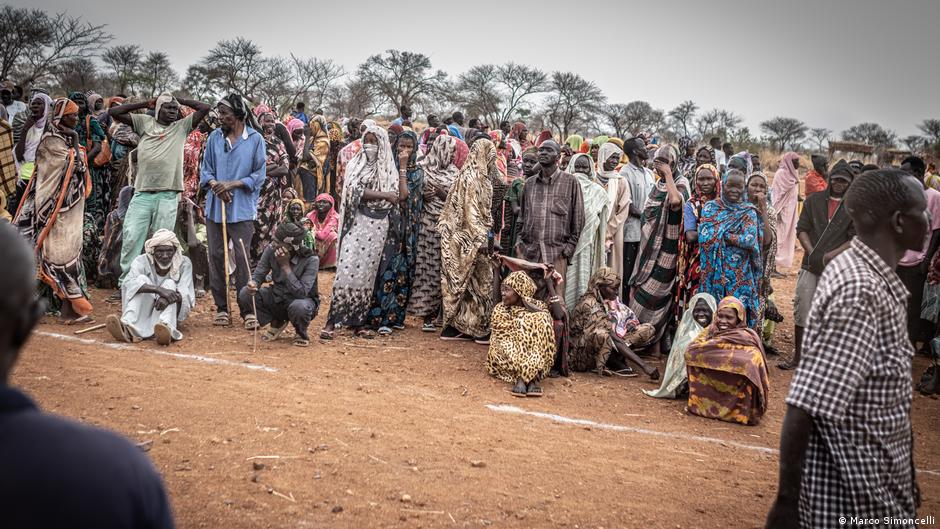
Deep in the rugged terrain of the Nuba Mountains lies the Umm Dullo Reception Camp, a barren place where internally displaced people have built makeshift shelters out of sticks and plastic, often under the shade of giant acacia trees.
The latest arrivals are housed in Zone 12, at the far end of the camp of more than 34,000 people. Fatma Aissa Kuku, 76, remembers life when she fled Kadugli, the capital of South Kordofan.
“I couldn’t sleep. There was ‘tut-tut-tut’ every night,” she says, imitating the sound of gunshots.
In the Umm Dullo camp, Kuku has found temporary shelter and has recently returned to peaceful sleep. Yet she cannot forget the brutal kidnapping of her three “brothers” who suddenly disappear:
“They came between morning and evening, and I haven’t seen my “brothers” since. I don’t know who these people were. If you ask about their identity, you will be met with great rudeness.”
New guests kept at arm’s length
Although the people of the Nuba Mountains do not state it explicitly, tensions are rife. RSF rarely mingles with local communities, adding a new, unfamiliar layer to the concerns it has inherited over the years.
Furthermore, the presence of new SPLM-N affiliates around hospitals and markets turns these crowded places into potential war targets, a problem that only the Nuba people are aware of.
According to Jalale Getachew Biru, little is known about the military agreement between the RSF and the SPLM-N, although senior analysts have settled on credible reports that the RSF has established military training camps within SPLM-N-controlled areas.
However, in general, Jalale Getachew is not confident about the longevity of the Biru alliance. When the SAF broke the siege of Kadugli, long controlled by the SPLM-N and RSF, earlier this year, the allies even began blaming each other for the loss, he explained:
“There was a skirmish where we were keeping an eye out to see if that was a sign of this alliance ultimately breaking down and them going their separate ways.”
However, the alliance remains intact at this time.
“I want to live in the Nuba Mountains forever”
At Mother of Mercy Hospital, the largest hospital in SPLM-N-controlled areas, three young, wounded RSF soldiers have pulled their beds out and into the shade to escape the afternoon heat.
Following horrific reports of systematic killings and gruesome war crimes, the RSF has been described as one of the most relentless militias of our time. But, in their own words, what are the soldiers really fighting for?
“We are fighting because of the government [in Sudan] Not doing enough. There are not enough hospitals, infrastructure and schools,” said Hasan Hamid.
For now, the RSF fighter has found unexpected refuge in the Nuba Mountains, and there is no sign that he and his comrades will be leaving any time soon.
“I want to stay here. I want to live in the Nuba Mountains forever.”
Edited by: Benita Van Eysen