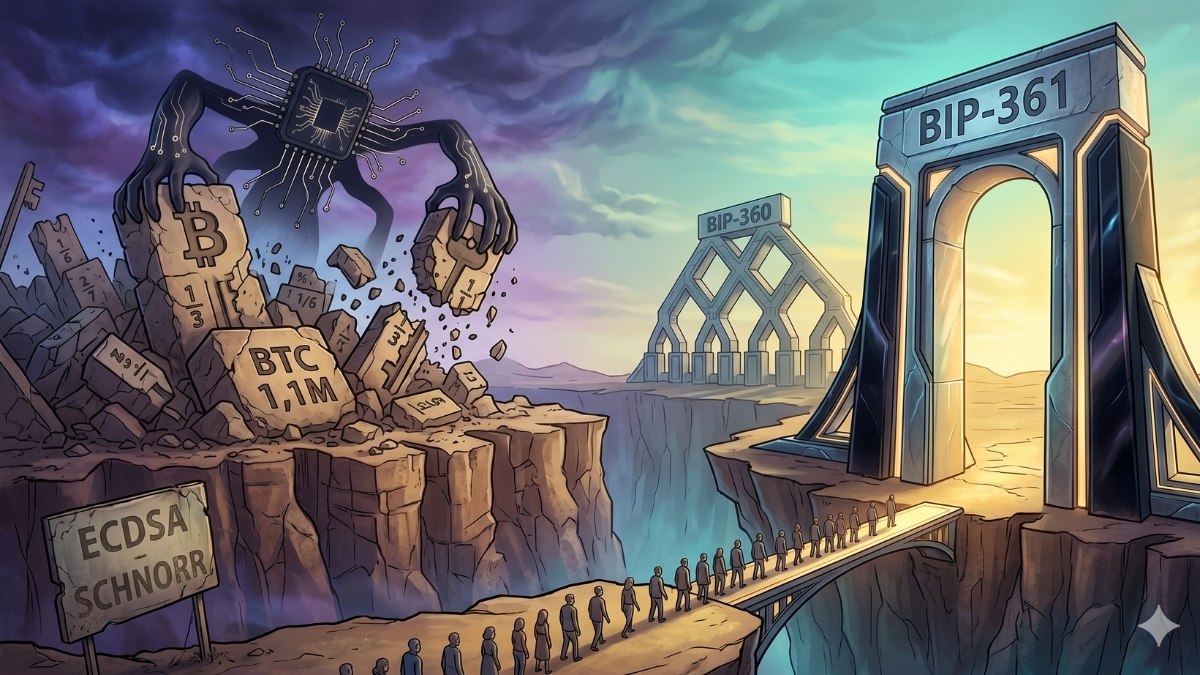
The authors estimate that a relevant quantum computer could arrive between 2027 and 2030
Funds that do not migrate would remain inaccessible and not transferable to third parties.
BIP-361 was formally incorporated into the official Bitcoin repository on April 14 and received its identification number. The proposal, led by cypherpunk Jameson Lopp —co-founder of Casa—, proposes implementing, through a soft fork, a mechanism that would make Bitcoin’s current cryptographic signatures invalid as of a certain date, forcing users to migrate their funds to addresses resistant to quantum computing before that threat is real.
The proposal is born in a context in which, according to data from Project Eleven, more than 34% of all bitcoin in circulation has its public key visible on the blockchain. That includes addresses associated with Satoshi Nakamoto, which accumulate around 1.1 million BTC. A sufficiently powerful quantum computer you could use those exposed keys to derive the private keys and transfer the funds. According to academic estimates cited in proposal BIP-361this scenario could materialize between 2027 and 2030.
The proposal is complementary to BIP-360, published in February 2026, which proposes a new type of address—Pay-to-Merkle-Root—designed to hide public keys, even when making a payment. While BIP-360 defines the destination to which the funds must migrate, BIP-361 establishes the deadline and the consequences of not doing so.
The initiative was developed together with Christian Papathanasiou, Ian Smith, Joe Ross, Steve Vaile and Pierre-Luc Dallaire-Demers.
Three phases for an orderly migration
The proposal divides the process into three stages. In phase A, which would last approximately three years after activation, only send funds to post-quantum addresses; Shipments to vulnerable addresses would be blocked. In phase B, two years after the first phase, nodes would reject any transactions that use ECDSA or Schnorr signatures (signatures currently used in Bitcoin), leaving funds that have not migrated inaccessible. A phase C, still under investigation, would explore the possibility of recovering those funds through a zero-knowledge proof proving possession of the original seed phrase.
The authors acknowledge that funds from abandoned or lost wallets—such as those attributed to Satoshi Nakamoto—would be permanently inaccessible after Phase B. The proposal cites Satoshi himself to frame this: Coins without an active owner that do not migrate would simply stop circulatingreducing the available supply.
The BIP-361 is in draft status and does not have an activation date. Like any change to the Bitcoin protocol, it requires broad consensus among developers, miners, exchanges, and custodians before moving forward. Its addition to the repository marks the beginning of the technical debate, not its conclusion.