
The search for alternative regulatory frameworks has led various technology entrepreneurs to consider Central America as a testing ground for new governance models. Among them is Tomek Kołodziejczuk, who for a decade led the Bitcoin Film Festival in Warsaw, and now decided to move his residence from the economic stability of Poland to the island of Roatán, in the Honduran Caribbean. Its destination is Próspera, an Employment and Economic Development Zone (ZEDE) that allows companies to operate with bitcoin (BTC) as a legal unit of account and select their own regulatory frameworks.
This transition from activism to infrastructure construction responds to a loss of trust in Europe’s traditional power structures. In an interview, on April 13, 2026, with the podcast Bitcoin Latam ReportKołodziejczuk stated that established institutions hardly give up autonomy voluntarilydescribing them as “occupied” by bureaucratic interests.
For investors, the paralysis they perceive in modern States is the main obstacle to the adoption of more dynamic financial models, which motivated their search for an environment with greater civil flexibility.
I’ve been trying to change the mindset of my community in Poland for years…eventually I realized it wasn’t working much. Countries already occupied by their own institutional mafia are not going to give up power voluntarily.
Tomek Kołodziejczuk.

Honduras and Bitcoin, a laboratory of autonomy in the Caribbean
In Próspera, he found flexibility translated into the fact that the area maintains autonomy in civil and regulatory matters, while applying Honduran criminal law. Tax rates include 5% on personal income, 1% on corporate income and 2.5% VAT. It does not charge capital gains or inheritance tax.
Additionally, companies can select regulatory frameworks from other countries or Próspera’s own. For Kołodziejczuk, the fact that bitcoin operates as a unit of account for taxes and accounting within the zone stands out.
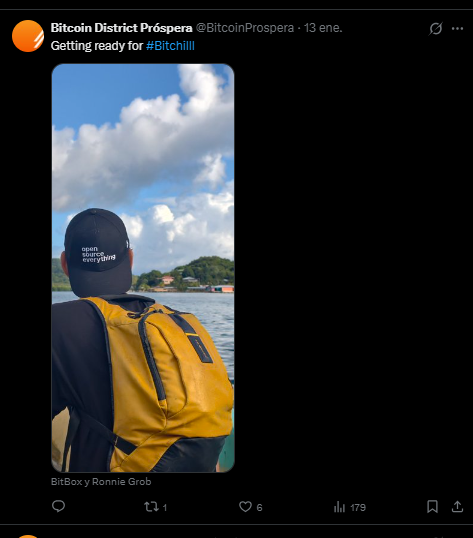
Under this scheme, it ensures that it develops its initiative called Bitcoin District, through which it organizes games, hackathons and international retreats, with the projection of developing a residential ecosystem in the next three years.
However, the legal certainty of these projects remained under scrutiny for years. The ZEDE model was the subject of intense legislative and judicial debates in Honduras, where sectors of the government questioned its constitutionality, as CriptoNoticias reported at the time. Although, a recent change in government has generated favorable expectations for Próspera, since the new Executive shows greater support for special economic zones.
Added to this political panorama is the challenge of execution on the ground. Although Próspera registers some 400 companies after five years of operation, the path to a fully integrated community is uncertain. Kołodziejczuk himself admits that involving the local population of Roatán in a nascent digital economy is complex, and that the bitcoin-based “circular economy” It remains more of an aspiration than a daily reality on the island.
Community participation is difficult to measure. It is difficult to maintain, especially in a country where people are not very focused on technological growth. People are more focused on field work and tourism. It is difficult in countries where people do not have the resources to invest their savings. Today, Bitcoin’s greatest utility remains as a store of value.
Tomek Kołodziejczuk.
Bitcoin enclaves grow in Latin America
The Bitcoin Center also operates in Roatán, a center dedicated to the teaching and promotion of Bitcoin. The Amity school, which is part of this center, is directed by Dusan Matuska, a Slovak who left Europe to settle in Honduras.
Kołodziejczuk’s case reflects a bitcoiner tendency to establish itself in jurisdictions with differentiated regimes in Latin America. In the end, the transfer of capital and talent from an economy with a GDP per capita higher than the regional average towards the Honduran coasts poses a new priority for these investors.
In his vision, the combination of a decentralized computer code and adaptable laws seems to offer a certainty that they no longer find in the traditional economies of the Old Continent.
It is clear that the so-called bitcoin citadels or BTC-based circular economies continue to expand, although most of these initiatives still face significant challenges. These challenges include integration with the local population and the construction of sustainable circular economies beyond foreign residents.