Trump claims Israel, Lebanon agree to 10-day ceasefire
US President Donald Trump, in a post on his Truth Social account, said that Israel and Lebanon have agreed to a 10-day ceasefire beginning 2100 GMT on Thursday.
“I just had excellent conversations with the highly respected President Joseph Aoun, of Lebanon, and Prime Minister Bibi Netanyahu, of Israel. These two leaders have agreed that in order to achieve peace between their countries, they will formally begin a 10-day ceasefire at 5 P.M. EST,” Trump wrote.
The deal was previously teased by Israeli security sources, who had told numerous US news outlets that a ceasefire was in the works.
Word of the deal comes as Lebanon faces fierce pressure from Iran-backed, Lebanon-based Hezbollah fighters at war with Israel, who have demanded the government in Beirut boycott any talks with Israel.
Lebanon has been rocked by years of fighting between Hezbollah and Israel.
The Lebanese government is not party to the conflict and has pleaded for a ceasefire and the withdrawal of Israeli troops from southern Lebanon.
Hezbollah has not yet commented on the deal.
https://p.dw.com/p/5CIrU
Modi, Macron discuss Strait of Hormuz in call
Prime Minister Narendra Modi said he had received a call from French President Emmanuel Macron in an online post late on Thursday.
“We discussed the situation in West Asia and agreed on the need to urgently restore safety and freedom of navigation in the Strait of Hormuz,” Modi said.
He said the two countries would continue “our close cooperation” to advance peace and stability in the region and beyond.
https://p.dw.com/p/5CIqK
April 16, 2026
Pakistan army chief holds talks with Iran speaker Ghalibaf: state TV
Pakistan’s army chief Field Marshal Asim Munir on Thursday met with Iranian Parliament Speaker Mohammad Bagher Ghalibaf, Iran’s state television reported.
“Field Marshal Asim Munir, Commander of the Pakistan Army, who travelled to our country yesterday, met and held talks with Mohammad Bagher Ghalibaf… this Thursday morning, April 16,” the report said.
There were no other details about their meeting.
After the Islamabad talks over the weekend ended without any breakthrough, Pakistan has been pushing for a second round of peace talks between Washington and Tehran.
There has been no decision whether negotiations would resume. However, White House Press Secretary Karoline Leavitt told reporters on Wednesday that further talks “would very likely” take place in Islamabad.
https://p.dw.com/p/5CIa7
April 16, 2026
Lebanon’s direct talks with Israel a ‘grave error,’ Hezbollah MP tells AFP
Lebanon’s decision to hold direct talks with Israel was a “grave error,” Hezbollah lawmaker Hussein Hajj Hassan told AFP on Thursday.
“Direct negotiations with the enemy are a grave sin and a grave error… and serve no interest for the country,” Hajj Hassan said from his parliamentary office.
He also urged Beirut to stop “this series of useless concessions” to Israel and the United States.
Lebanon was pulled into the Middle East conflict when the Iranian-backed militant group Hezbollah fired rockets at Israel shortly after the start of the joint US-Israeli attacks against Iran.
Israel says it has been targeting Hezbollah sites and strongholds in Lebanon.
On Tuesday, Israeli and Lebanese ambassadors held rare talks in Washington.
https://p.dw.com/p/5CISP
April 16, 2026
Lebanese president refuses to speak to Israeli PM
Lebanese President Joseph Aoun on Thursday refused to speak to Israeli Prime Minister Benjamin Netanyahu, a government official familiar with the developments told The Associated Press.
The discussion would have been the first direct conversation between the leaders of both countries in more than 30 years.
US President Donald Trump had announced that Aoun and Netanyahu would speak about stopping the fighting between Israel and the Iran-backed militant group Hezbollah in Lebanon.
The official, speaking on condition of anonymity in line with regulations, said the remarks were made during a phone call with US Secretary of State Marco Rubio and that Washington was “understanding of Lebanon’s position.”
Earlier, Aoun said that a ceasefire would be “the natural starting point for direct negotiations between the two countries.”
https://p.dw.com/p/5CISN
April 16, 2026
Hegseth warns Iran: US forces ready to restart combat
If Iran doesn’t agree to a deal, “bombs dropping on infrastructure, power and energy” will resume, US Defense Secretary Pete Hegseth told a Pentagon briefing on Thursday.
“You, Iran, can choose a prosperous future, a golden bridge, and we hope that you do for the people of Iran,” he said.
“But if Iran chooses poorly, then they will have a blockade and bombs dropping on infrastructure, power and energy,” Hegseth added.
He also said that Washington will prevent all ships “regardless of nationality” from entering or exiting Iranian ports in the Strait of Hormuz for “as long as it takes.”
Following the failure of the Islamabad talks over the weekend to put an end to the war, US President Donald Trump ordered a naval blockade on Iranian ports in an attempt to force Tehran into accepting Washington’s terms for the peace deal.
https://p.dw.com/p/5CHp4
Lebanon’s president holds phone call with Rubio
Lebanese President Joseph Aoun held a phone call with US Secretary of State Marco Rubio, the Lebanese presidency said on Thursday.
The statement said Aoun thanked Rubio for Washington’s efforts to reach a ceasefire. There was no mention any contact with Israeli Prime Minister Benjamin Netanyahu.
https://p.dw.com/p/5CHcm
April 16, 2026
Pakistan’s PM in Qatar in bid for second round of US-Iran talks
Pakistan’s Prime Minister Shehbaz Sharif visited Qatar on Thursday during a push by Islamabad for a second round of negotiations between Washington and Tehran.
Sharif discussed with Qatar’s Emir Sheikh Tamim bin Hamad Al Thani “the latest regional and international developments, particularly in the Middle East,” Sharif’s office said.
The Qatari ruler praised the role of Pakistan, the key mediator in the ceasefire between the United States and Iran.
The two leaders also voiced support for “de-escalation efforts and enhancing international coordination to ensure the security and stability of the region, particularly ensuring the maintenance of smooth flow of energy supply chains,” according to the Pakistani statement.
Sharif, who is on a four-day diplomatic blitz, was due later in Turkey.
https://p.dw.com/p/5CHP1
April 16, 2026
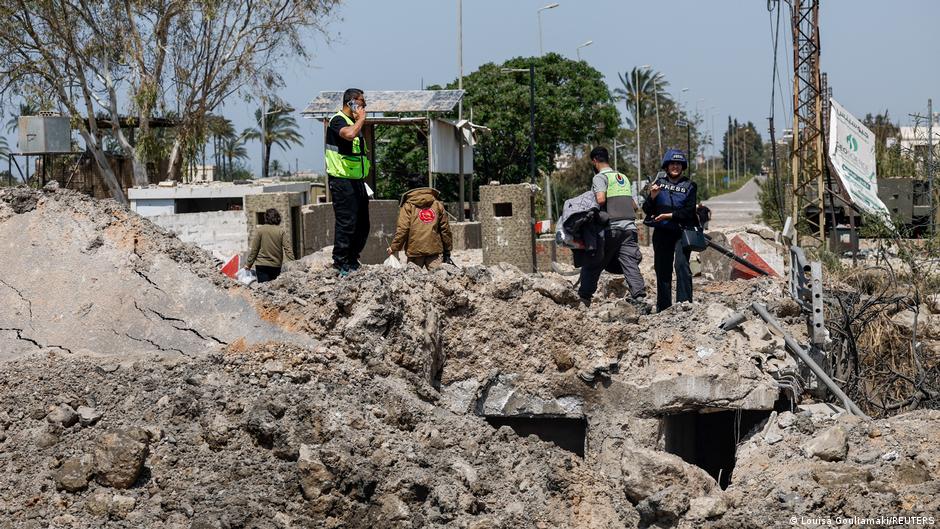
Israeli strike destroys last bridge in southern Lebanon: state media
An Israeli strike has severed a key bridge in southern Lebanon, the last one linking the area to the rest of the country, the state-run National News Agency (NNA) reported.
“Enemy aircraft carried out two consecutive strikes on the Qasmieh bridge, the last bridge between the Tyre and Sidon regions, completely destroying it,” the NNA said.
A senior Lebanese security official told Reuters news agency that the strike “shattered” the bridge over the Litani River and left no possibility of repairing it.
NNA also reported another strike targeting a car on the road linking the Lebanese capital, Beirut, to the Syrian capital, Damascus.
The attack, which killed one person, occurred in the Dahr al-Baidar area in the mountains east of Beirut.
https://p.dw.com/p/5CH9B
April 16, 2026
Lebanon president: Ceasefire crucial before talks with Israel
Lebanon’s President Joseph Aoun on Thursday said a ceasefire must come before any direct talks with Israel.
“The ceasefire requested by Lebanon with Israel is the natural starting point for direct negotiations between the two countries,” Aoun said in a statement, according to the AFP news agency.
Aoun’s remarks followed comments by US President Donald Trump, who said the “leaders” of Israel and Lebanon would speak later on Thursday.
An Israeli official earlier confirmed that Prime Minister Benjamin Netanyahu was expected to hold talks with the Lebanese president.
“The prime minister will speak for the first time with the president of Lebanon after so many years of a complete breakdown in dialogue between the two countries,” Israel’s Minister for Innovation, Science and Technology Gila Gamliel, a member of Netanyahu’s Likud party, told Israeli Army Radio.
“This move will hopefully ultimately lead to prosperity and flourishing for Lebanon as a state,” she said.
“We are taking historic steps on every level – shifting from mere containment, as in the past, to the outright eradication of any potential threat from those who seek to harm the citizens of the State of Israel,” Gamliel added, referring to the Iran-backed militant group Hezbollah.
https://p.dw.com/p/5CH7q
April 16, 2026
New round of US-Iran peace talks still undecided
As the delegation from Pakistan visited Tehran to continue pushing for dialogue between Iran and the United States, a spokesperson for Pakistan’s Foreign Ministry said on Thursday that no dates have been set for the second round of talks them.
Meanwhile, a senior Iranian official said that Iran and the US have made some progress and that the visit by Pakistan’s army chief, Field Marshal Asim Munir, to Tehran had helped bridge differences, according to Reuters news agency.
“The trip of the Pakistani army chief to Tehran was effective in reducing differences in some areas, but fundamental disagreements still remain in the nuclear field…. More hopes have been created for extending the ceasefire and holding a second round of talks,” the senior official said.
“The fate of Iran’s highly enriched uranium and the duration of Iran’s nuclear restrictions are among the highly disputed
issues for which no solution has yet been found,” he added.
Last weekend, Iran and the United States did not reach an agreement during talks in Islamabad.
While US Vice President JD Vance described the US offer as their “final and best” one, Mohammad Bagher Ghalibaf, the speaker of the Iranian parliament, said that the US “ultimately failed” to gain the trust of the Iranian delegation.
https://p.dw.com/p/5CGft
IN DEPTH: What’s behind Israeli attacks along Lebanon’s Litani River?
A small river has become a flashpoint in a broader regional conflict.
Israel is pushing forward with plans to remove Lebanese homes and residents from between the Litani River and its own border, creating a buffer zone.
Read more on why the area is strategically important in the Middle East conflict.
https://p.dw.com/p/5CGP2
April 16, 2026
Lebanon says unaware of planned talks with Israel
After US President Donald Trump said that the leaders of Israel and Lebanon would speak on Thursday, an official source told AFP that Beirut is unaware of any upcoming contact.
“We are not aware of any planned contact with the Israeli side, and we have not been informed of any through official channels,” the source said.
Reuters also reported a Lebanese official saying that the Lebanese government had “no information” about any planned talks with Israel.
Meanwhile, a member of Israel’s security cabinet told Israel’s Army Radio on Thursday that Israeli Prime Minister Benjamin Netanyahu will speak withLebanese President Joseph Aoun.
https://p.dw.com/p/5CGOR
April 16, 2026
Germany approved €6.6 million in arms exports to Israel
Germany approved arms exports to Israel worth €6.6 million ($7.8 million) in the first weeks of the Iran war, government data shows.
The sum covers approvals during the period from Febuary 28 to March 27, according to responses from the Economy Ministry to queries by the Left Party.
The volume of these exports remained relatively low compared with previous months. Germany licensed military exports worth €167 million in the roughly four months after easing restrictions imposed during the Gaza war last November, according to the dpa news agency.
Amid growing criticism of Israel’s operations in Gaza, the German government moved in August to suspend exports of military equipment that could be used in the conflict.
The partial embargo drew criticism in Israel as well as within Germany’s ruling conservative bloc. It was lifted after about three and a half months following a ceasefire agreement between Israel and Hamas.
https://p.dw.com/p/5CG9Q
April 16, 2026
Trump says Israel and Lebanon leaders will speak Thursday
US President Donald Trump said the leaders of Israel and Lebanon will speak on Thursday, following rare direct talks between Israeli and Lebanese representatives in Washington earlier this week.
“It has been a long time since the two leaders have spoken, like 34 years. It will happen tomorrow. Nice!,” Trump wrote on sociale media late Wednesday, without specifying who would take part or providing further details.
Lebanon was drawn into the Iran-war on March 2 after Iran-backed Hezbollah began attacking Israel. Since then, more than 2,000 people have been killed in Israeli strikes, according to Lebanese authorities.
Fighting between Israeli forces and Hezbollah continued on Wednesday.
https://p.dw.com/p/5CG1h