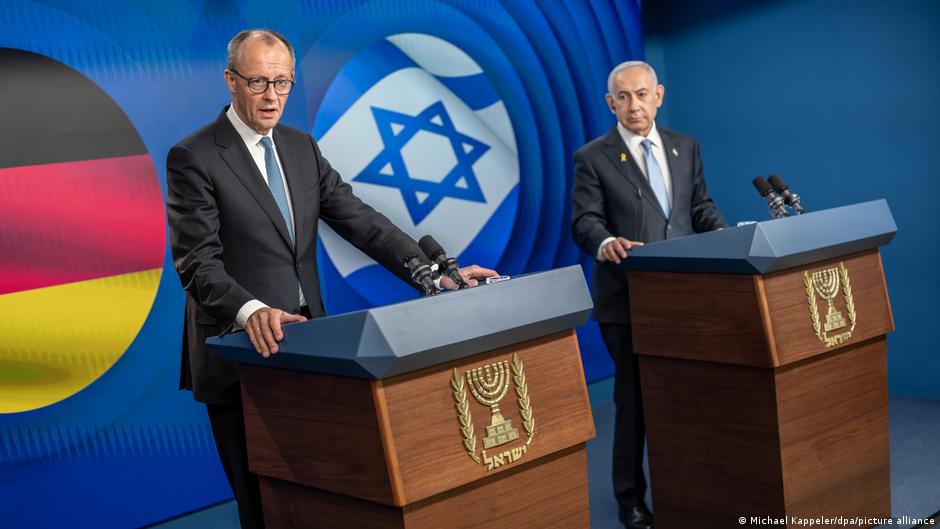
Earlier this week, when German Chancellor Friedrich Merz spoke by phone with Israeli Prime Minister Benjamin Netanyahu, it seemed like a routine exchange between world leaders.
Later, Merz spokesman Stephen Cornelius sent a press release about the call. The last two sentences read: “In the conversation, the Chancellor expressed his deep concern about developments in the Palestinian territories. In fact there should be no partial annexation of the West Bank.”
On Platform
None of this is really new. For example, in a call between the two heads of government in mid-July 2025, the German government reported: “The Chancellor stressed that no steps should be taken towards any annexation of the West Bank.” Nevertheless, the German side made it clear that it firmly opposes any unilateral Israeli action.
Berlin continues to support a two-state solution for Israelis and Palestinians. However, Israeli policy had set aside this two-state solution long before the Hamas terrorist attacks of October 7, 2023.
Smotrich criticizes Merz’s criticism of West Bank settlements
However, this time verbal tensions escalated after the German warning, with Israeli Finance Minister Bezalel Smotrich sharply criticizing Meraz on social media.
“The days when the Germans ordered the Jews where they were allowed to live or forbidden to live, those days are over and will not return. You will not force us to go to the ghetto again, certainly not in our own country,” the 46-year-old wrote on Monday evening, in response to the German leader’s post.
Smotrich, the grandson of Holocaust survivors, is one of several far-right politicians in Netanyahu’s Cabinet. He was born in the Israeli-occupied Golan Heights and today lives in the Israeli-occupied West Bank.
Smotrich has repeatedly attracted attention for statements widely described as racist, xenophobic and homophobic. He also sometimes positions himself in open opposition to Israel’s Supreme Court.
With Israel’s parliamentary elections expected in the autumn, he is trying to differentiate himself politically from Netanyahu.
Smotrich released his statement on the eve of Yom HaShoah, Holocaust Remembrance Day in Israel, when the country commemorates the 6 million Jews murdered by Nazi Germany during World War II. On that day, life in Israel stops for several minutes as survivors of the Nazi mass murder of Jews and others participate in memorial ceremonies.
Smotrich referred to this day in his criticism of Merz, referencing Jewish settlement and ending with the words “Am Yisrael Chai” – “The people of Israel live.”
Israeli ambassador in Berlin supports Merz
Speaking in Berlin on Tuesday, Israel’s Ambassador to Germany Ron Prosor called Merz a “great friend of Israel,” contradicting Smotrich in an interview with Israeli broadcaster Kan.
“It is possible and completely legitimate to argue with the Germans – especially on this day, which is so emotional,” Prosor said. However, he said that the statements made by Smotrich “really undermine the memory of the genocide and present things in a completely distorted light.”
In other words, Prosser – who himself often strongly opposes critics of Israel in German debates about Israeli policies – accused Smotrich of the mass murder of Jews.
During a similar confrontation, just three weeks earlier the Chancellor had been threatened with an unprecedented attack by an Israeli minister. In late March, Israeli Foreign Minister Gideon Saar reacted sharply to a post on Ax by Stefan Seibert, the German Ambassador to Israel.
In his post, Seibert mentioned, among other things, the violence of Israeli settlers against Palestinian villagers in the West Bank, occupied by Israel since 1967.
Seibert, whose tenure in Tel Aviv ends this summer, is not generally a critic of Israeli policy. For Chancellor Angela Merkel’s former spokesman, his post from Israel seemed like a heartfelt statement. He has learned the Hebrew language and has strongly advocated efforts to secure the release of hostages kidnapped in Israel by Gaza-based Hamas militants.
Growing rift between Germany and Israel
But what has been revealed?
The first example is the lack of recent government consultation between the two countries. Germany and Israel held their first government consultations in 2008. Earlier that year, Chancellor Merkel spoke in the Israeli parliament, the Knesset, on the occasion of the 60th anniversary of Israel’s founding – the first German head of government to do so. And he did so in German.
Some Israeli MPs walked out of the House. Netanyahu, then the opposition leader, criticized the fact that Merkel had come forward at all.
The format of these government consultations – in which the head of government and all ministers participate – is considered a sign of exceptionally close cooperation. Germany holds such consultations with about a dozen countries. However, the seventh and so far last German-Israeli consultations took place eight years ago, in 2018. Only with Russia and Türkiye has the interval between discussions been longer.
Then, in October 2025, Merz distanced herself from the term “reason of state”, which, from a German perspective, had been in use at least since Merkel’s 2008 statement. For Merkel, this refers to Germany’s “special political responsibility” for Israel’s security. Merz told the German daily Frankfurter Allgemeine Sunday Newspaper He has always struggled with the term, “because all its implications have never been fully made clear.”
Since then, the question of how Germany should concretely define its responsibility towards Israel has been discussed more frequently, including in criticism of Israel’s conduct in the Gaza War and in debates over German arms exports to Israel. However, the more principled question of whether Germany would participate in the international peacekeeping force for Gaza has not been discussed.
Ultimately, Israel and Germany have long agreed that they do not agree on the question of a two-state solution. Repeatedly, German Foreign Ministry spokesmen have described new Israeli settlement projects in the occupied West Bank as a violation of international law.
The Israeli government has categorically rejected statehood for the Palestinians. With Israel’s ever-expanding settlements, the prospects for a Palestinian state are gradually diminishing. The United Nations also considers disputed Israeli settlements a major obstacle to a peace agreement. Palestinian civilians have been repeatedly killed in attacks by radical Israeli settlers on Palestinian villages.
It was against this backdrop that Meraz expressed his concerns – and the Israeli Finance Minister immediately attacked him.
Following Smotrich’s criticism of Merz, the British daily Guardian Quoting an expert on Israel from the International Crisis Group, a Brussels-based NGO.
Mairav Zonszen explained
Zonszen called on the German government to reconsider its stance towards the Netanyahu government.
This article was originally written in German.