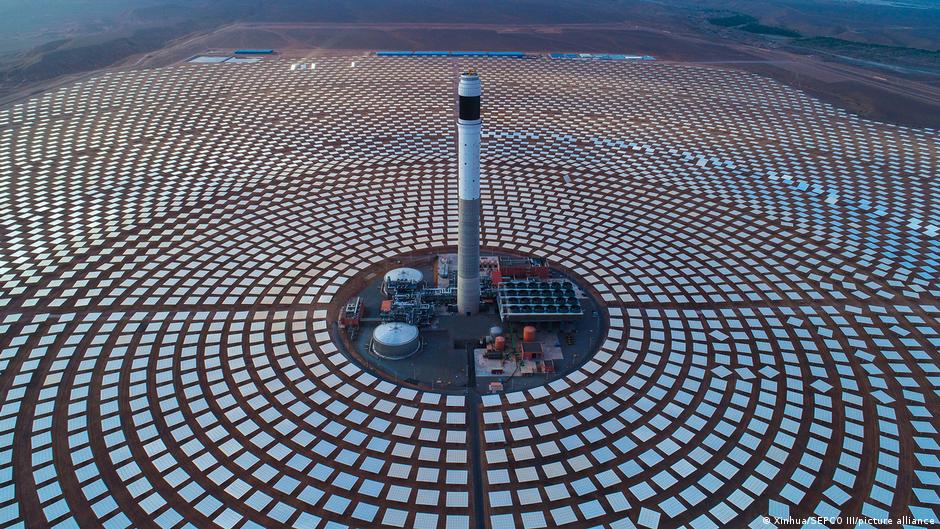
The Moroccan city of Ouarzazate, about 200 kilometers (125 mi) southeast of Marrakesh, lies on the edge of the Sahara and is known as the “Gate to the Desert”.
Ouarzazate is perhaps best known for the Atlas Film Studios, where blockbuster movies ranging from “The Mummy” to “Gladiator” and “Game of Thrones” have been filmed. But a new industry is taking shape.
Near the city, on a high plateau surrounded by the Atlas Mountains, one of the world’s largest solar power plants is being built. It has been named Noor, which means light in Arabic.
Spread over approximately 500 hectares (about 1,200 acres), the solar facility produces enough energy to power more than one million homes. But this is no ordinary solar farm.
Fossil fuels still dominate the energy mix
Instead of the black PV panels commonly seen, Noor uses concentrated solar power. A sphere of 2 million giant mirrors reflects the sun’s rays onto a central receiver located at the top of the 247-metre (810-foot) tower. Concentrated sunlight melts the molten salt to 600 °C (1,112 °F). This creates steam, which turns turbines, generating electricity even hours after sunset.
However, electricity remains expensive in Ouarzazate. Most homes rely not on solar energy, but on butane gas. So why hasn’t clean energy arrived for local communities?
One reason is that Morocco’s energy grid is still heavily dependent on fossil fuels, and particularly coal-based power generation. Intisar Faqir, a senior fellow and founding director of the North Africa and Sahel Program at the Middle East Institute in Washington DC, said this has slowed the country’s clean energy transition.
“Electricity generated from fossil fuels contributes about 48% of the country’s energy-related greenhouse gas emissions,” he said.
Moroccans spend about $110 (€94) of their average monthly income of $550 on electricity. This is in a hot and dry country, where residents rely on air conditioning or fans to stay cool. Temperatures in Ouarzazate regularly exceed 40 °C during the summer, and the number of hot days and nights has almost doubled in the region since the 1970s.
Fakir explained that this expense is partly due to the fact that Morocco does not produce any fossil fuels domestically, and imports about 90% of its coal, oil and gas. Fluctuating energy markets and prices mean fossil fuel imports consume a larger share of national budgets, driving a growing shift away from the coal, oil and gas that warm the planet.
Power grid limitations delay energy transition
That said, Morocco has made more progress on renewable energy than most North African countries.
“Even by global standards, Morocco’s transition plan is quite ambitious,” Fakir said. By 2030, the country plans to be able to power its economy with 52% renewable electricity. By 2050, it aims to have 70% clean energy capacity. And given that the country has plenty of sun and coastal breeze, the conditions seem right.
The Nour solar plant may be the star of Morocco’s shift toward renewable energy, but it is just one of about two dozen solar, wind and hydropower megaprojects already built. Another dozen are in the pipeline.
The country recently pledged to phase out coal power by 2040 as part of its clean energy transition.
But something remains to be done in this. While it currently has enough renewable technology to generate 46% of its electricity, the country will have achieved only slightly more than half in 2023.
“Actual production is significantly limited by the country’s ability to integrate what it produces,” Fakir said. “Morocco still needs to invest in its grid capacity so it can integrate these renewable energies into daily use.” This includes investing in energy storage methods.
He said more investment is also needed if the country is to achieve its goal of selling its clean energy abroad – especially to Europe.
“Although solar panels and wind turbines have become cheaper, building large-scale clean energy systems like Nur still requires serious upfront investment for low-income countries,” he explained.
Are megaprojects the way forward for renewable energy?
Researchers and civil society organizations have also been critical of the government’s focus on megaprojects such as Noor, rather than more decentralised, smaller-scale clean energy schemes, including rooftop PV panels for homes, businesses and farms.
One criticism is that concentrated solar power uses a lot of water. Its millions of mirrors need to be cleaned with water to remove sand and dust that get in the way of their ability to reflect light. Furthermore, much pasture land was appropriated, with little consultation, from local farmers to host Noor.
The project has divided localities, many of which have received little benefit. Resident Imrane, 83, said electricity is still too expensive for villagers, adding that the solar tower’s mirrors and concentrated sunlight have raised temperatures in their villages.
Fakir said that, despite the expense, the Noor Solar Project was an experiment.
“These are great major projects that prove the extent of Morocco’s technological capabilities,” he said. “But they also highlight again the challenge that despite such huge investment, renewables are still struggling to displace coal and fossil fuel generation.”
Edited by: Stuart Braun
This article was taken from the DW Living Planet Radio series on solar energy. Click here to listen.