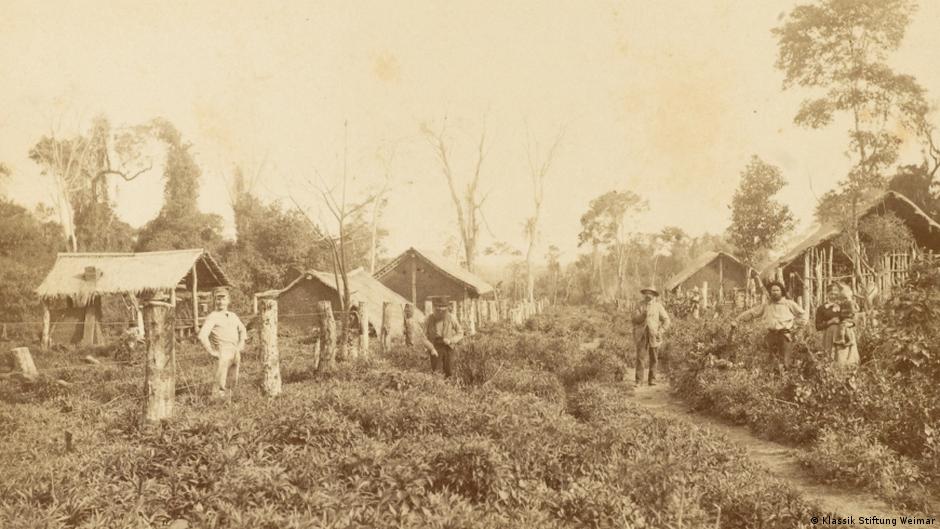
At the end of the 19th century, Berlin schoolteacher Bernhard Forster declared that German culture and virtues were in danger – and that the Jews were to blame. A staunch anti-Semite, he faced repeated trials in the German Empire for racist incitement. He faced disciplinary proceedings in his school and was even placed on the wanted list. He no longer sees any future for himself in his motherland. Instead, he dreamed of a new “Jew-free” Germania that would grow “revitalized and full of strength” under his leadership.
A utopia in South America
He already had an idea where such a place could be. He had declared, “I will transplant German culture into ‘new and promising soil’ – in Paraguay, where the Aguare-Me and Aguare-Guazú rivers meet.”
For two years, from 1883 to 1885, Forster traveled across the country on horseback, looking for a place where he could realize his utopia. “Of course, he was motivated by his political or ideological beliefs,” archaeologist Natasha Mehler tells DW. “However, from today’s perspective, one could also say that he was a classic social misfit who tried to make a new life for himself elsewhere.”
Accompanying him on this new life journey was his wife Elisabeth, sister of the philosopher Friedrich Nietzsche. She confirmed her husband’s vision: “We will breed an Aryan master race in the jungles of South America. Only the strongest, the purest blood will join us. The old Germany is corrupt, but the new Germania will last forever.”
Promoting a ‘heaven-like haven’
For the country’s first independent colony, the Paraguayan government provided Forster with 20,000 hectares of land about 150 kilometers north of the capital, Asuncion.
Only Germans were allowed to settle in “Nueva Germania”. After the War of the Triple Alliance (1864–1870) between Paraguay and the three countries Brazil, Uruguay, and Argentina, Paraguay not only lost 50% of its territory, but worse, almost 70% of its population. That is why settlers willing to invest in the country were welcomed with open arms.
In an agreement with the Paraguayan government, foresters committed to resettling at least 140 families within two years. Before leaving for Paraguay in 1886, Elisabeth Forster-Nietzsche and Bernhard Forster ran advertisements in newspapers and public lectures to attract settlers – especially artisans and farmers – and raise funds.
Less interest in New Germania
Yet the much-touted “heaven-like haven” attracted little interest. Forster succeeded in convincing only 14 families to join him. It is not known whether the settlers who followed Forster to Nueva Germania shared his racist ideology, although during his travels through Germany he lectured them on topics such as “the purification and rebirth of the human race” and “the liberation of civilization”.
“We know what land they got and where they lived,” says Mehler, “but little is known about the migrants’ intentions.” “They were mostly people who had little or no money. They were certainly dissatisfied with what the German Empire had left behind because of industrialization.”
She suggests that perhaps the youngest sons were deprived of the inheritance. “And so, they simply put their faith in Bernhard Forster’s promises, pooling together their last savings to buy passage on a ship and acquire a plot of land, before leaving for Paraguay with their families.”
heaven in danger
The settlers soon became discouraged. He felt that Forster’s promises of exceptionally fertile soil and favorable climate did not reflect reality.
“During the rainy season it is really unbearably hot and humid, and also marshy and damp because of the rivers,” says Mehler, who led two field expeditions in the footsteps of the early colony. “During the dry season, the soil became very sandy and dry. This made farming difficult; extracting crops from the soil was laborious work.”
Nueva Germania’s crops were meager; Parasites and tropical diseases made life even more difficult for the settlers. While wealthy families had the means to relocate, most were forced to stay put and continue the fight for survival. As one desperate resident wrote in a letter to relatives: “Dear motherland of my loved ones, oh, how I yearn for you. If I had lived in Germany, I would have saved myself from suffering so much… Courage and health are vanishing, mind and body are growing weary, and we colonialists will reach our graves before time has passed.”
Luxury at ‘Forsterhof’
Meanwhile, as one frustrated resident complained, Bernhard Forster and Elisabeth Forster-Nietzsche liked to portray themselves as a ruling couple and paid little attention to their fellow residents. The couple lived in the center of Nueva Germania, with other houses within 5 kilometers of each other. Mehler says, “Forster may have thought that people who are isolated are less inclined to come together and criticize what is happening, or even to rebel.”
a failed utopia
The colony did not retain its desired “racial purity” for long. Mehler believes that without the assistance of the indigenous Guarani people in the area, the first generation of settlers in Nueva Germania would not have survived.
The utopian compromise was ultimately destined to fail. “They never managed to establish a stable financial foundation. All Förster’s letters to Germany, in which he pleaded for support, were in vain. After all, this was not a colony granted by the Emperor, but a private enterprise. And it was clear that Förster was not a financial expert either.”
Friedrich Nietzsche refused any financial support to his sister and opposed his brother-in-law’s anti-Semitic views. To persuade him, his sister promised to name an area of the colony after him, “Friedrichshain”. However, Nietzsche scoffed at the idea and suggested they name it “Llamaland”, since “Llama” was his sister’s nickname.
Two years after the establishment of the colony, only 40 families had settled in Nueva Germania, much less than the 140 planned in the agreement with the government.
Bernhard Forster found himself deep in debt and despair. He died on June 3, 1889. Although it is believed that he may have committed suicide, this has never been proven. Förster-Nietzsche reported in German newspapers that her husband died as a result of his great efforts on behalf of the colony. She attempted to keep the colony going for a few more years but eventually returned to Germany.
Descendants and a new colony
Nueva Germania still exists today, with houses built on a wide dirt road leading to the river, and dirty water flowing slowly around the outskirts of the village. About 2,000 people live in the village, many of whom speak German. When asked about the founding of the city, residents expressed surprise. They are not happy that the media is focusing on their dark past.
“Sometimes I thought they were thinking: ‘We have completely different problems here. I need to make sure that my tractor and my chicken farm are running smoothly and that my road won’t be washed away in the next rainy season. And yes, maybe my grandfather or my great-grandfather had some nationalist leanings, but to us today, it all seems very distant’,” says Mehler.
Through his research, Mahler discovered a striking parallel with the present day. “During the COVID-19 pandemic, many German anti-vaxxers declared Paraguay as their destination. We actually found a written source from Bernhard Forster, who strongly opposed the introduction of mandatory smallpox vaccination in the German Empire. He wrote, ‘Come with me to Paraguay; there is no mandatory vaccination there, so you can do whatever you want’.”
Mehler was seated with anti-vaxxers on a flight to Asuncion. At the airport, she saw promotional posters for “El Paradiso Verde” or “The Green Paradise”, a German-speaking colony for anti-vaxxers and conspiracy theorists.
“I was amazed at how dramatically history has repeated itself in just 140 years,” says Mehler.
This article was originally written in German.