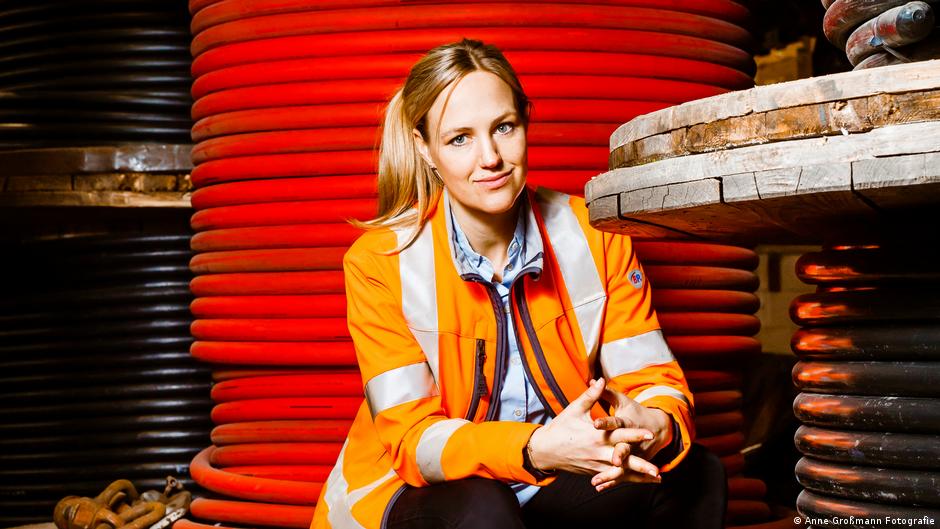
Jennifer Herb spends a lot of time along railway tracks in all types of weather.
As a shunting attendant At DB Cargo, a subsidiary of German railway giant Deutsche Bahn, she checks brakes, inspects undercarriage and joints and disassembles freight cars.
His work clothes have to move with him every step of the way: bending, climbing, turning and walking many kilometers over rough ground. They must be visible day and night and protect it from snow, wind, sun and rain.
Herb usually wears a high-visibility jacket and trousers with bright orange reflective stripes. They were created specifically for women and contain high stretch material.
“The clothes work with me, like another coworker,” wrote a shunting attendant on the blog of Cologne-based workwear manufacturer Bierbaum-Proennen.
Poorly fitting workwear can lead to accidents in the workplace
High-visibility clothing used to be stiff and heavy – especially for women who were forced to wear men’s designs in smaller sizes.
These clothes were often too tight around the hips, preventing jackets from closing properly, and the sleeves were so long that they had to be rolled up.
Women were hesitant to keep tools in their breast pockets. Pants clinging to the thighs or hanging at the waist. Even men’s safety shoes often fail to accommodate women’s narrow feet.
According to a 2010 British study by the Women’s Engineering Society, more than half of respondents felt that their personal protective equipment restricted them rather than kept them safe.
But it’s not about being fashionable, these issues can reduce concentration, increase the risk of mistakes and, in the worst case, lead to accidents at the workplace.
Outfitters specializing in workwear for women
Larissa Zeichart knows this feeling all too well.
Just 10 years ago, Zeichart and his sister took over the family business, LAT. The German company specializes in laying high-voltage cables along railway tracks.
As an electrical engineer, Zeichart had to inspect construction sites wearing men’s protective clothing, which was standard practice at the time. “Not only did it look bad, it was also impractical,” he said.
“I was constantly freezing, and it was unsafe because I kept catching on things. It can be life-threatening, especially in tunnels if there’s a train coming and you can’t get to safety fast enough because your jacket gets stuck.”
So, Zeichart started looking for better-fitting workwear for himself and his female employees – and he found it at Bierbaum-Proennen. It was like “a liberation,” she recalled.
Workwear should also feel good
Heike Altenhofen is Product Manager for Workwear at Bierbaum-Proenen.
Founded in 1788, the company has been family-owned for seven generations and has been making workwear since the late 19th century.
“Underrepresentation of women has always existed in the medical field, a field where traditionally the majority of employees were women,” Altenhofen explained.
In male-dominated industries, women have long accepted the lack of properly fitting workwear without complaint. There was no alternative and most women did not think it could ever be different.
“Workwear was completely different in the past,” Altenhofen said. “You wore it because you had to.”
Today, women expect to feel at least as comfortable in their work clothes as they do in their outdoor leisure clothes. After all, they spend up to 40 hours a week wearing it.
Sometimes it’s the details that matter most
In collaboration with Deutsche Bahn, the Cologne-based outfitter began tailoring high-visibility clothing to fit the female body about 15 years ago.
“Some women told us they weren’t taken seriously when they wore men’s clothing,” Altenhofen said.
Deutsche Bahn’s female engineers and shunting attendants contributed their ideas and tried out new designs. And often it was the little details like bust darts, two-way zippers or an elastic waistband at the back that made all the difference.
“Our female customers tell us they still want the clothes to look like the men’s version and that we use the same materials,” the product manager explained.
Personal protective equipment must meet the requirements of each particular workplace: visibility, freedom of movement, temperature and humidity regulation, robustness or being flame resistant.
Today, Bierbaum-Proenen manufactures protective equipment for companies in the construction, chemical, energy, transportation and waste management and recycling sectors.
There are still relatively few women in these industries. Altenhofen points out that unlike the men’s range, women’s fits are not always bespoke. “But they have been developed with men’s designs in mind and certified by testing institutions. That’s why we can introduce them quickly when needed.”
Sales volumes are modest, but it is important to have a range of women’s workwear to meet customer expectations. “Even if there’s just one woman at work, she deserves properly fitting clothing,” Altenhofen said.
Boosting your image with women’s workwear
According to Altenhofen, some companies are now specifying women’s workwear in their tenders. “We’ve already won contracts because of it.”
Employers who invest in gender-equal workwear can strengthen their image and increase employees’ identification with the job and company. Big corporations and their works councils are paying close attention.
At LAT, Larisa Zeichart is convinced that more fashionable, comfortable workwear is one reason her company attracts more applications from young women than in the rest of the region.
Sina Klein, a master roofer and influencer with nearly 82,000 followers on Instagram, also frequently emphasizes the importance of well-fitting and attractive workwear to bring more women into the business.
Women’s workwear as a competitive advantage
“Only protective clothing that is comfortable and that people actually enjoy wearing can protect them in an emergency,” Lena Højland, product director at Danish workwear manufacturer Fristads, said in an interview with industry portal Bausicherheit.
“Heavy clothing is often taken off, even in hazardous work areas,” Hojland said.
Specialized workwear for women is becoming increasingly common. Now, many manufacturers offer dedicated lines for women, including Mascot, Kubler, Carhartt, Fristads, and Diadora.
“Many large customers want a single workwear provider for their entire workforce, even if women are only 10%,” Hojland said. “If you can’t offer gender-inclusive solutions, you’re often out of the running.”
This article was originally written in German.