Kremlin spokesman Dmitry Peskov said on 12 April that Russia had gained almost complete control over the eastern Ukrainian region of Luhansk, but about 18% of the Donetsk region remained outside Russian control.
The Russian army continues to advance, with its current offensive primarily targeting Kostiantynivka. The capture of the city would open the way for the Russians to advance on the last major cities in the region, Kramatorsk and Sloviansk.
Kostiantynivka is ‘a thorn’ for the Russian army
The commander of a Ukrainian military unit known as LISS (Ukrainian for Fox), speaking to DW on a recent visit to the area, said fighting was ongoing on the outskirts of Kostiantynivka. He said some Russian soldiers managed to infiltrate into the city from the surrounding forests under the cover of fog.
“They are scanning the entire front and looking for places where they can either infiltrate or breach the defensive line,” Liss said.
“After the present series of attacks, they will probably select a specific section of the front and apply targeted pressure on it. This has been their standard strategy since last year.”
Lis described Kostiantynivka as “a thorn” to the Russian army. “Unless they pass through there, they cannot advance. The urban area of Kostyentynivka, Druzhkivka, Kramatorsk and Sloviansk is like a big city,” he said, warning that if the Russians made progress there, it would be very difficult to stop them.
Along with trying to bring the entire area under its control through force, Russia is also exerting diplomatic pressure. During previous peace talks Moscow had demanded the withdrawal of Ukrainian forces from the entire Donbass region, i.e. both Luhansk and Donetsk.
Kiev has strongly rejected this demand, with Ukrainian President Volodymyr Zelensky expressing fears that Russia could use the region as a launch pad for attacks on other areas after Ukrainian forces withdraw. Zelensky has said that the region has “strong defensive and fortification structures” and that even during the fighting, about 200,000 people live there.
“How can we give up in negotiations the territory for which thousands of our people have given their lives? It is out of the question,” said Ruslan, a mortar commander guarding a brigade at the entrance to Kostiantynivka.
Battalion Chief of Staff Edwards agreed, saying, “This is a city where our citizens still live. It must be protected.” “If we leave it like this, soon there will be nothing left of the Donetsk region. If Kostiantynivka falls, Kramatorsk is the next target.”
‘Life in the city is scary’
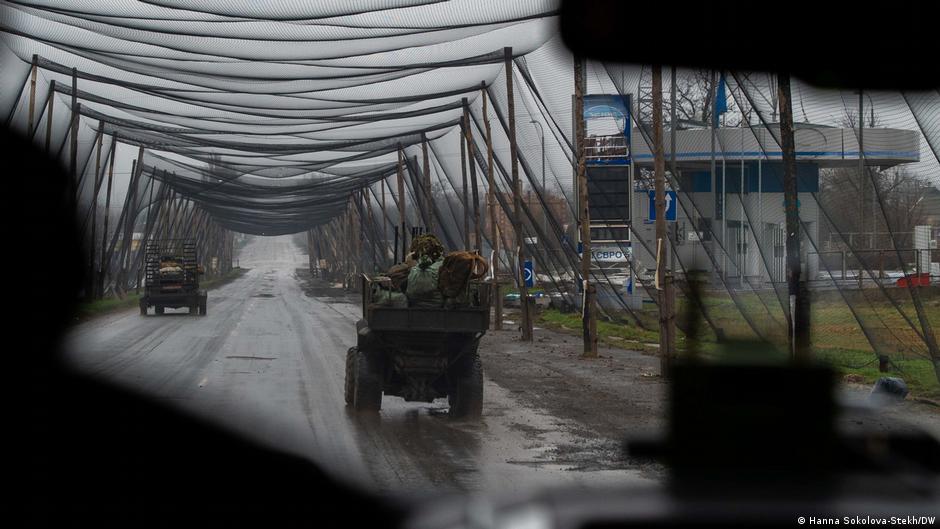
It is unclear how many civilians remain in Kostiantynivka, a town that once had a population of 70,000. Evacuation is only possible on foot, via a seriously damaged net-covered road – designed to protect against Russian drone attacks.
“When I left Kostiantynivka and hid in three houses on the way, I found dead civilians there,” a company commander of a rifle brigade, who did not want to be identified, told DW. “I don’t understand the people who live there. Why don’t they just leave?”
In the morning, traveling with Ukrainian military personnel to nearby Druzhkivka, many people were on the streets for work – most of them municipal workers.
“Life in the city is scary,” said Ninel, a local woman.
An older man named Vitaly said he too had no plans to go. “But where else should I go?” he told DW. “I don’t have much time left to live anyway.”
Destruction in Kramatorsk, Sloviansk
Even though Kramatorsk is not directly on the front lines, the destruction there is growing worse by the day. On March 29 alone, Russian forces attacked with multiple aerial bombs, killing three people, including a 13-year-old boy.
One of these bombs fell in a residential area, which had already been attacked seven times. People surprisingly remained calm after the attack and started clearing the debris.
“We’ll pack our things,” Olena said, looking out her window, which no longer had any glass. If the curfew already in place at night is extended significantly, Olena said they will have to leave.
“It was the same in Pokrovsk, Kostiantynivka and then Druzhkivka. We have a feeling it will happen to us too.”
Anti-drone security nets have long been a familiar sight above frontline roads. Now, they have also spread to the streets on the outskirts of Kramatorsk and neighboring Sloviansk. Some neighborhoods of Sloviansk are already within range of Russian first-person view drones, so many children there have already been evacuated. However, the rest of the city still feels vibrant. Cafés are open, and retirees and women with children are on the streets.
“If I had money I would go. It’s hard to see all this happening,” said Irina, an elderly woman. “If we really leave this part of Donbass, it will save many lives – both soldiers and civilians,” he said. “But imagine leaving this region. It is part of Ukraine, after all.”
Sloviansk is also under constant fire. There is a hotel in the center of the city which was burnt down in the attack by many martyred drones. Vladislav Samusenko was sleeping in a room when the attack occurred.
“Thank God I’m still alive,” he said with a sigh, pointing to the destroyed hotel room.
‘Many dead bodies in backyards and on streets’
Before the war, Samusenko founded a non-profit organization called Rhythm of Our Lives to help orphans. But when Russia launched its full-scale invasion in February 2022, it also began organizing the evacuation of civilians from endangered areas.
“It immediately became clear to me that human life had to be saved,” he said.
On March 24, they evacuated an elderly couple – a woman and a paralyzed man – from Kostiantynivka. Due to fear of Russian attacks, they had to walk 8 kilometers (about 5 miles) to reach the city. “There are many bodies in backyards and on the streets. You can smell them when you walk past a house,” he said.
Samusenko said that most retired people are preferring to live in the city. But the aid workers also found some youth who were afraid of joining the army.
“We have very few fighters. Our soldiers are exhausted and have no replacement,” Samusenko said. He said that as long as citizens continue to ask him for help, he will continue to arrange evacuations from war-torn cities whenever possible.
This article was originally written in Ukrainian.