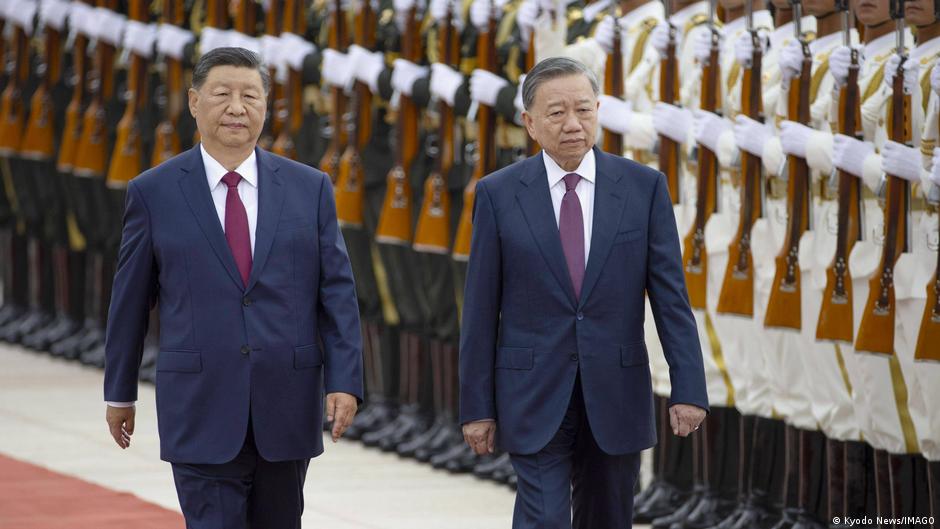
Vietnamese Communist Party leader To Lam became the country’s president this month after a unanimous vote in the country’s National Assembly.
The move went against the informal norms that have long shaped elite politics in Hanoi. For decades, the Vietnamese Communist Party (VCP) has tried to avoid concentrating too much power in a single pair of hands.
Unlike China, where since the 1990s, the top party leader has often also served as state president, Vietnam has generally preferred a more collective leadership style, known as the so-called “four pillars” system, in which authority is divided between the party chief, state president, prime minister, and National Assembly.
That system was never the complete separation of powers found in liberal democracies. But within the scope of one-party rule, it created a measure of internal balance and helped reduce the risk of one individual dominating the political system.
Now, analysts say, that balance is changing.
“This brings the Vietnamese political system closer to the Chinese system, which is dominated by [China’s President] Xi Jinping,” Alfred Gerstel, an expert on Indo-Pacific international relations at the University of Vienna, told DW.
Gerstel said, “Given her concentration of power, To Lam may be able to implement her ambitious reforms more quickly, but there is a risk that established checks and balances will stop working and dissenting opinions within the party will be heard less and less.”
politicians die in office
Vietnam’s political system has long relied heavily on tradition as well as formal rules. In addition to the “four pillars” system, retirement-age norms also once helped regulate the turnover of political elites.
But in recent years it has become easier to bend both of those guardrails. The VCP is now more willing to give aging leaders a pass on retirement and give them new powers in return.
For example, former party chief Nguyen Phu Trong won a third term in 2021, breaking the long-observed two-term norm. He had already combined the party leadership and the presidency from 2018 to 2021, following the death of the previous president in office. Truong himself served as leader of the Communist Party until his death in 2024 at the age of 80.
Looking to China for surveillance equipment
Lam, a former public security minister, emerged as a key enforcer of Trong’s anti-corruption campaign, which removed hundreds of officials and helped reorder the political hierarchy.
Like Trong, To Lam also held both positions for some time before being forced to step down from the presidency.
In January, he was confirmed at the Communist Party Congress for another five-year term as party leader and, just a few months later, secured a five-year term as president.
Under To Lam, Vietnam is also showing greater interest in elements of China’s security and surveillance model, with Gerstel arguing that this trend “runs hand in hand with new bilateral agreements and will further restrict freedom of expression in Vietnam.”
AI camera networks are coming to Vietnam
Even before Lam rose to the top, Vietnam was one of the most restrictive states in the region. It ranks 173rd out of 180 countries in Reporters Without Borders’ World Press Freedom Index.
Rights say the government has increased pressure on civil society in recent years, reducing what little space remains for dissent.
Hanoi is planning to set up a state-run data-trading exchange under the supervision of the Ministry of Public Security, “mirroring China’s centralized data model,” Reuters news agency reported last week.
Vietnam is also expanding a national electronic identification system, which enables authorities to identify individuals through an AI camera network being rolled out across the country – a parallel to China’s.
Recent government documents also mention the creation of a “national firewall”, while new legislation has increased the ability of Internet providers to collect users’ personal data.
Lam hosted by Xi Jinping
This week, To Lam visited China, her first official diplomatic visit since assuming the presidency, in line with tradition established by previous Vietnamese leaders and Hanoi’s official stance that sees both countries as socialist “comrades and brothers.”
During the visit, Xi Jinping emphasized ideological unity and strategic coordination. According to Chinese state media, Xi called the defense of socialism and Communist Party rule a common strategic interest of both China and Vietnam.
Security was also on top of the agenda. Along with Lam in Beijing, Vietnam’s public security minister, Luong Tam Quang, met separately with China’s three top security officials, and suggested deepening ties in the institutions that both systems rely on to maintain political control.
Two paths forward for Vietnam’s new president
Nevertheless, the comparison with China has obvious limitations.
“Vietnam has not responded to Xi Jinping’s Stalinist elimination of senior generals and Xi’s attempt to create a widespread state of fear in Chinese society,” Hunter Marston, a non-resident fellow at the Institute for Global Affairs, told DW.
“Vietnam is far from a progressive democracy, but it lacks some of the authoritarian repression that China regularly relies on for the political survival of the Chinese Communist Party and Xi Jinping,” he said.
In other words, while Vietnam remains an authoritarian one-party state, it has not created the same level of omnipresent repression, ideological control, or cult of personality seen under Xi. Nor has To Lam yet shown that he can dominate the system in the same way as China’s leader.
Now, with To Lam ruling as both party chief and president, the country’s future will depend on how he uses his new, sweeping powers. If Lam rules pragmatically, supporters may see the merger of the two posts as a way to more quickly pursue reforms and give Vietnam’s paramount leader a greater formal role in reaching out to partners abroad.
But if the trend continues toward tighter repression, weaker internal sanctions, and a stronger security state, Vietnam may begin to look less like the collectivist authoritarian system it once boasted and more like its giant northern neighbor.
Edited by: Darko Janjevic