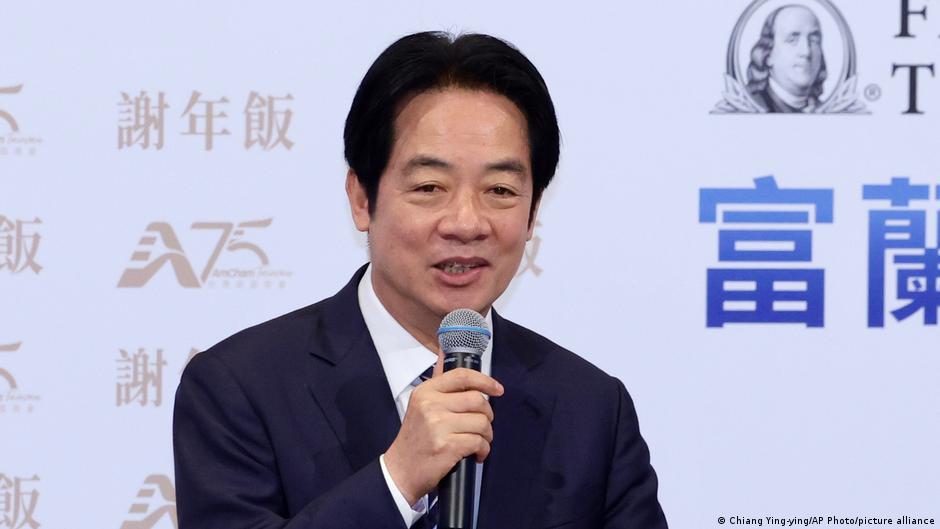
China said on Wednesday it “deeply appreciates” the African countries that refused to grant overflight rights to Taiwanese President Lai Ching-te’s plane, forcing him to cancel a visit to Eswatini.
China claims self-ruled Taiwan as part of its territory and opposes the island having diplomatic relations with other countries.
Lai was to visit Eswatini, Taiwan’s only remaining ally on the African continent, from 22–26 April.
But that plan was canceled after Seychelles, Mauritius and Madagascar unexpectedly withdrew flight permits “due to strong pressure from Chinese authorities, including economic pressure,” a Taiwanese official said Tuesday.
What did China say on the visit of Taiwan President?
Beijing denied that it had applied economic pressure to block Lai’s visit, but said it had “high appreciation” for the three countries’ actions.
“Relevant countries have maintained support for the one-China principle, which is fully in line with … the basic norms of international relations, which China highly appreciates,” China’s Foreign Ministry said in a statement.
“No one can stop the historical trend of China’s eventual unification,” the statement said, referring to Beijing’s claims on Taiwan.
Separately, a spokesman for China’s Taiwan Affairs Office told reporters, “A just cause gets abundant support, while an unjust cause gets little support,” quoting the ancient Chinese philosopher Mencius.
Eswatini ‘regrets’ canceling trip
Seychelles and Madagascar said they took the decision because they do not recognize Taiwan.
Taiwan’s Foreign Ministry on Wednesday described the country’s situation as “in slavery to China.”
“The Republic of China is a sovereign state that has the right to engage with the world – a right that cannot be denied, and no country has the right to hinder it,” it said in a statement, referring to Taiwan by its formal name.
Eswatini, a small southern African kingdom formerly known as Swaziland, is one of only 12 countries to have diplomatic relations with Taiwan.
A spokesman for the Eswatini government said it “regretted” that Lai did not visit, but stressed that the setback “does not change the status of our long-term bilateral relations.”
How did others react?
The development comes after Taiwan’s opposition Kuomintang (KMT) chief Cheng Li-wun met Chinese President Xi Jinping in Beijing.
The opposition party, which frequently clashes with Lai’s government, urged China to show restraint and give Taiwan diplomatic space.
“I think pressure from mainland China is not smart, especially after the Cheng-xi meeting,” senior KMT lawmaker Lai Shih-bao told reporters in Taipei.
Many US lawmakers also expressed concern over this incident.
“This is not diplomacy; this is economic pressure aimed at isolating a democratic partner,” the US House Select Committee on China wrote on X.
Edited by: Shawn Sinico