
The system guarantees parity through the use of USDC, avoiding the volatility of local currencies.
It allows access to funds without the need to manage private keys or cryptocurrency wallets.
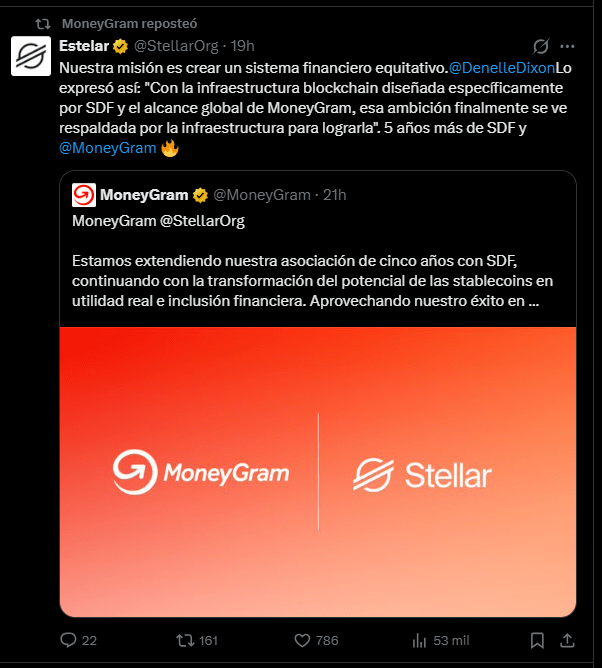
The remittance industry in Latin America is beginning to integrate the technical efficiency that Bitcoin introduced 18 years ago to try to solve its own structural deficiencies. MoneyGram, one of the oldest operators in the sector, adopted the Stellar network and the Circle USD Coin stablecoin into its operating model.
With its decision, the company seeks to replicate the immediacy of digital assets without dismantling its physical office infrastructure; a strategy that, after debuting in Colombia, as reported by CriptoNoticias, now it extends this month to El Salvador as an integration proposal between the traditional system and the cryptocurrency ecosystem.
The move does not represent an innovation in terms of speed, a standard already established by peer-to-peer networks, but instead addresses the dilemma of the “last mile”, that is, the conversion of digital assets into paper money, as detailed in a statement official.
In regions with a high dependence on cash, such as El Salvador, for example, this integration allows capital to be held in USDC, an asset backed 1:1 by dollar reserves, until the exact moment of withdrawal.
With this mechanic, the intention is protect the value of the transfer against the volatility of local currenciesa critical risk in traditional bank shipments that require several days for settlement.
For the user who already operates with digital assets, the question arises as to what value this service provides compared to a direct sending between private cryptocurrency wallets. This mystery is clarified by observing the physical logistics. While standalone use of stablecoins requires the recipient to manage their own technical keys and find secondary markets to obtain cash, this model uses the MoneyGram network as a global ATM.
The competitive advantage is not technological, but rather access to allow the recipient to obtain physical tickets at a local counter without the need to have a bank account or basic knowledge of digital assets.
According to the company’s statement, operation is concentrated in a mobile application, available on iOS and Android systems, which functions as a simplified interface. The system eliminates the need to manage private keys or pay network fees manually, although it introduces as a counterpart the identity identification protocols (KYC) specific to the regulated system.
The dilemma between privacy and convenience
According to Anthony Soohoo, CEO of the company, the objective is to transform stablecoins into a tool for mass consumption, putting the ease of physical withdrawal before the technical sovereignty of the user.
The impact on costs is the point where competition becomes more acute. This is because while the World Bank places the overall average cost of sending remittances at 6.49% of the amount transferred (first quarter of 2025), the model on Stellar projects to reduce these margins to less than 1%.
Although this figure is competitive, it reflects the cost of maintaining physical service points, a burden that users of open networks often ignore, but which remains essential for the unbanked sector that depends on money in hand for their daily economy.
However, this convergence raises a fundamental contradiction. By basing the service on USDC, a centralized and regulated asset in the United States, the operation is subject to surveillance mechanisms and potential freezing of funds. This marks an insurmountable distance from the resistance to censorship that defines the original cryptocurrencies such as bitcoin.